


























Views
Downloads

Oak Tree Life Cycle Worksheet (3 Levels) | Grade 2-3 Ready
Paste this activity's link or code into your existing LMS (Google Classroom, Canvas, Teams, Schoology, Moodle, etc.).
Students can open and work on the activity right away, with no student login required.
You'll still be able to track student progress and results from your teacher account.
This foundational science worksheet helps students master the oak tree life cycle by sequencing its developmental stages. By drawing directional arrows and illustrating specific growth phases, young learners actively model how organisms grow, reproduce, and eventually decay, transforming abstract biological concepts into concrete visual understanding.
At a Glance
- Grade: 2-3 · Subject: Science
- Standard:
3-LS1-1— Develop models describing diverse organism life cycles.- Skill Focus: Plant life cycles
- Format: 3 pages · 2 problems · No answer key · PDF
- Best For: Differentiated independent practice
- Time: 15–20 minutes
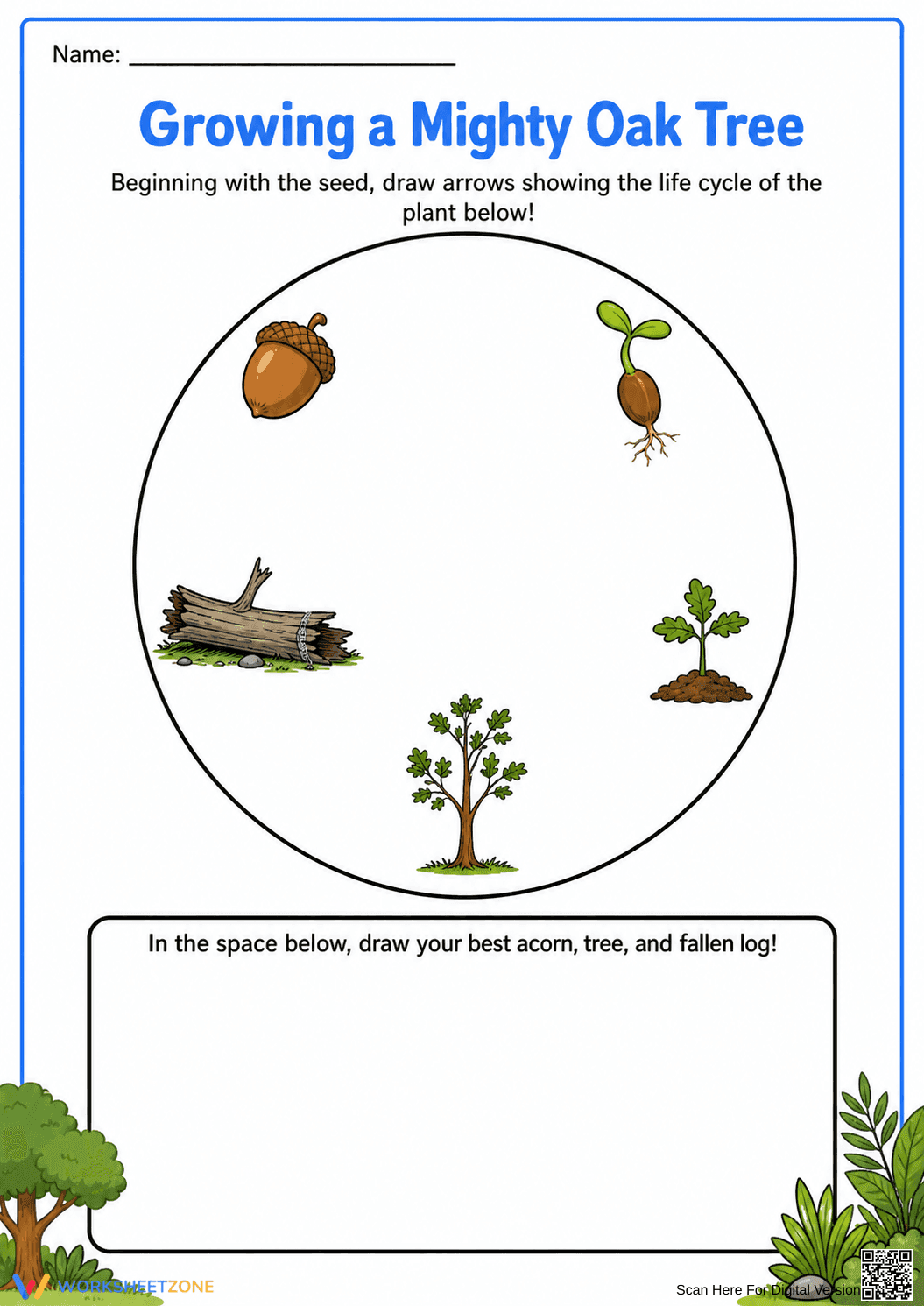
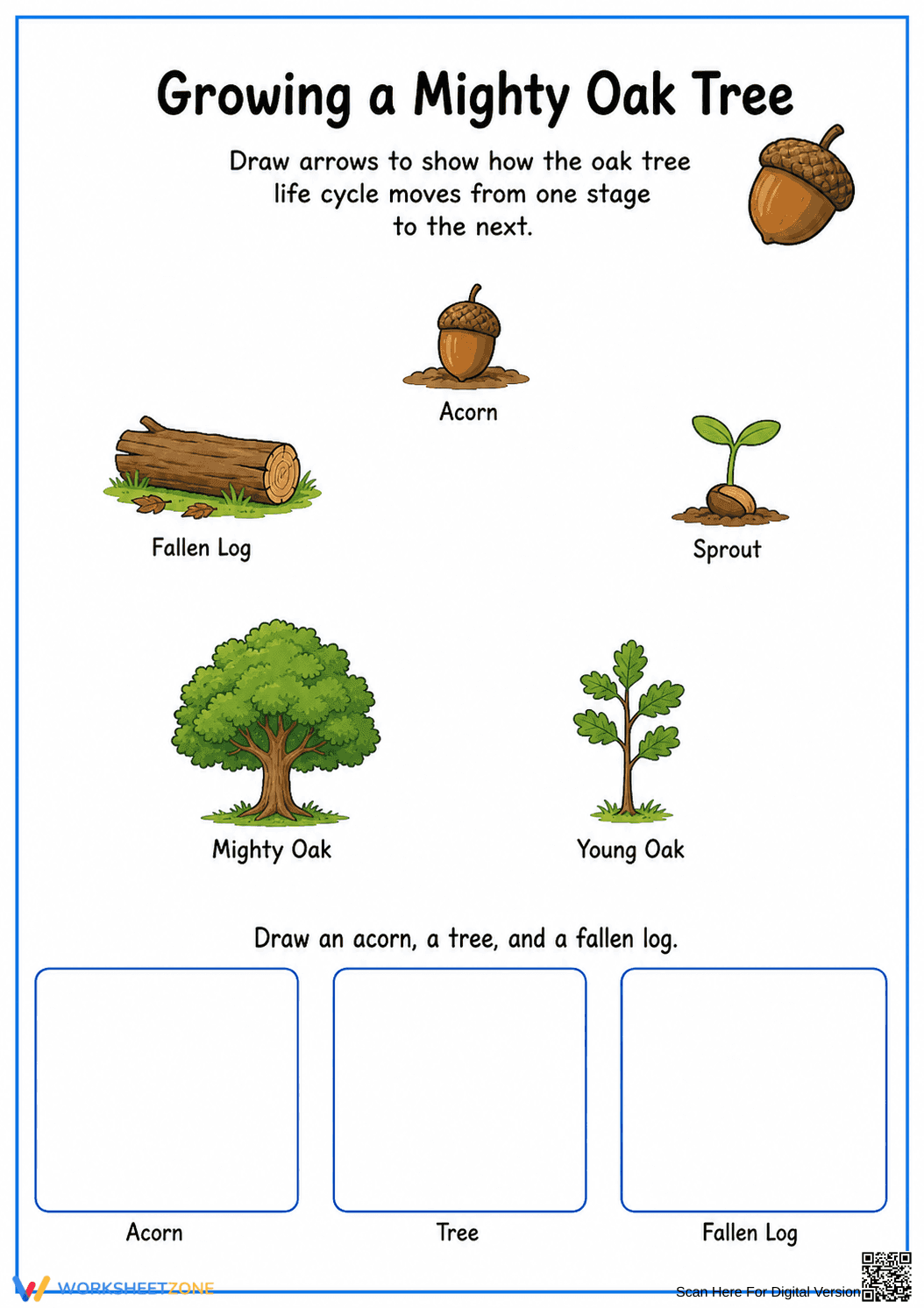
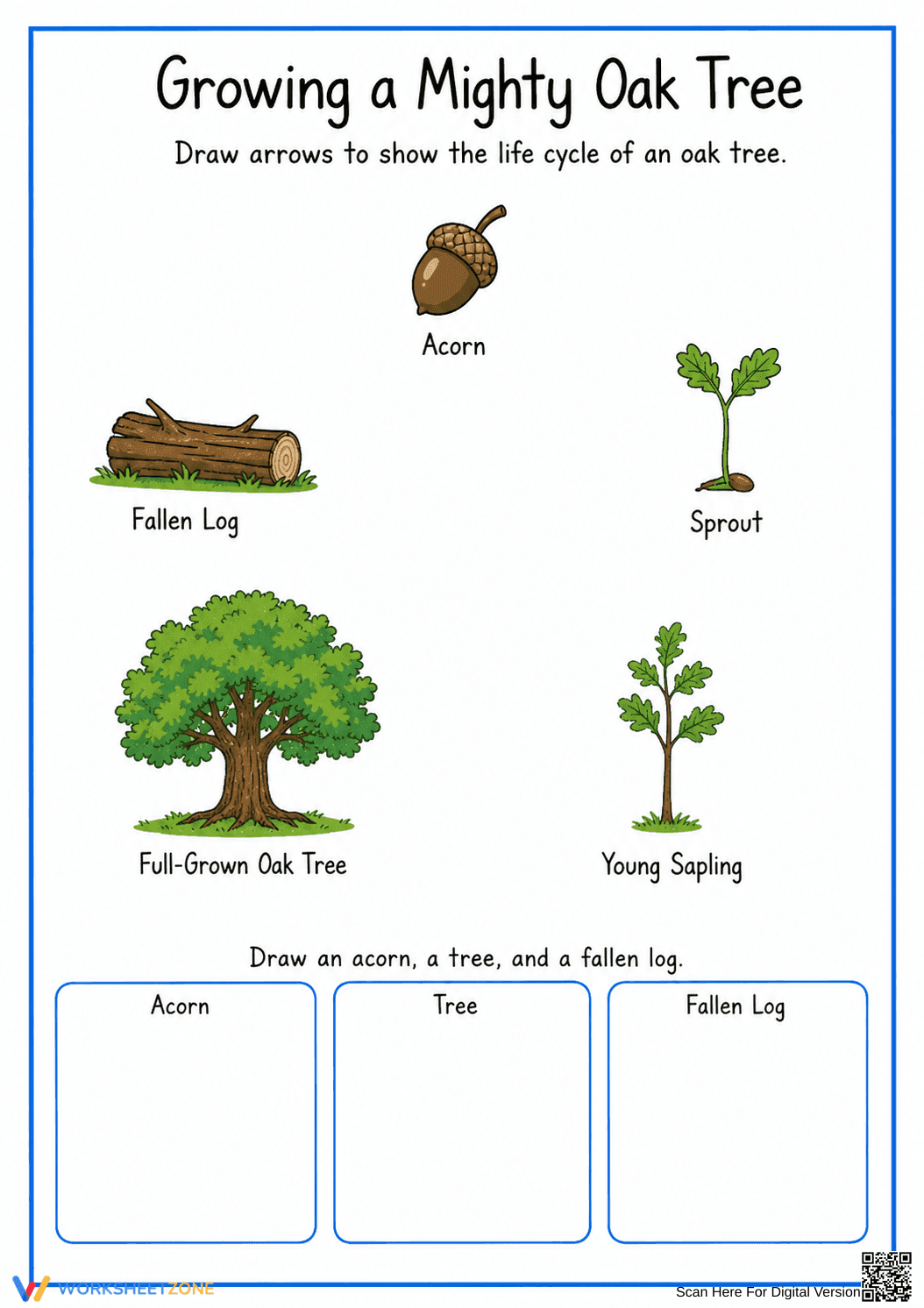
This resource includes three pages designed for varying readiness levels. Each features a circular diagram of an oak tree's developmental stages. Students complete two tasks: drawing arrows to indicate the cycle's sequence and sketching their own representations of an acorn, tree, and log. The visual format supports early readers while reinforcing botanical vocabulary.
To support diverse classrooms, all three versions are included in this download:
- Below grade: Features fully labeled stages (Acorn, Sprout, Young Oak, Mighty Oak, Fallen Log) with three distinct drawing boxes to heavily scaffold the sequencing and illustration tasks.
- On grade: Utilizes slightly more advanced vocabulary (Young Sapling, Full-Grown Oak Tree) while maintaining the structured three-box drawing layout for clear, guided practice.
- Above grade: Removes all text labels from the cycle diagram and provides a single, open drawing space, challenging advanced students to recall vocabulary from memory and organize their illustrations independently.
This activity is directly aligned with 3-LS1-1, requiring students to "develop models to describe that organisms have unique and diverse life cycles but all have in common birth, growth, reproduction, and death." By mapping the oak tree's progression from seed to decaying log, students visually represent this continuous biological loop. Both standard codes can be copied directly into lesson plans, IEP goals, or district curriculum mapping tools.
Deploy this worksheet during independent practice in a botany unit. After a read-aloud about trees, assign the appropriate tiered page to solidify understanding. As a formative assessment observation tip, watch how students draw directional arrows; arrows pointing the wrong way immediately indicate a misconception about the continuous nature of biological cycles. Students will complete their page within 15 to 20 minutes.
This resource is primarily designed for second and third-grade general education students, though its highly visual nature makes it exceptionally effective for English Language Learners and students receiving special education services. The built-in differentiation allows teachers to support struggling learners with labeled diagrams while simultaneously challenging advanced students with the unlabeled version. It pairs perfectly with an anchor chart detailing the parts of a seed or a hands-on seed germination lab.
Teaching the plant life cycle requires instructional materials that allow students to actively construct their own models of biological phenomena. Aligned with 3-LS1-1, this resource prompts learners to develop models describing diverse organism life cycles through sequential diagramming and guided illustration. According to a ScienceDirect TpT Analysis, elementary science resources that incorporate visual modeling and tiered differentiation significantly improve retention of domain-specific vocabulary compared to standard text-based worksheets. By offering three distinct levels of scaffolding, this activity ensures that all students can access complex botanical concepts regardless of their current reading proficiency. The combination of sequencing tasks and creative drawing exercises provides multiple pathways for students to demonstrate their conceptual understanding of how living things grow, change, and contribute to their ecosystems over time.


