


























Views
Downloads
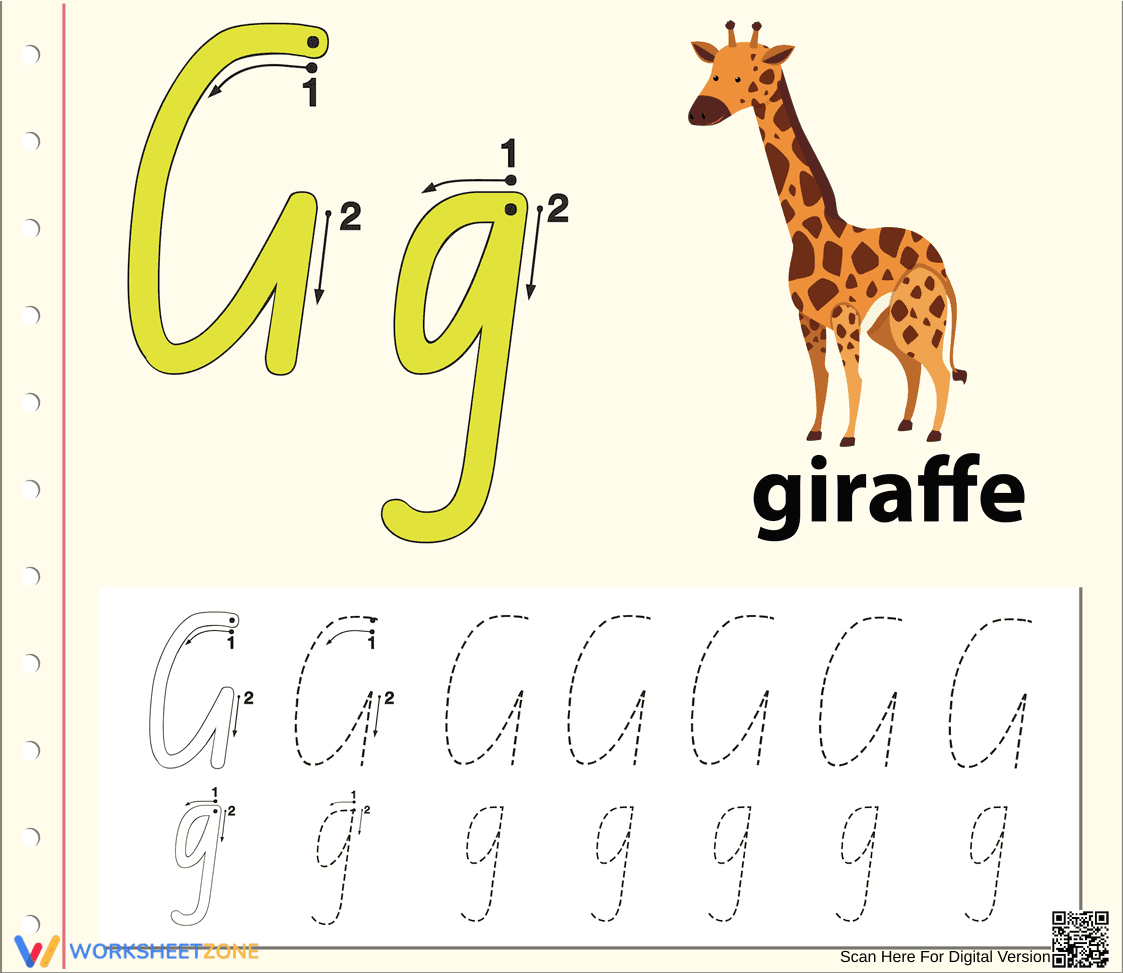

Cursive Letter G Tracing Worksheet | Essential Grade 1
Paste this activity's link or code into your existing LMS (Google Classroom, Canvas, Teams, Schoology, Moodle, etc.).
Students can open and work on the activity right away, with no student login required.
You'll still be able to track student progress and results from your teacher account.
This Grade 1 cursive handwriting worksheet provides a focused environment for students to master the formation of the letter G. By combining visual cues with repetitive tracing, the resource ensures that learners develop the necessary fine motor control for fluent writing. Students will practice both uppercase and lowercase versions, building confidence through a structured, giraffe-themed layout.
At a Glance
- Grade: 1 · Subject: Handwriting
- Standard:
CCSS.ELA-LITERACY.L.1.1.A— Print all upper- and lowercase letters accurately- Skill Focus: Cursive Letter G Formation
- Format: 1 page · 14 problems · Answer key included · PDF
- Best For: Morning work or handwriting centers
- Time: 5–10 minutes
The worksheet features a clear, high-contrast layout designed for young eyes. At the top, large-scale models of uppercase and lowercase cursive G include numbered arrows to guide stroke order. Below these models, two dedicated rows provide 14 tracing tasks—7 for the capital G and 7 for the lowercase g. The D'nealian-style font ensures a smooth transition for students moving beyond basic print.
Zero-Prep Workflow
- Step 1: Print the single-page PDF (30 seconds).
- Step 2: Distribute to students during morning work or handwriting centers (1 minute).
- Step 3: Review the directional arrows as a whole group before students begin tracing (1 minute).
Total teacher prep time is under 3 minutes, making this an ideal solution for busy classrooms or unexpected substitute plans.
Standards Alignment
This resource is primarily aligned with CCSS.ELA-LITERACY.L.1.1.A, which requires students to print all upper- and lowercase letters. While cursive is often introduced as an extension, the foundational skill of letter formation remains the core objective. Both standard codes can be copied directly into lesson plans, IEP goals, or district curriculum mapping tools.
How to Use It
Use this worksheet during the independent practice phase of a handwriting lesson after demonstrating the letter formation on a whiteboard. It also functions effectively as a formative assessment tool; teachers can observe student grip and stroke direction during the 10-minute completion window. This is particularly useful for identifying students who may need additional occupational therapy support.
Who It's For
This resource is designed for Grade 1 students ready to transition to cursive, as well as Kindergarten students needing advanced fine motor challenges. It pairs naturally with alphabet anchor charts or phonics lessons focusing on the hard "g" sound. The giraffe illustration provides a helpful mnemonic for students to remember the letter's name and sound.
Handwriting instruction remains a foundational component of early literacy, as the physical act of letter formation reinforces letter recognition and phonological awareness. This worksheet targets CCSS.ELA-LITERACY.L.1.1.A by providing structured tracing for the cursive letter G, utilizing D'nealian-style strokes that facilitate the transition from print to fluent script. According to Fisher & Frey (2014), the gradual release of responsibility model—moving from the highly scaffolded directional models at the top of the page to independent tracing tasks—is essential for developing muscle memory in young learners. By engaging with 14 specific tracing opportunities, students internalize the complex loops and tails of the letter G, which supports overall writing fluency. This resource serves as a practical tool for educators seeking to integrate fine motor development into their daily ELA blocks without increasing administrative burden. The inclusion of a visual anchor, the giraffe, further aids in associative learning for early elementary students.


