































Gratitude in Action: My Kindness Plan | Grade 3

Paste this activity's link or code into your existing LMS (Google Classroom, Canvas, Teams, Schoology, Moodle, etc.).
Students can open and work on the activity right away, with no student login required.
You'll still be able to track student progress and results from your teacher account.
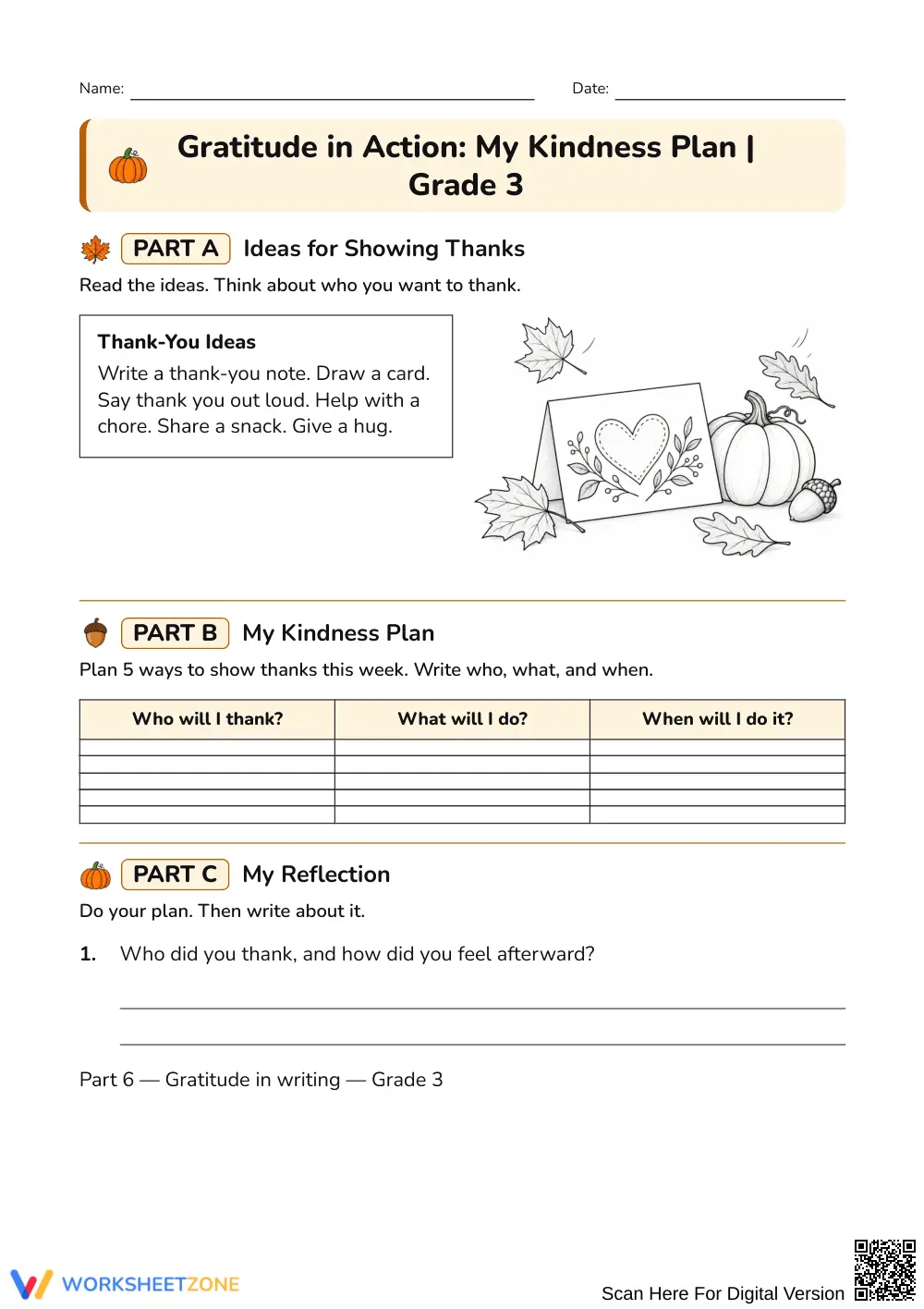
This Grade 3 behavior and social-emotional learning worksheet guides students to turn feelings of appreciation into actionable habits. Learners study concrete gratitude prompts, map out five personal acts of kindness across their week, and reflect on the emotional impact of their actions using a scaffolded writing frame.
At a Glance
- Grade: 3 · Subject: Behavior Worksheets
- Standard:
SEL-C3— Identify and execute proactive acts of gratitude to build positive interpersonal relationships- Skill Focus: Planning and reflecting on actionable acts of gratitude
- Format: 1 pages · 2 problems · Answer key included · PDF
- Best For: Morning meeting or weekly advisory block
- Time: 15–20 minutes
What's Inside
Designed on a single clean page, this printable resource equips elementary learners with an idea bank featuring six accessible thank-you gestures. Students complete a structured three-column planning chart that requires identifying the recipient, the specific action, and the timeline, followed by an open-ended personal reflection section with an authentic student exemplar model.
Zero-Prep Classroom Workflow
- Print (30 seconds): Send this single-page PDF directly to your photocopier with zero collating, cutting, or sorting required.
- Distribute (1 minute): Hand out the organizer during morning advisory or a dedicated character education period with clear initial instructions.
- Review (10 minutes): Facilitate peer sharing or collect completed reflection logs at the end of the week using the included reference key.
Total educator preparation requires under 2 minutes, making this an ideal print-and-go option for substitute lesson plans, school counselor check-ins, or mid-week reset activities.
Standards Alignment
This resource aligns with fundamental elementary social-emotional learning competencies: SEL-C3: Demonstrate social awareness and relationship skills by planning, executing, and evaluating helpful actions toward peers and family members. It reinforces responsible decision-making by prompting students to set measurable social goals. Both standard codes can be copied directly into lesson plans, IEP goals, or district curriculum mapping tools.
How to Use It
Introduce this worksheet directly after a whole-class read-aloud about appreciation or during a Monday morning community circle. Ask learners to select five distinct individuals across home and school environments to build broad perspective-taking. When observing independent work, look for specific verbs in column two rather than vague intentions like "be nice." Expect the initial planning portion to take roughly 15 minutes, with the final reflection box completed after students carry out their commitments later in the week.
Who It's For
This exercise serves general third-grade classrooms, elementary counseling caseloads, and positive behavioral intervention supports (PBIS). Emerging writers benefit from the sentence starters and curated gesture list, while advanced learners can expand their reflection responses into full journal entries. Pair this activity naturally with a classroom anchor chart detailing community appreciation or personal thank-you card templates.
According to Fisher & Frey (2014), structured social-emotional frameworks help elementary students bridge the gap between abstract prosocial values and observable behaviors through scaffolded modeling and guided application. Explicit planning tools promote intentional relationship-building by turning general expressions of kindness into concrete commitments that third graders can schedule and self-evaluate. The inclusion of an explicit reflection prompt further reinforces emotional literacy, encouraging students to recognize the mutual positive affect generated when showing appreciation. Systematic implementation of actionable gratitude routines supports classroom culture and improves student self-regulation across diverse learning environments.


