


























Views
Downloads
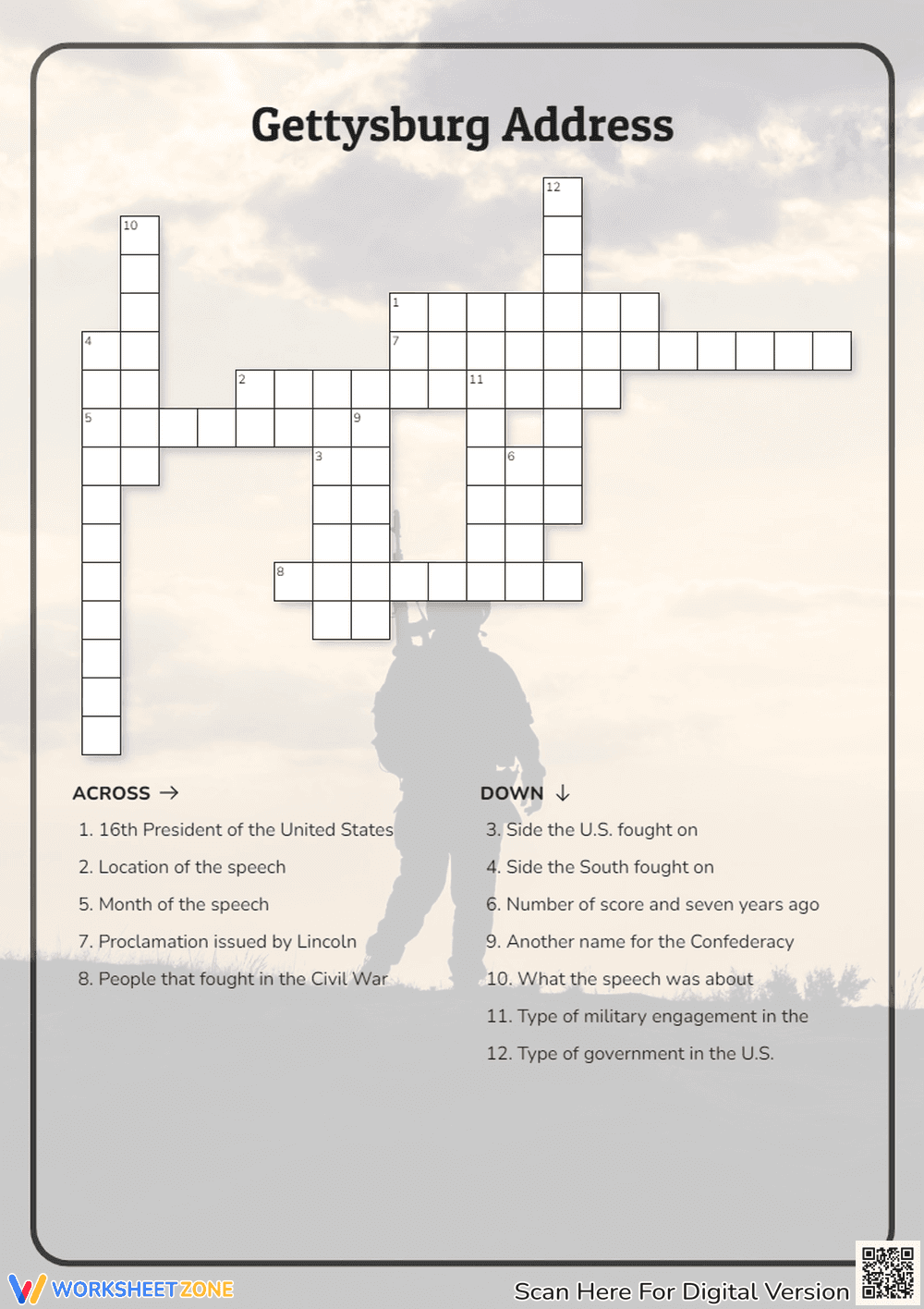

Gettysburg Address Crossword | Grade 5 Printable
Paste this activity's link or code into your existing LMS (Google Classroom, Canvas, Teams, Schoology, Moodle, etc.).
Students can open and work on the activity right away, with no student login required.
You'll still be able to track student progress and results from your teacher account.
This printable Gettysburg Address crossword puzzle helps fifth-grade students master essential Civil War vocabulary and historical facts. By solving twelve targeted clues about Abraham Lincoln's famous speech, learners reinforce their understanding of key historical figures, locations, and concepts while building domain-specific reading comprehension skills.
At a Glance
- Grade: 5 · Subject: Social Studies
- Standard:
CCSS.ELA-LITERACY.RI.5.4— Determine the meaning of domain-specific words- Skill Focus: Historical vocabulary
- Format: 1 page · 12 problems · Answer key included · PDF
- Best For: Independent practice or review
- Time: 15–20 minutes
This single-page resource features a classic crossword grid paired with twelve distinct clues divided into across and down categories. Students will recall specific details such as the sixteenth president, the location of the speech, and the sides that fought in the Civil War. The straightforward layout ensures students can focus entirely on the content without confusing instructions, and a complete answer key is provided for quick grading.
Zero-Prep Workflow
This worksheet is designed for immediate classroom implementation with minimal teacher effort.
- Print (1 minute): Simply download the PDF and print a class set. The high-contrast design ensures clear copies every time.
- Distribute (1 minute): Hand out the puzzle as a bell-ringer, early finisher activity, or dedicated vocabulary review.
- Review (3 minutes): Use the included answer key to quickly check student responses or project it for self-correction.
With a total teacher prep time of under two minutes, this activity is an excellent addition to any emergency sub plan or busy instructional week.
Standards Alignment
This activity aligns directly with CCSS.ELA-LITERACY.RI.5.4, requiring students to determine the meaning of general academic and domain-specific words and phrases in a text relevant to a grade 5 topic or subject area. By recalling terms like Confederacy and Proclamation, students demonstrate mastery of historical terminology. Both standard codes can be copied directly into lesson plans, IEP goals, or district curriculum mapping tools.
How to Use It
Deploy this crossword puzzle after a direct instruction lesson on the Civil War to solidify new vocabulary. It serves as an engaging independent practice activity that typically takes students 15 to 20 minutes to complete. As a formative assessment tip, observe which clues students skip or struggle with; this quickly highlights gaps in historical context that may require a brief reteach before moving forward.
Who It's For
This resource is primarily designed for fourth and fifth-grade students studying early American history. The familiar puzzle format provides built-in differentiation, as the intersecting letters offer natural scaffolding for struggling readers or English Language Learners trying to spell complex historical terms. It pairs perfectly with a primary source reading of the Gettysburg Address or a classroom anchor chart detailing Civil War timelines.
Integrating domain-specific vocabulary practice into social studies instruction is critical for long-term reading comprehension. This worksheet targets CCSS.ELA-LITERACY.RI.5.4, prompting students to determine the meaning of domain-specific words related to the Civil War. According to a recent EdReports 2024 analysis, cross-curricular literacy activities that embed historical terminology within engaging formats, such as puzzles, significantly increase student retention of academic language. When students actively retrieve facts about the Gettysburg Address to complete a grid, they move beyond passive reading and engage in active cognitive recall. This structured repetition helps transition new vocabulary from short-term memory into active working vocabulary. By utilizing targeted retrieval practice, educators can ensure that foundational historical concepts are firmly established, paving the way for deeper analytical discussions about primary source documents and historical events.


