


























Views
Downloads
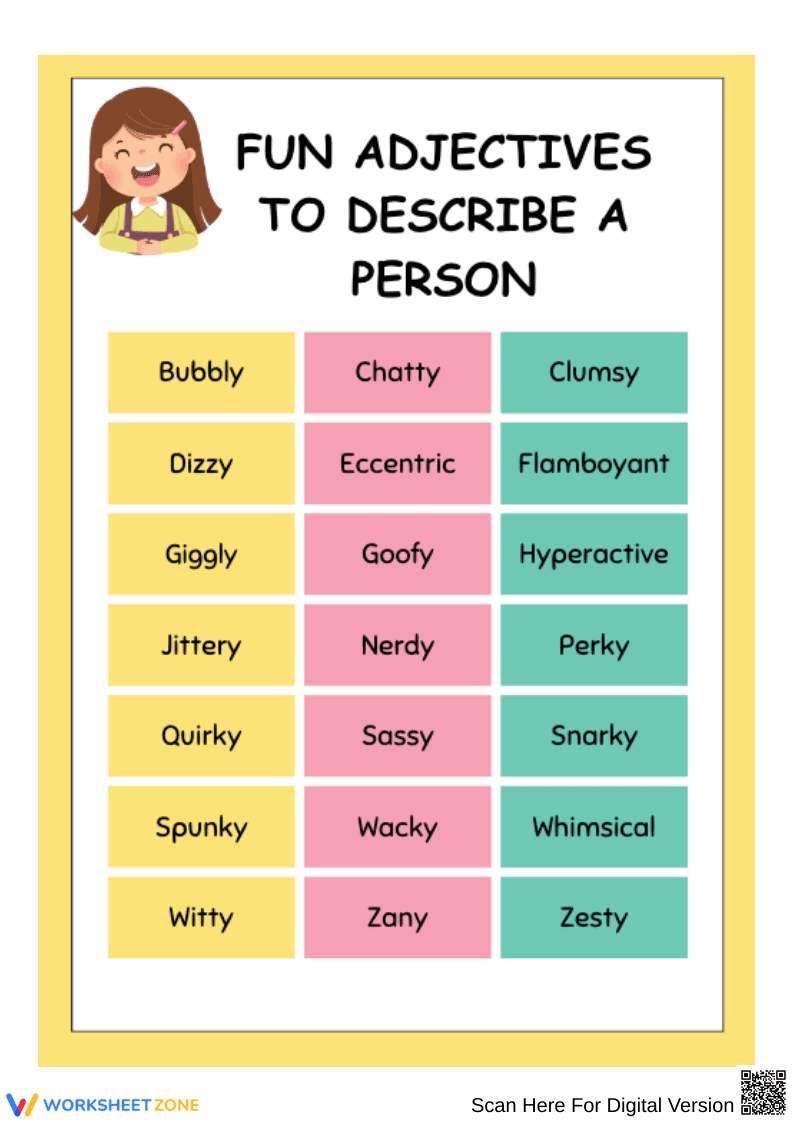

Fun Adjectives Worksheet | Printable Grade 3–4 ELA
Paste this activity's link or code into your existing LMS (Google Classroom, Canvas, Teams, Schoology, Moodle, etc.).
Students can open and work on the activity right away, with no student login required.
You'll still be able to track student progress and results from your teacher account.
This Grade 3–4 adjectives worksheet builds students' ability to identify and use descriptive words for a person's character and behavior, giving them 12 structured practice problems that move from recognition to application. Students leave with a working bank of vivid adjectives ready for use in their own writing.
At a Glance
- Grade: 3–4 · Subject: ELA / Grammar & Vocabulary
- Standard:
CCSS.ELA-LITERACY.L.3.1.A— Explain function of adjectives and use them correctly in sentences- Skill Focus: Adjectives describing personal character and behavior
- Format: 1 page · 12 problems · Answer key included · PDF
- Best For: Vocabulary building and parts-of-speech practice
- Time: 15–25 minutes
Inside: one focused page of 12 problems centered on adjectives that describe personality and behavior. Tasks include word-matching, fill-in-the-blank sentences, and a short application prompt where students choose adjectives to describe a real or fictional person. A full answer key follows the student page, with accepted-answer notes for open-response items.
- Guided practice (problems 1–4): Word bank provided. Students match adjectives to illustrated character descriptions, reducing cognitive load while building familiarity with target vocabulary.
- Supported practice (problems 5–9): Sentence frames with blanks. Students select the best adjective from a reduced list, applying meaning in context with partial scaffolding still in place.
- Independent practice (problems 10–12): No word bank. Students write their own sentences using three self-chosen adjectives from the lesson, demonstrating ownership of the vocabulary. This gradual-release sequence mirrors the I Do / We Do / You Do model, ensuring students build confidence before working without support.
Standards Alignment
Primary standard: CCSS.ELA-LITERACY.L.3.1.A — Explain the function of nouns, pronouns, verbs, adjectives, and adverbs in general and their functions in particular sentences. Supporting standard CCSS.ELA-LITERACY.L.4.1.A extends this work by asking students to use adjectives with precision in more complex sentences. Both standard codes can be copied directly into lesson plans, IEP goals, or district curriculum mapping tools.
How to Use It
Use during direct instruction as a guided-practice exit point: after modeling two or three adjectives as a class, release students to problems 1–4 while circulating. Alternatively, assign problems 5–12 after instruction as an independent formative check. Observation tip: students who consistently choose generic words (nice, good, bad) in problems 10–12 need additional vocabulary exposure before the next writing task. Expected completion time: 15–25 minutes depending on grade and support level.
Who It's For
Grade 3 students meeting L.3.1.A for the first time and Grade 4 students consolidating adjective use before tackling comparative and superlative forms. Pairs naturally with a character-description anchor chart or a short mentor text featuring a vivid protagonist. Students who finish early can extend by writing a three-sentence character sketch using at least five adjectives from the worksheet.
Adjective instruction at Grades 3–4 directly supports writing quality and reading comprehension. CCSS.ELA-LITERACY.L.3.1.A asks students to explain the function of adjectives and deploy them accurately in sentences — a skill tied to measurable gains in descriptive writing scores. Fisher & Frey (2014) identify explicit vocabulary instruction paired with structured practice as a high-leverage strategy for word retention, noting that students who encounter new words in multiple task formats show stronger long-term recall than those who receive definition-only instruction. This 12-problem worksheet applies that principle: students see each target adjective in a matching context, a sentence context, and a generative writing context before the lesson ends. The single-page, answer-key-included format makes it practical for classroom teachers, interventionists, and substitute teachers working within Grades 3–4 ELA units on parts of speech and descriptive language.


