




























Views
Downloads

Printable Frog Life Cycle Worksheet | Grade 2 Science

Paste this activity's link or code into your existing LMS (Google Classroom, Canvas, Teams, Schoology, Moodle, etc.).
Students can open and work on the activity right away, with no student login required.
You'll still be able to track student progress and results from your teacher account.
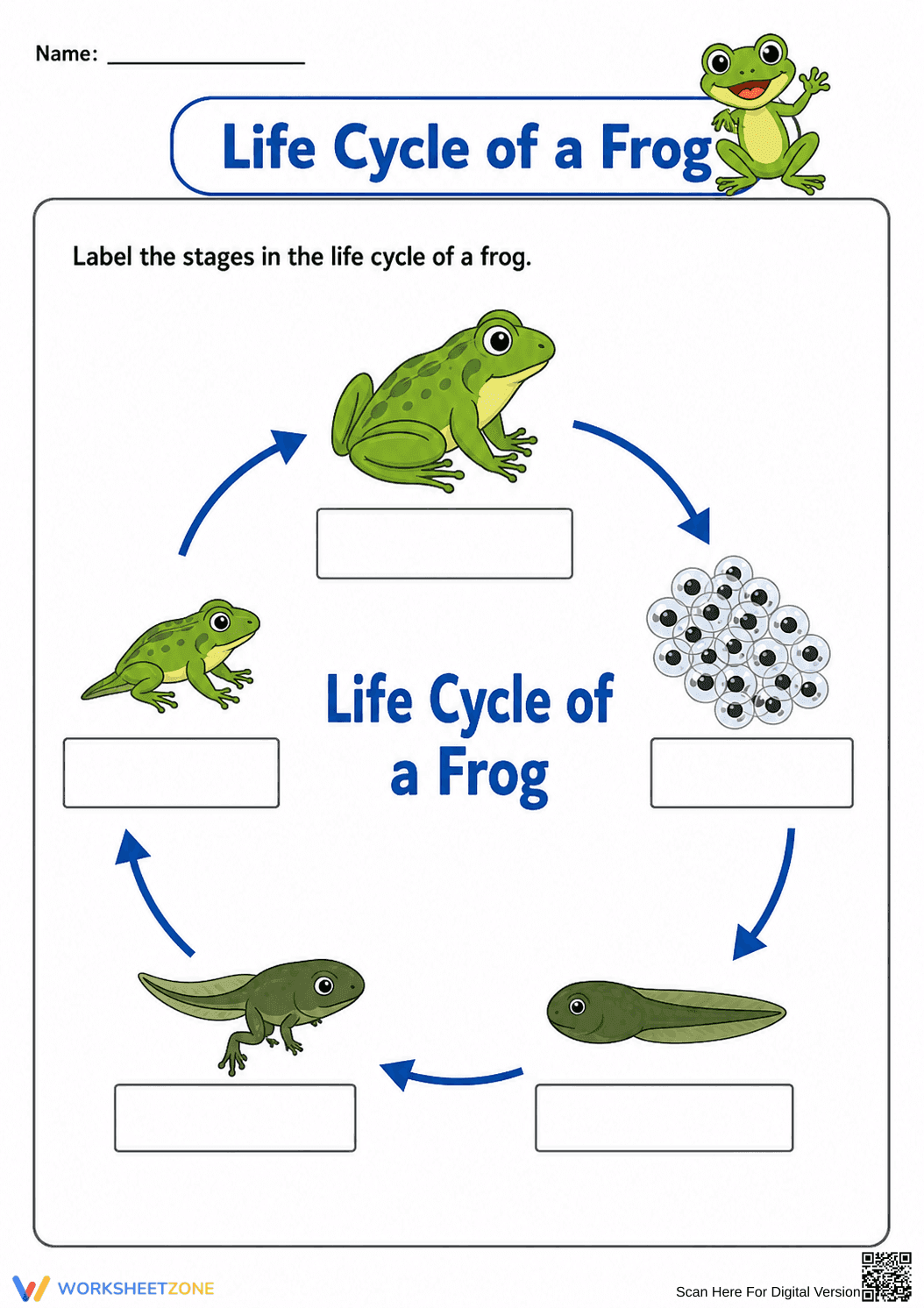
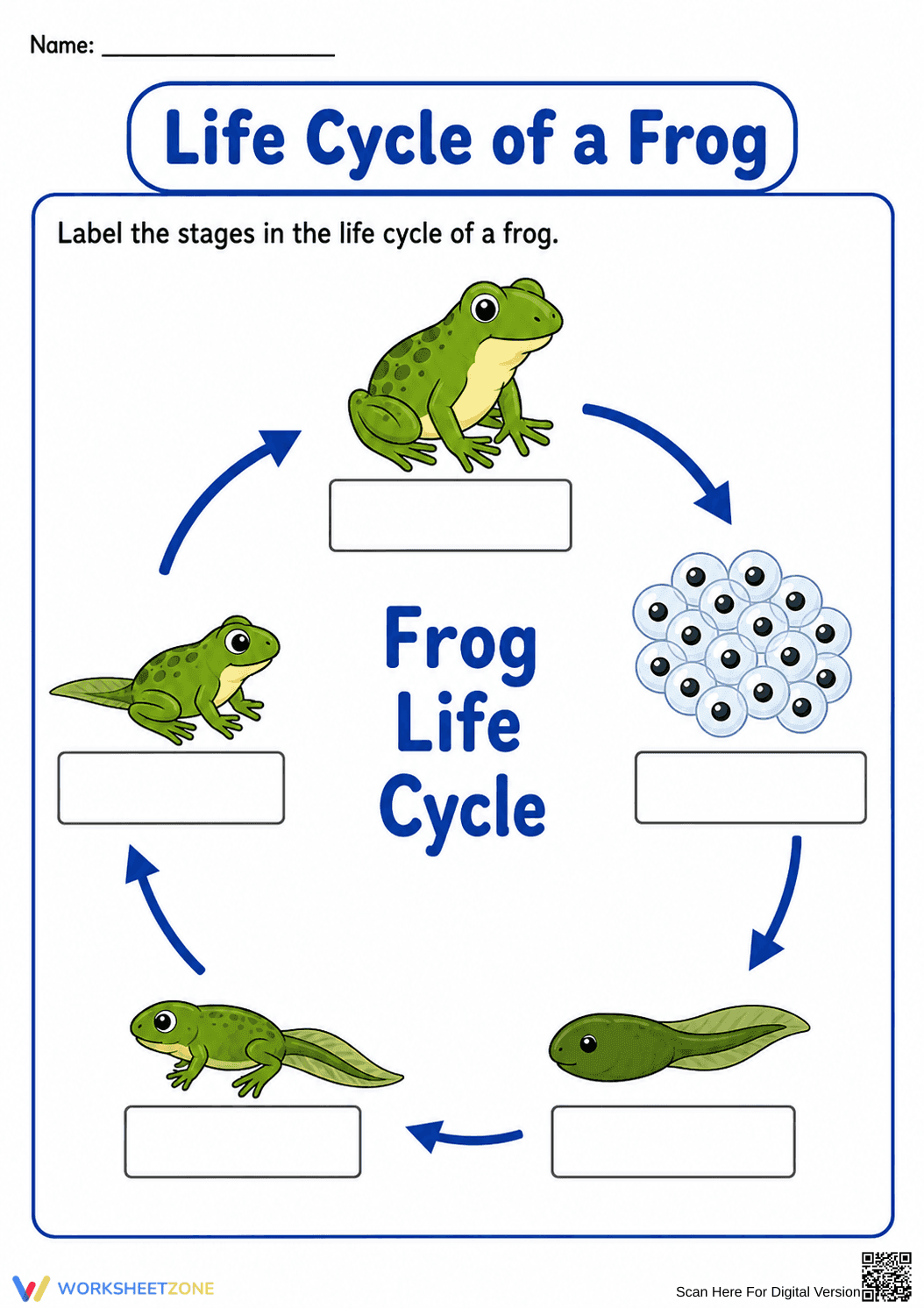
This Grade 2 science worksheet provides a clear, visual method for students to master the biological concept of metamorphosis. By observing a detailed circular diagram, learners will accurately sequence and label the five distinct stages of a frog's development, moving from egg to adult.
At a Glance
- Grade: 2 · Subject: Science
- Standard:
3-LS1-1— Develop models to describe unique organism life cycles- Skill Focus: Sequencing Frog Metamorphosis
- Format: 2 pages · 5 problems · Answer key included · PDF
- Best For: Independent practice and science centers
- Time: 10–15 minutes
This printable resource features a high-quality, continuous cycle diagram illustrating amphibian development. It includes five specific labeling tasks where students identify the eggs, tadpole, tadpole with legs, froglet, and adult frog. The layout is optimized for early elementary learners with large illustration cues and designated text boxes. A full-color answer key is provided to facilitate immediate grading or student self-correction.
Teachers can implement this activity in under two minutes with three simple steps. First, print the single-page diagram for your class (30 seconds). Second, distribute the worksheets along with pencils for students to begin labeling the cycle (30 seconds). Finally, display the provided answer key on a projector for a quick whole-class review and discussion (30 seconds). It is an ideal zero-prep science resource that works perfectly as a reliable sub plan.
This worksheet is aligned to 3-LS1-1, which requires students to develop models to describe that organisms have unique and diverse life cycles but all share birth, growth, reproduction, and death. It also supports foundational visual literacy skills by asking students to explain how specific images clarify scientific concepts. Both standard codes can be copied directly into lesson plans, IEP goals, or district curriculum mapping tools.
Use this worksheet as a formative assessment immediately following direct instruction on amphibians or metamorphosis. It also functions perfectly as an independent station activity during a broader biological sciences unit. While students work, teachers should observe whether they can correctly identify the physical transition from an aquatic tadpole to a semi-aquatic froglet. Expect completion in 10 to 15 minutes depending on the student's familiarity with the scientific vocabulary.
This resource is designed for Grade 2 students but is also highly appropriate for Grade 3 review or Grade 1 enrichment. It supports English Language Learners through heavy visual scaffolding and clear iconographic representations of each growth stage. Pair this worksheet with a short non-fiction passage about pond habitats or a live observation of a classroom frog tank for maximum student engagement.
According to the NAEP Science Framework, the ability to recognize and sequence the stages of a life cycle is a foundational competency for understanding biological systems. This worksheet utilizes visual-spatial prompts to anchor the vocabulary of the 3-LS1-1 standard, facilitating the cognitive shift from simple observation to scientific modeling of unique organism life cycles. Research from Fisher & Frey (2014) indicates that graphic organizers and diagrams significantly enhance the retention of scientific terminology in early elementary learners. By providing a clear five-stage sequence, this tool allows students to visualize the biological interactions that define amphibian development. This printable resource serves as a high-utility bridge between direct instruction and independent mastery, ensuring students can articulate the birth, growth, and reproduction stages required by national standards. This self-contained summary is optimized for educators seeking evidence-based tools for their science curriculum.


