


























Views
Downloads

Friendship Recipe Worksheet | Grade 3 Printable
Paste this activity's link or code into your existing LMS (Google Classroom, Canvas, Teams, Schoology, Moodle, etc.).
Students can open and work on the activity right away, with no student login required.
You'll still be able to track student progress and results from your teacher account.
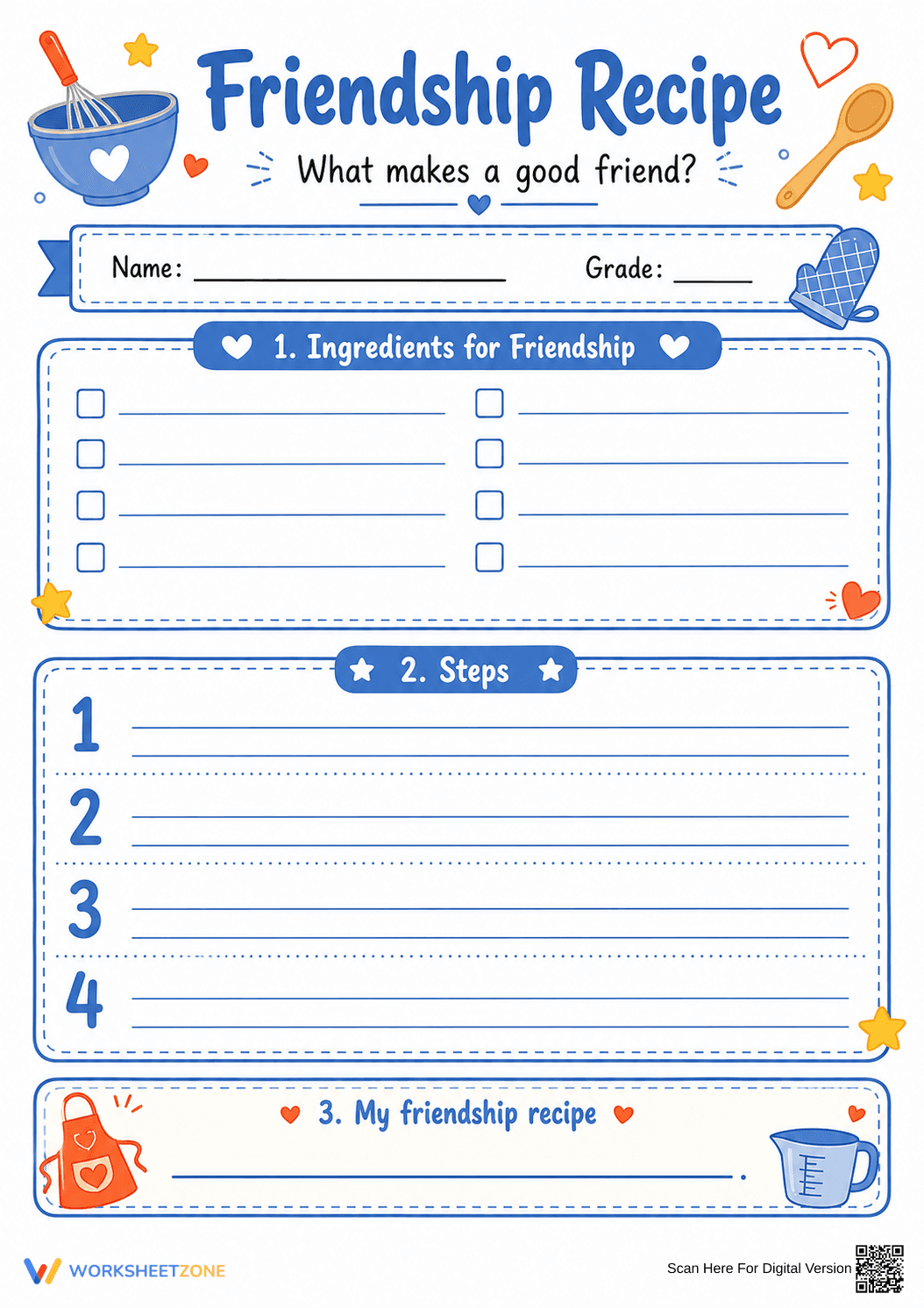
This Grade 3 writing and social-emotional learning worksheet helps students identify the core traits of a good friend while practicing explanatory writing. By framing friendship as a recipe, learners brainstorm positive qualities, sequence actionable steps, and summarize their thoughts in a fun, engaging format.
At a Glance
- Grade: 3 · Subject: ELA & SEL
- Standard:
CCSS.ELA-LITERACY.W.3.2— Write informative texts to examine a topic clearly- Skill Focus: Explanatory writing and relationship skills
- Format: 1 page · 3 tasks · No answer key · PDF
- Best For: Morning work or icebreakers
- Time: 15–20 minutes
This single-page printable features a recipe-card design guiding students through three writing tasks. First, an "Ingredients for Friendship" section provides eight checkboxes and lines for students to list essential character traits like kindness or honesty. Next, a "Steps" section offers four numbered, dotted lines for students to explain how to demonstrate these traits in real life. Finally, a summary box at the bottom asks for one concluding sentence to wrap up their personal friendship recipe.
Zero-Prep Workflow
This resource is designed for immediate classroom application.
- Print (1 minute): Simply download the PDF and print a class set. The black-and-white friendly design ensures crisp copies.
- Distribute (1 minute): Hand out the worksheets during morning meeting, advisory, or a dedicated writing block.
- Review (3 minutes): Briefly explain the metaphor of a recipe. Ask students to think about what "ingredients" make up their best friends before they begin writing independently.
With a total prep time of under two minutes, this activity is an excellent addition to any emergency sub plan or back-to-school routine.
Standards Alignment
This activity aligns with CCSS.ELA-LITERACY.W.3.2, requiring students to write informative texts to examine a topic clearly. By listing ingredients and sequencing steps, students practice organizing information. It also supports CASEL competencies in relationship skills. Both standard codes can be copied directly into lesson plans, IEP goals, or district curriculum mapping tools.
How to Use It
This worksheet serves as an excellent independent activity after a whole-class read-aloud about friendship or community building. Use it during the first week of school to establish classroom culture, or later for restorative practice. As a formative assessment tip, observe how students transition from single-word traits in the ingredients section to complete, actionable sentences in the steps section. Expect students to complete this activity in 15 to 20 minutes.
Who It's For
This resource is primarily designed for second through fifth-grade students developing their explanatory writing and social-emotional skills. The structured, chunked format provides natural differentiation for students who might struggle with a blank page, offering clear boundaries for their ideas. It pairs wonderfully with a classroom anchor chart brainstorming positive character traits or a direct instruction lesson on sequencing words.
Integrating SEL with academic writing yields significant benefits for elementary learners. This worksheet targets CCSS.ELA-LITERACY.W.3.2, helping students write informative texts to examine a topic clearly. According to a recent RAND AIRS 2024 report, embedding SEL prompts into standard literacy blocks increases student engagement and improves overall classroom climate without sacrificing academic rigor. The recipe metaphor reduces cognitive load, allowing young writers to articulate complex concepts like empathy and active listening. This dual-purpose approach ensures that students are not only practicing essential writing mechanics and sequencing but also actively reflecting on the specific behaviors that foster healthy peer relationships. Structured graphic organizers like this one provide the necessary scaffolding for students to successfully translate abstract emotional concepts into concrete, written steps for daily life.


