


























Views
Downloads
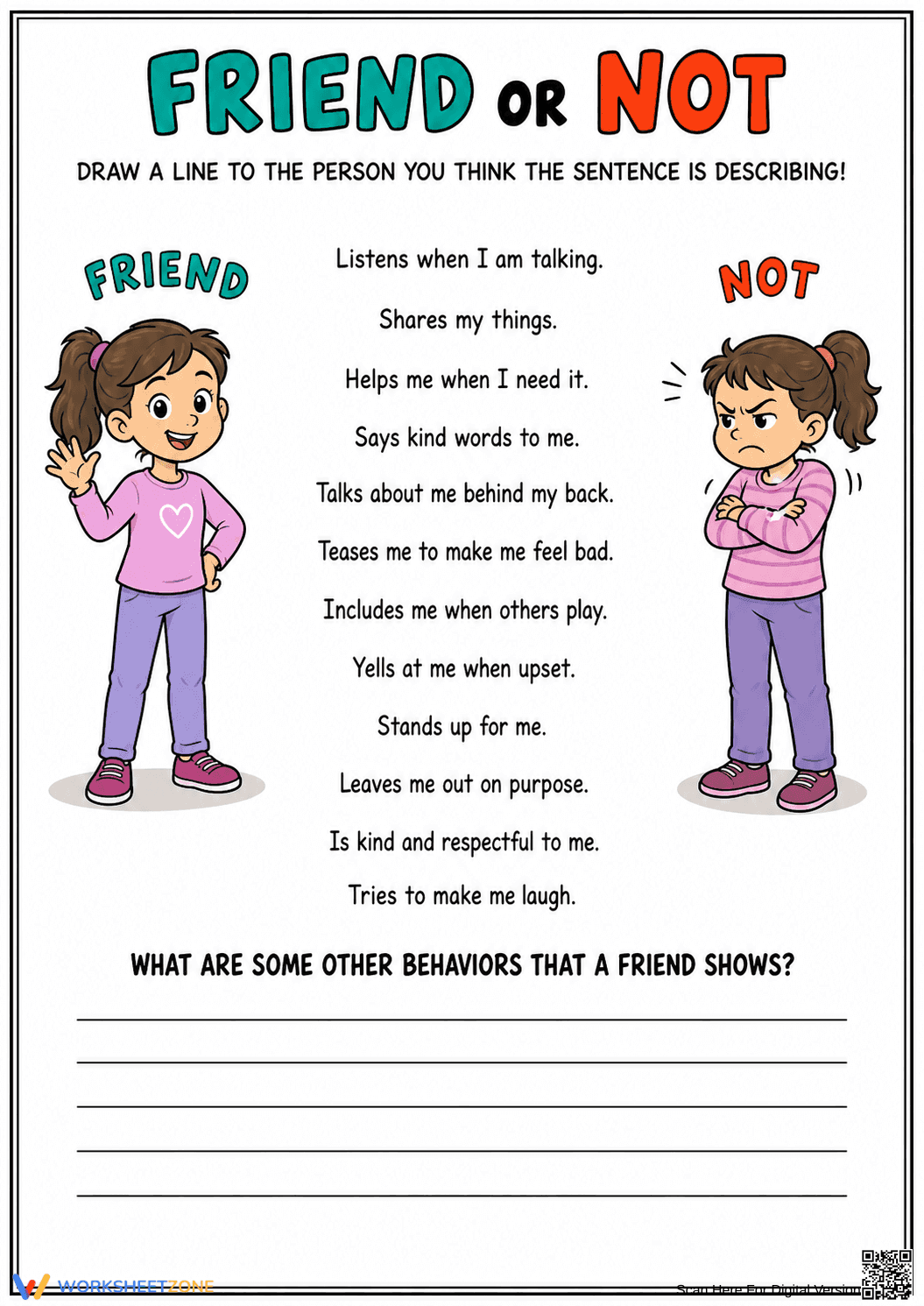

Friend or Not Worksheet: Essential Social Skills Grade 2
Paste this activity's link or code into your existing LMS (Google Classroom, Canvas, Teams, Schoology, Moodle, etc.).
Students can open and work on the activity right away, with no student login required.
You'll still be able to track student progress and results from your teacher account.
This social-emotional learning worksheet helps students distinguish between positive and negative peer behaviors. By categorizing 12 specific actions, learners develop the self-awareness needed to build healthy relationships. It provides a clear visual framework for identifying kindness, respect, and support versus exclusionary or hurtful actions in a classroom setting.
At a Glance
- Grade: Grade 2 · Subject: Social Skills
- Standard:
CCSS.ELA-LITERACY.SL.2.1— Follow agreed-upon rules for discussions and social interactions with peers- Skill Focus: Identifying friendship traits
- Format: 1 page · 13 tasks · Answer key included · PDF
- Best For: Morning meeting or SEL small groups
- Time: 15–20 minutes
The worksheet features a clean, two-column layout with engaging character illustrations representing "Friend" and "Not." It includes 12 descriptive phrases such as "Listens when I am talking" and "Leaves me out on purpose." Below the matching activity, a dedicated writing section provides four lines for students to brainstorm and record additional positive friendship behaviors they value.
This resource is designed for a seamless classroom experience. First, print the single-page PDF (30 seconds). Next, distribute the sheets and read the 12 behavioral prompts aloud to ensure comprehension (5 minutes). Finally, review the matches as a group to facilitate a class discussion on social boundaries and empathy (10 minutes). Total teacher preparation time is under 2 minutes, making it an ideal sub plan or warm-up.
This activity aligns with CCSS.ELA-LITERACY.SL.2.1, which focuses on following agreed-upon rules for social interactions and collaborative conversations. By identifying what constitutes a "friend," students learn the foundational vocabulary for social-emotional success. Both standard codes can be copied directly into lesson plans, IEP goals, or district curriculum mapping tools.
Use this as a formative assessment during a unit on community building. Assign it after a read-aloud about friendship to see if students can apply the story's themes to concrete behaviors. Observe which students struggle to identify "teasing" or "excluding" as negative traits, as this indicates a need for targeted social skills intervention. Expected completion time ranges from 15 to 20 minutes depending on the depth of discussion.
This worksheet is ideal for elementary students in grades 1 through 3, particularly those developing interpersonal awareness. It serves as an excellent resource for school counselors, special education teachers working on social goals, and general education teachers during morning meetings. It pairs naturally with an anchor chart listing "Green Choice" and "Red Choice" behaviors or a direct instruction lesson on empathy.
According to the RAND AIRS 2024 report, explicit instruction in social-emotional competencies significantly improves classroom climate and reduces peer conflict. This worksheet addresses the core competency of relationship skills by requiring students to evaluate 12 distinct social interactions against a standard of "friendship." By utilizing the CCSS.ELA-LITERACY.SL.2.1 framework, the activity moves beyond simple matching to encourage higher-order reflection on social norms. Research from Fisher & Frey (2014) emphasizes that visual scaffolds, like the character icons used here, help younger learners internalize abstract concepts such as "respect" and "loyalty." Providing students with a structured way to categorize behaviors allows them to build a mental model for healthy peer engagement. This evidence-based approach ensures that social skills instruction is both measurable and impactful within the primary grade curriculum.


