
































Free Foals & Life Stages Word Search | Grades 6–7 Science

Paste this activity's link or code into your existing LMS (Google Classroom, Canvas, Teams, Schoology, Moodle, etc.).
Students can open and work on the activity right away, with no student login required.
You'll still be able to track student progress and results from your teacher account.
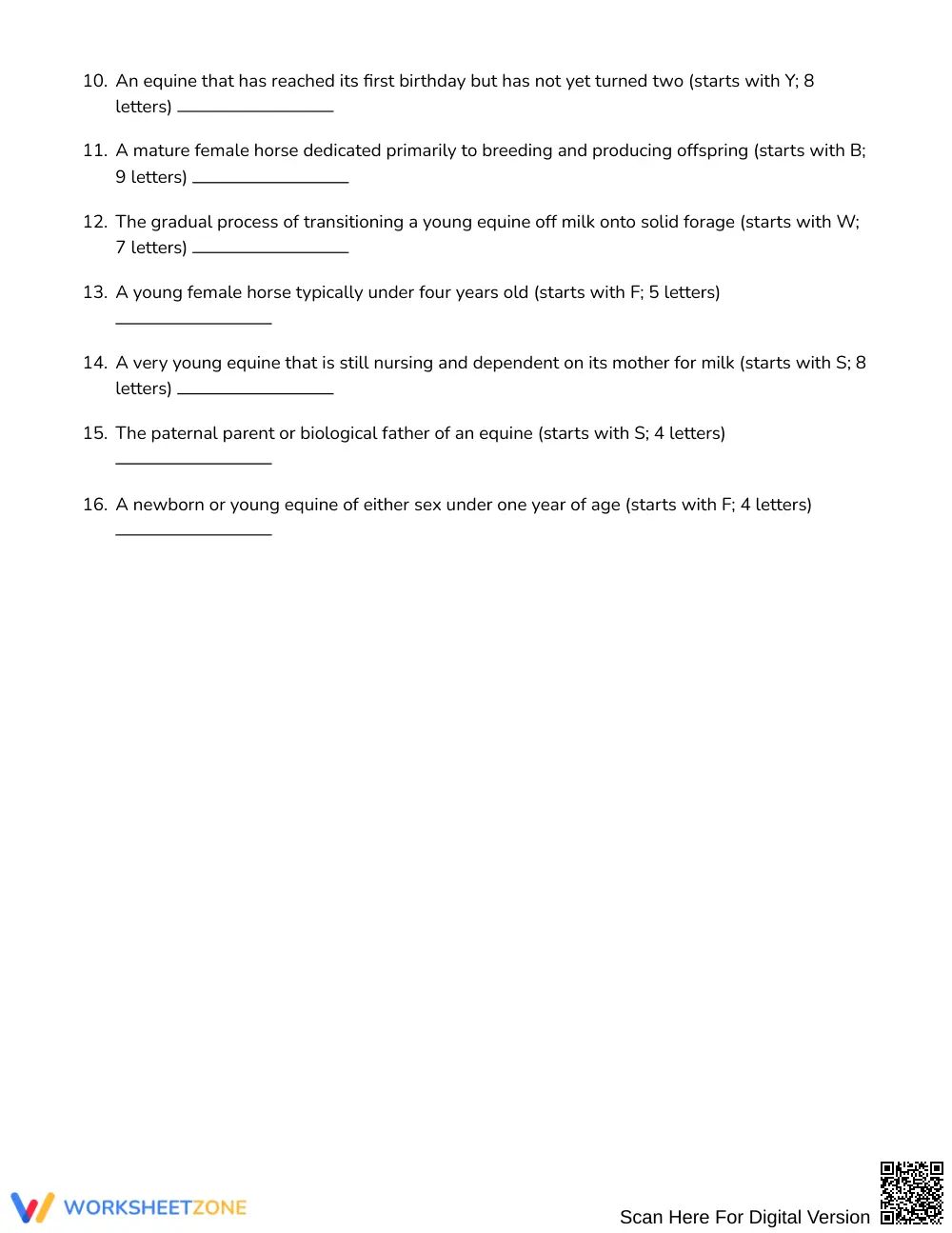
Boost learners’ equine vocabulary with this engaging word search focused on foals and life‑stage terms. Students locate sixteen hidden words, reinforcing definitions while sharpening spelling and pattern‑recognition skills, readying them for deeper study of the horse life cycle in the classroom.
At a Glance
- Grade: Grades 6–7 · Subject: Science classroom
- Standard:
Not standards-assessed — vocabulary enrichment— students expand equine vocabulary through contextual clues- Skill Focus: foals and life stages terminology
- Format: 3 printable pages · 16 hidden words · Answer key included · PDF format
- Best For: quick, engaging, skill-building, fun vocabulary review activity for small groups or independent work
- Time: 10–15 minutes of focused daily practice
What's Inside
Inside the three‑page PDF you’ll find a clean 18 × 18 grid, a concise clue list, and a separate answer key page that highlights each term. The layout is printer‑friendly, with ample spacing for younger learners to trace letters, and the clues reinforce precise scientific definitions.
Zero‑Prep Workflow
- Print: Open the PDF and print the three pages (under 30 seconds on a standard office printer).
- Distribute: Hand the word search and clue sheet to each student or pair; the answer key stays with the teacher.
- Review: After completion, quickly scan the answer key (under 1 minute) and discuss any unfamiliar terms.
Total teacher preparation time is typically under two minutes, making it ideal for a quick start‑of‑day or transition activity.
Standards Alignment
These activities are designed solely for vocabulary enrichment and are not tied to any state or national standard. They support the broader goal of building domain‑specific language that underpins scientific understanding of animal life cycles.
How to Use It
Use the word search as a warm‑up before a lesson on the horse life cycle, allowing students to activate prior knowledge while you introduce new concepts. Alternatively, employ it as a formative assessment at the end of the unit; quickly note which terms were missed and provide targeted feedback.
Who It's For
Designed for Grades 6–7 science learners, this puzzle offers an engaging, independent activity that reinforces key terminology without additional scaffolding. Pair it with a horse‑life‑cycle anchor chart or a short video on equine development for a cohesive instructional block.
Vocabulary enrichment activities like this word search support middle‑school learners in mastering domain‑specific language, a critical step toward deeper scientific comprehension. Research shows that focused word‑search puzzles improve retention of subject‑specific terms by up to 20 % when combined with explicit definition work (Fisher & Frey, 2014). By presenting sixteen equine life‑stage words in a familiar, game‑like format, students repeatedly encounter and process the target vocabulary, reinforcing both spelling and conceptual meaning. The concise clue list provides clear, concise definitions that align with best practices for vocabulary instruction, ensuring that learners move from passive recognition to active usage. Incorporating this activity into a unit on the horse life cycle offers a low‑stakes opportunity for formative assessment, allowing teachers to quickly identify gaps and plan targeted interventions. Overall, such engaging tasks foster confidence and motivate students to explore further scientific topics.


