

































Free Energy Flow Analysis Worksheet | Grade 6-12 Science

Paste this activity's link or code into your existing LMS (Google Classroom, Canvas, Teams, Schoology, Moodle, etc.).
Students can open and work on the activity right away, with no student login required.
You'll still be able to track student progress and results from your teacher account.
Students will master data-table analysis of energy flow by interpreting food-chain tables, calculating percent transfers, and explaining why energy diminishes at higher trophic levels. This worksheet guides learners through real-world examples, reinforcing scientific reasoning and quantitative skills essential for mastering energy concepts.
At a Glance
- Grade: Grades 6–12 · Subject: Science
- Standard:
— Analyze energy flow data in food chains using tables and calculations- Skill Focus: Data Table Analysis of Energy Flow
- Format: 4 pages · 19 problems · Answer key included · PDF
- Best For: Guided classroom practice for students on real ecosystem energy concepts
- Time: 30–45 minutes
What's Inside
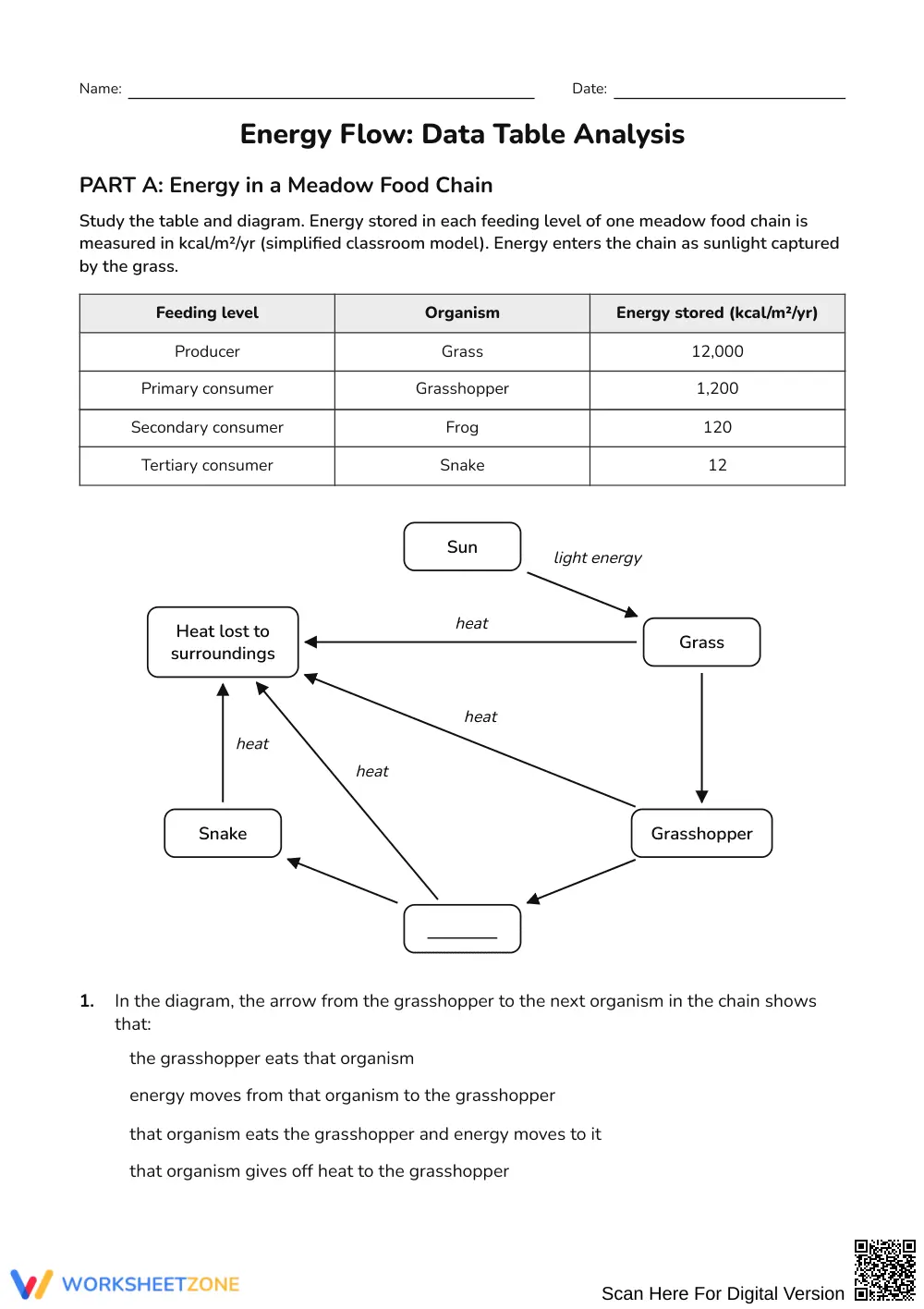
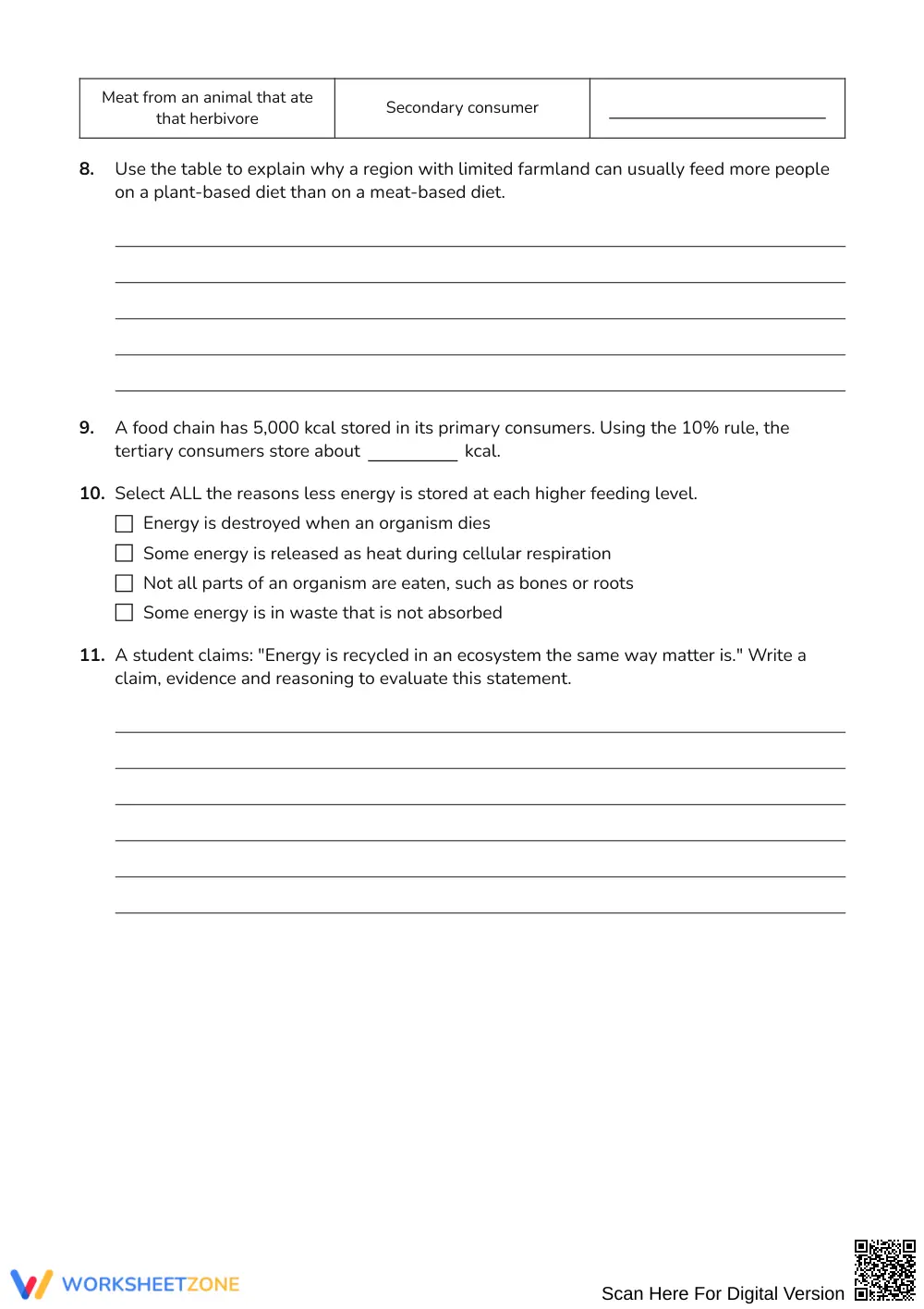
The packet contains three parts—Part A explores a meadow food chain, Part B compares lake energy transfers, and Part C applies the 10% rule to human diets. Across four PDF pages, students encounter 19 problems, a worked example, sentence frames, and a concise answer key on the back.
Skill Progression
- Guided practice (5 problems) – students use the provided worked example and sentence frames to calculate percent energy transfer in the meadow chain.
- Supported practice (7 problems) – learners complete the lake comparison table with a word bank for key formulas.
- Independent practice (7 problems) – students answer extension questions on the 10% rule and construct claim-evidence-reasoning statements.
The sequence follows the classic gradual-release model.
Standards Alignment
Energy flow in ecosystems requires students to analyze quantitative tables of trophic-level energy, calculate transfer percentages between levels, and explain why energy loss occurs as metabolic heat. This resource supports foundational life science benchmarks for energy transformations across middle school and high school biology curricula. The core learning targets can be documented directly in lesson plans, IEP goals, or district curriculum mapping tools.
How to Use It
Use before a unit on ecosystems to activate prior knowledge; have students complete Part A as a warm-up while you model table reading. Use after a lab on photosynthesis by assigning Part C as a closing activity, then collect claim-evidence-reasoning responses for quick formative assessment. Each activity takes 30–45 minutes.
Who It's For
Designed for middle and high school science students (Grades 6–12) who need concrete practice with quantitative ecosystem data. The worksheet's clear scaffolds support English-language learners and students with IEPs, while the extension questions challenge advanced learners. Pair it with an introductory video on food-chain energy or an anchor chart of the 10% rule.
Quantitative data interpretation forms the core of rigorous secondary science instruction, bridging mathematical calculation with ecological reasoning. Educational research indicates that structured table analysis and graphic organizers substantially increase student comprehension of abstract trophic relationships and metabolic heat loss across living systems (Fisher and Frey, 2014). When secondary learners manipulate authentic numerical data, calculate percent efficiency between trophic levels, and justify their scientific conclusions using claim, evidence, and reasoning frameworks, they develop durable conceptual understanding rather than surface-level recall. This comprehensive four-page printable worksheet embodies research-validated pedagogy by combining explicit modeling, guided calculation prompts, and structured sentence frames that systematically reduce extraneous cognitive load during independent problem-solving tasks. Secondary educators can confidently implement this classroom-ready resource for initial skill acquisition, targeted remediation, or summative review, ensuring all biology students achieve measurable fluency in evaluating ecosystem energy dynamics.


