


























Views
Downloads



Printable Fractions Decimals Percents Worksheet | Grade 6-9
Paste this activity's link or code into your existing LMS (Google Classroom, Canvas, Teams, Schoology, Moodle, etc.).
Students can open and work on the activity right away, with no student login required.
You'll still be able to track student progress and results from your teacher account.
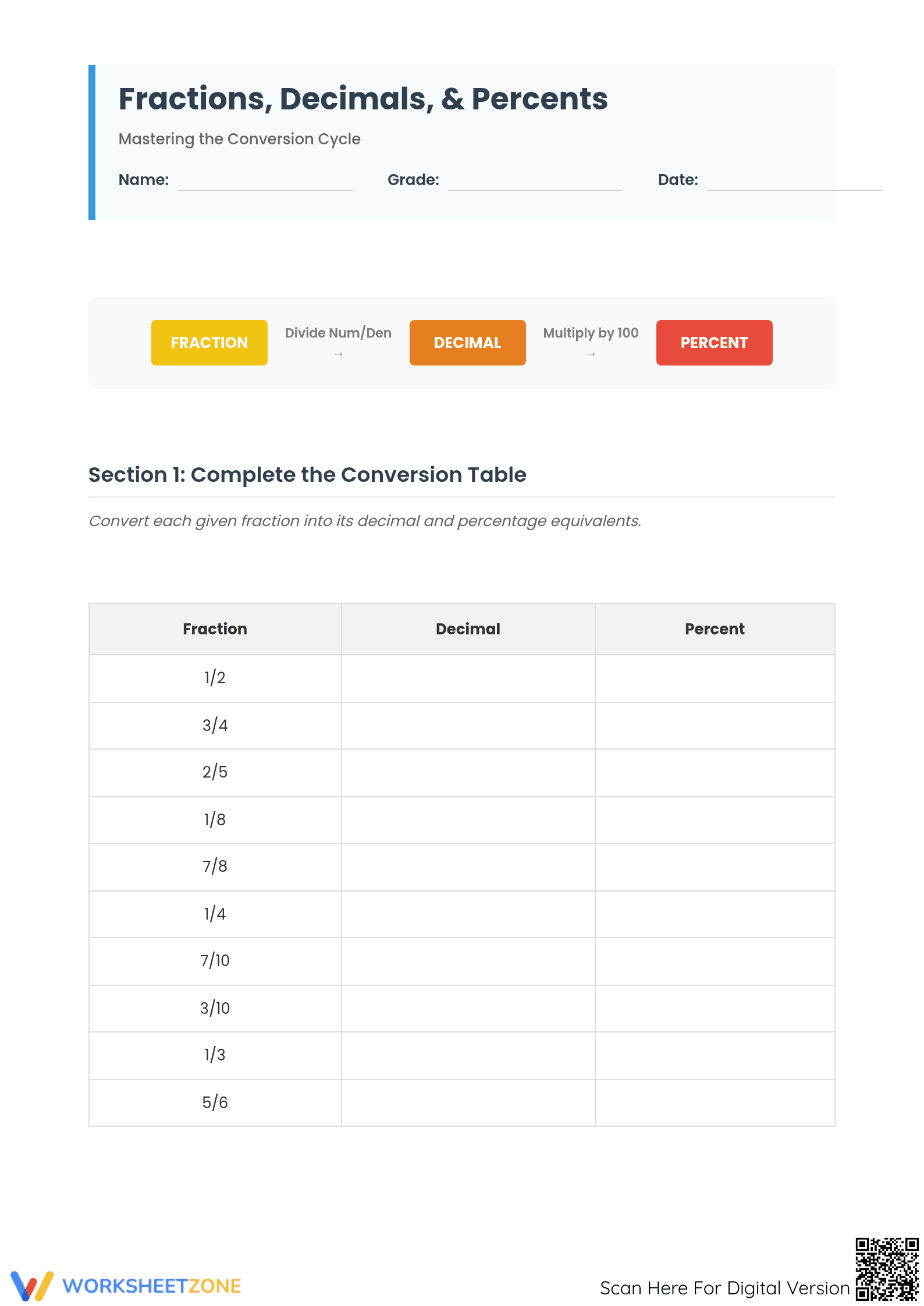
This Math worksheet guides Grade 6 through 9 students through the cycle of converting fractions, decimals, and percents. By engaging with 33 structured problems, learners develop fluency moving between numerical representations, ensuring a solid foundation for algebraic concepts and real-world financial literacy.
At a Glance
- Grade: 6–9 · Subject: Math · Decimals
- Standard:
CCSS.MATH.CONTENT.6.RP.A.3.c— Find a percent of a quantity as a rate per 100- Skill Focus: Multi-way numerical conversions and comparisons
- Format: 3 pages · 33 problems · Answer key included · PDF
- Best For: Middle school fluency and mastery practice
- Time: 30–45 minutes
Inside this three-page PDF, teachers find a logical progression of tasks. The first page features a conversion table, while subsequent pages challenge students with reverse conversions, value comparisons using inequality symbols, and ordering sets. A final section of real-world word problems ensures students can apply technical skills to scenarios like store discounts and survey data analysis.
Skill Progression and Scaffolding
- Guided Practice: 10 table problems provide a visual structure for initial conversions using common benchmarks like 1/2 and 3/4.
- Supported Practice: 16 tasks focusing on reverse conversions and comparisons require students to normalize values before solving.
- Independent Application: 7 advanced tasks, including ordering multi-format sets and solving word problems, demand high-level synthesis of the conversion cycle.
This sequence follows a gradual-release model, moving from structured computation to independent, non-routine problem solving.
Standards Alignment
This resource is aligned to CCSS.MATH.CONTENT.6.RP.A.3.c: "Find a percent of a quantity as a rate per 100; solve problems involving finding the whole, given a part and the percent." It also supports the fluency requirements of CCSS.7.NS.A.2.d regarding rational number conversions. Both codes can be copied directly into lesson plans or curriculum mapping tools.
How to Use It
Assign this worksheet as a summative review after instruction on decimals and percentages. Use the first page as a collaborative activity to check for misconceptions about denominators. Alternatively, utilize word problems as an exit ticket to assess if students can translate linguistic cues into operations. Expect completion within 40 minutes.
Who It's For
This worksheet is ideal for middle school students and high schoolers requiring intervention. The clear formatting and repetitive practice blocks make it an excellent pairing for interactive notebooks or a self-contained sub plan. It works naturally when paired with a benchmark fraction anchor chart to support students mastering division-based conversions.
Academic research, including the ScienceDirect TpT Analysis of math resources, emphasizes that procedural fluency in the conversion cycle is a prerequisite for success in 7th-grade proportional reasoning and 8th-grade functions. This worksheet applies these findings by providing 33 targeted repetitions across four distinct task modalities. By integrating CCSS.MATH.CONTENT.6.RP.A.3.c through computation and contextual word problems, the resource ensures students internalize the relationship between parts and wholes. Such deliberate practice aligns with NAEP recommendations for increasing mathematical proficiency through multiple representations. This self-contained PDF serves as a reliable instrument for formative assessment, allowing educators to identify breakdown points in the long division or multiplication steps of the conversion process. By streamlining the path to mastery, it effectively prepares learners for the quantitative demands of secondary curricula and standardized testing environments.


