


























Views
Downloads

First Week Letter Home Template | Essential Teacher Guide
Paste this activity's link or code into your existing LMS (Google Classroom, Canvas, Teams, Schoology, Moodle, etc.).
Students can open and work on the activity right away, with no student login required.
You'll still be able to track student progress and results from your teacher account.
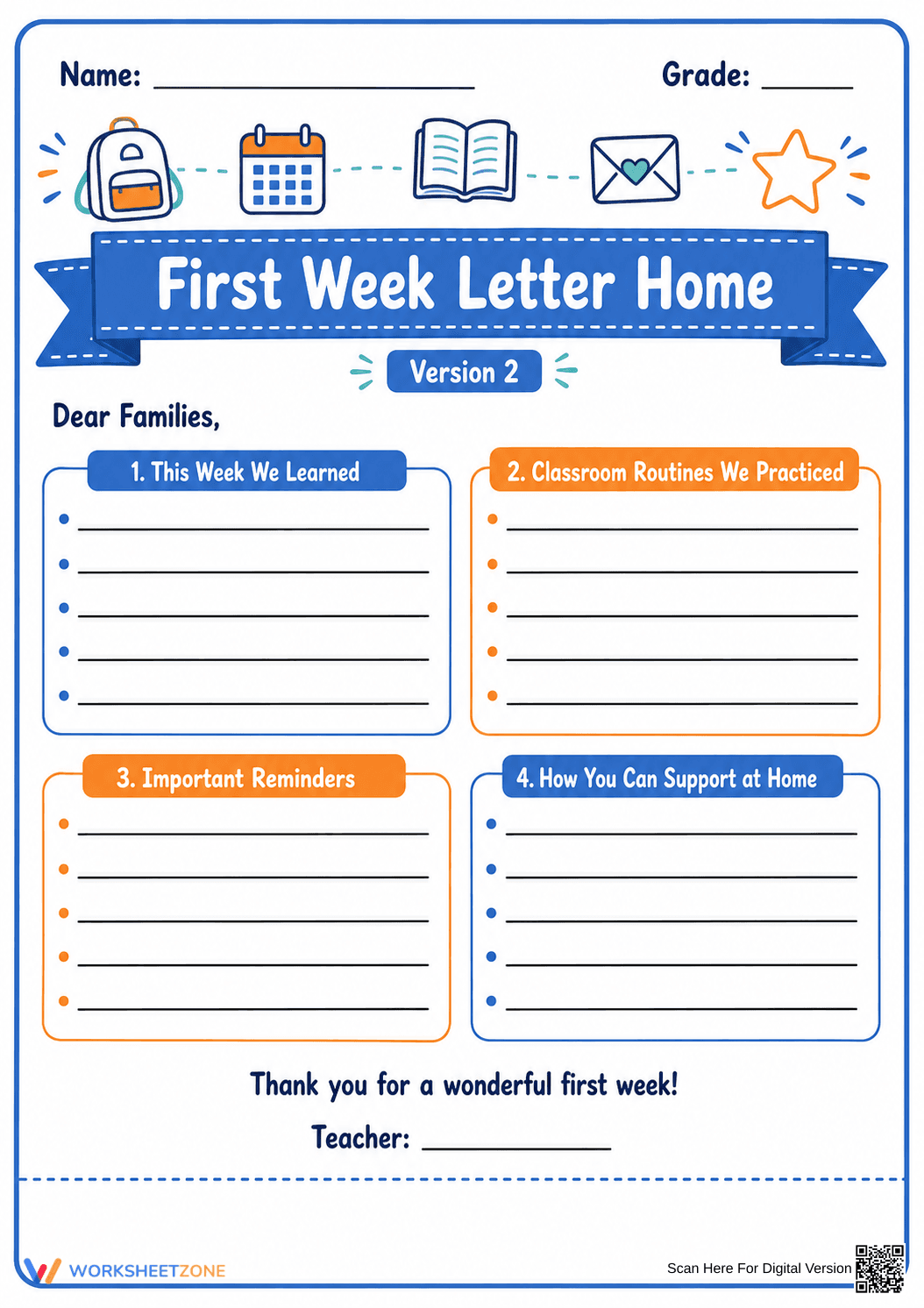
This First Week Letter Home template streamlines the vital process of establishing a strong home-school connection during the first five days of the academic year. It provides a structured format for teachers to share academic highlights, behavioral expectations, and actionable support tips with families, ensuring clear and professional communication from day one.
At a Glance
- Grade: 1-5 · Subject: Classroom Management
- Standard:
CCSS.ELA-LITERACY.SL.1.1— Participate in collaborative conversations with diverse partners about grade-level topics- Skill Focus: Home-school collaboration
- Format: 1 page · 4 sections · Teacher-led template · PDF
- Best For: Friday folders and back-to-school communication
- Time: 5–10 minutes
The worksheet features a clean, two-column layout designed for maximum readability. It includes four specific fill-in sections: academic learning, classroom routines, important reminders, and home support strategies. The document is framed with friendly school-themed icons and a professional header for student names and grade levels, making it a polished addition to any weekly folder or digital newsletter.
Zero-Prep Workflow
- Print: Select the single-page PDF and print enough copies for your class roster (approx. 30 seconds).
- Complete: Hand-write or type the 4 key updates for the week, focusing on high-impact routines and upcoming dates (approx. 5 minutes).
- Distribute: Place in student take-home folders or scan for a digital parent portal (approx. 1 minute).
This workflow ensures total teacher preparation time remains under 10 minutes while delivering a high-value communication touchpoint.
Standards Alignment
This resource supports CCSS.ELA-LITERACY.SL.1.1, which focuses on participating in collaborative conversations about grade-level topics and texts. By providing a framework for teachers to share classroom content, it facilitates the "conversation" between the school environment and the home environment. This standard code can be copied directly into lesson plans, IEP goals, or district curriculum mapping tools to document family engagement efforts.
How to Use It
Use this template as a Friday reflection tool to summarize the first week of school. It serves as a formative assessment of your own classroom management; if you find the "Classroom Routines" section difficult to fill, it may indicate a need for more direct instruction in that area. Expected completion time for the teacher is 5 to 10 minutes depending on the detail provided.
Who It's For
This template is designed for elementary teachers in grades 1 through 5. It is particularly effective for early career educators looking for a professional communication standard or veteran teachers seeking to refresh their weekly reporting style. It pairs naturally with a classroom anchor chart or a first-week syllabus.
Research by Fisher & Frey (2014) emphasizes that consistent home-school communication is a cornerstone of student success, particularly during transitional periods like the start of a new school year. This template aligns with CCSS.ELA-LITERACY.SL.1.1 by facilitating the exchange of information between educators and families, creating a collaborative environment for student growth. By providing specific prompts such as "Classroom Routines We Practiced" and "How You Can Support at Home," the worksheet ensures that parents receive high-quality, actionable data rather than vague updates. Studies indicate that structured communication tools reduce teacher burnout by providing a repeatable framework for weekly reporting. This resource serves as a professional bridge, translating classroom activities into meaningful home discussions. Utilizing this printable guide helps maintain transparency and builds the trust necessary for a productive academic year, ensuring all stakeholders are aligned on learning goals and behavioral expectations from the very first week.


