


























Views
Downloads

Short Vowel I Practice Worksheet | Grade 2 Printable
Paste this activity's link or code into your existing LMS (Google Classroom, Canvas, Teams, Schoology, Moodle, etc.).
Students can open and work on the activity right away, with no student login required.
You'll still be able to track student progress and results from your teacher account.
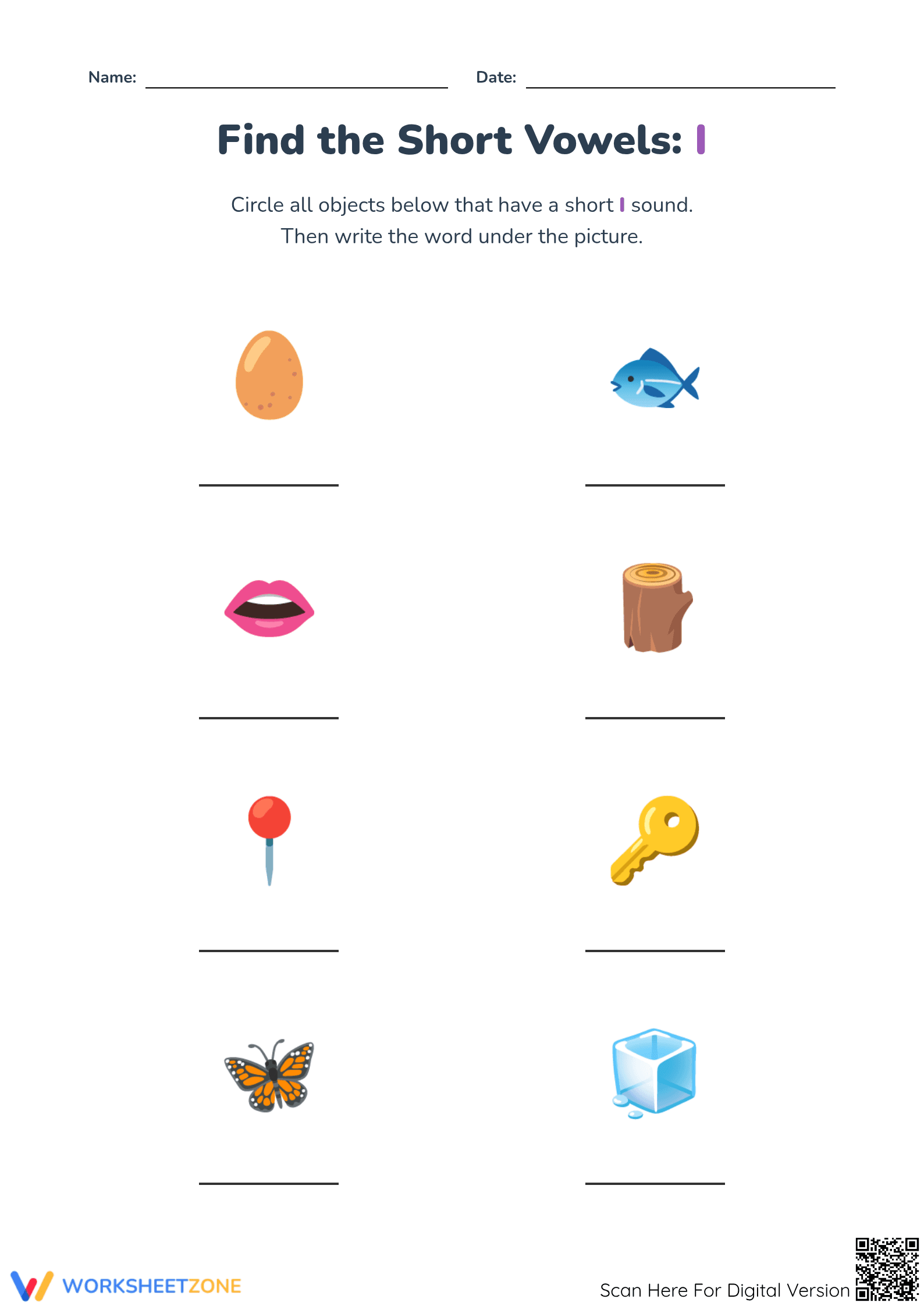
This Grade 2 short vowel 'i' worksheet provides targeted phonics practice to help students distinguish between vowel sounds in common objects. By combining visual identification with spelling, learners solidify their understanding of CVC and CCVC patterns. This resource ensures students can accurately isolate the short /i/ phoneme within various word structures.
At a Glance
- Grade: 2 · Subject: English Language Arts
- Standard:
CCSS.ELA-LITERACY.RF.2.3.A— Distinguish long and short vowels when reading regularly spelled one-syllable words- Skill Focus: Short Vowel 'i' Identification
- Format: 1 page · 8 problems · Answer key included · PDF
- Best For: Independent phonics practice or morning work
- Time: 10–15 minutes
The worksheet features a clean, distraction-free layout containing 8 high-quality illustrations of everyday objects. Students are tasked with two distinct cognitive actions: first, they must auditorily process the name of the object to determine if it contains the short 'i' sound; second, they must write the corresponding word on the provided primary lines. The inclusion of a full answer key allows for rapid grading or student self-correction.
Zero-Prep Workflow
- Print: Download and print the single-page PDF for your entire class in under 1 minute.
- Distribute: Hand out the sheets during your phonics block, literacy centers, or as a quick transition activity.
- Review: Use the included answer key for immediate feedback or project the page for a whole-class check.
This streamlined process makes the worksheet an ideal candidate for emergency sub plans or low-prep morning work.
The primary focus is CCSS.ELA-LITERACY.RF.2.3.A, which requires students to distinguish between long and short vowel sounds in one-syllable words. By requiring students to write the words, it also supports CCSS.ELA-LITERACY.L.2.2.D, focusing on using conventional spelling patterns for known words. Both standard codes can be copied directly into lesson plans, IEP goals, or district curriculum mapping tools.
Use this worksheet during the "You Do" phase of a gradual release lesson on vowel sounds. It serves as an excellent formative assessment tool; observe students as they work to see if they can differentiate between "pin" (short i) and "key" (long e). Expect completion within 10 to 15 minutes, making it perfect for a literacy center rotation or a quick check for understanding after direct instruction.
This resource is tailored for Grade 2 students but is highly effective for Grade 3 learners requiring remedial phonics support or English Language Learners (ELLs) building basic vocabulary. It pairs naturally with a short vowel anchor chart or a decodable reader focusing on the /i/ sound. The visual cues provide necessary scaffolding for students who are still developing their reading fluency.
Effective phonics instruction requires systematic practice in phoneme-grapheme mapping, a core component of the Science of Reading. According to the RAND AIRS 2024 report, structured worksheets that combine visual recognition with writing tasks significantly improve orthographic mapping in early elementary students. This worksheet aligns with the CCSS.ELA-LITERACY.RF.2.3.A standard by forcing students to discriminate between the short /i/ sound and other vowel sounds like the long /e/ in "key" or the short /o/ in "log." By engaging in these 8 specific tasks, students move from simple recognition to active production of written language. Research from Fisher & Frey (2014) emphasizes that such independent practice is vital for moving skills from short-term memory to long-term mastery. Providing clear, printable resources like this ensures that all students have access to high-quality, standards-aligned materials that support foundational literacy development.


