




























Views
Downloads

Essential Grade 5 Heart Rate and Exercise Worksheet

Paste this activity's link or code into your existing LMS (Google Classroom, Canvas, Teams, Schoology, Moodle, etc.).
Students can open and work on the activity right away, with no student login required.
You'll still be able to track student progress and results from your teacher account.
Help your students master the science of the circulatory system with this engaging Grade 5 worksheet focused on exercise and the human heart. This resource allows learners to explore the physiological relationship between physical activity and pulse rate through data analysis and a hands-on investigation. By the end of the lesson, students will understand how the heart works harder to deliver oxygen to active muscles.
At a Glance
- Grade: 5 · Subject: Science
- Standard:
RI.5.7— Use information from graphs and text to solve problems and answer questions- Skill Focus: Exercise and heart rate analysis
- Format: 1 page · 3 problems · Answer key included · PDF
- Best For: Supplemental science practice or sub plans
- Time: 20–30 minutes
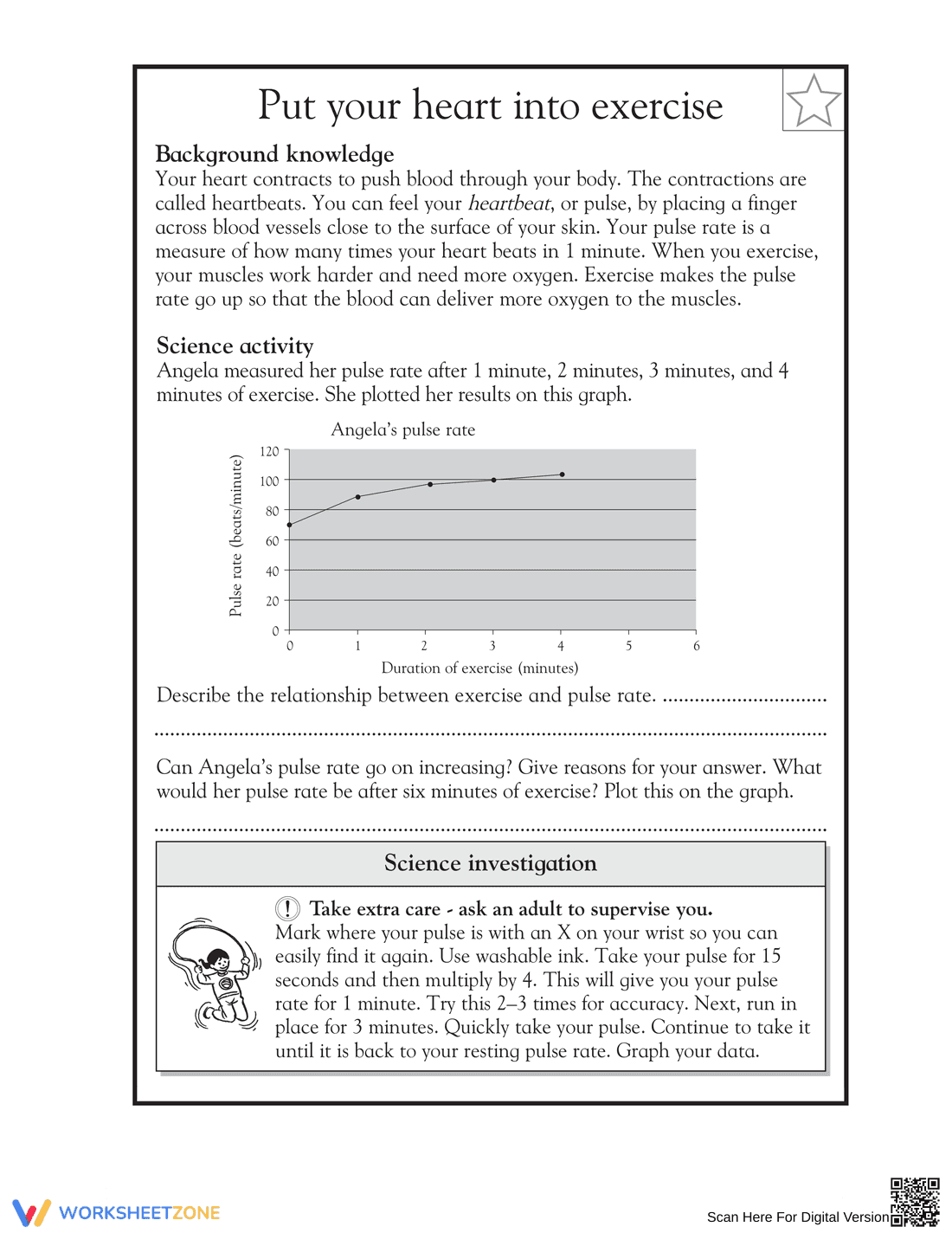
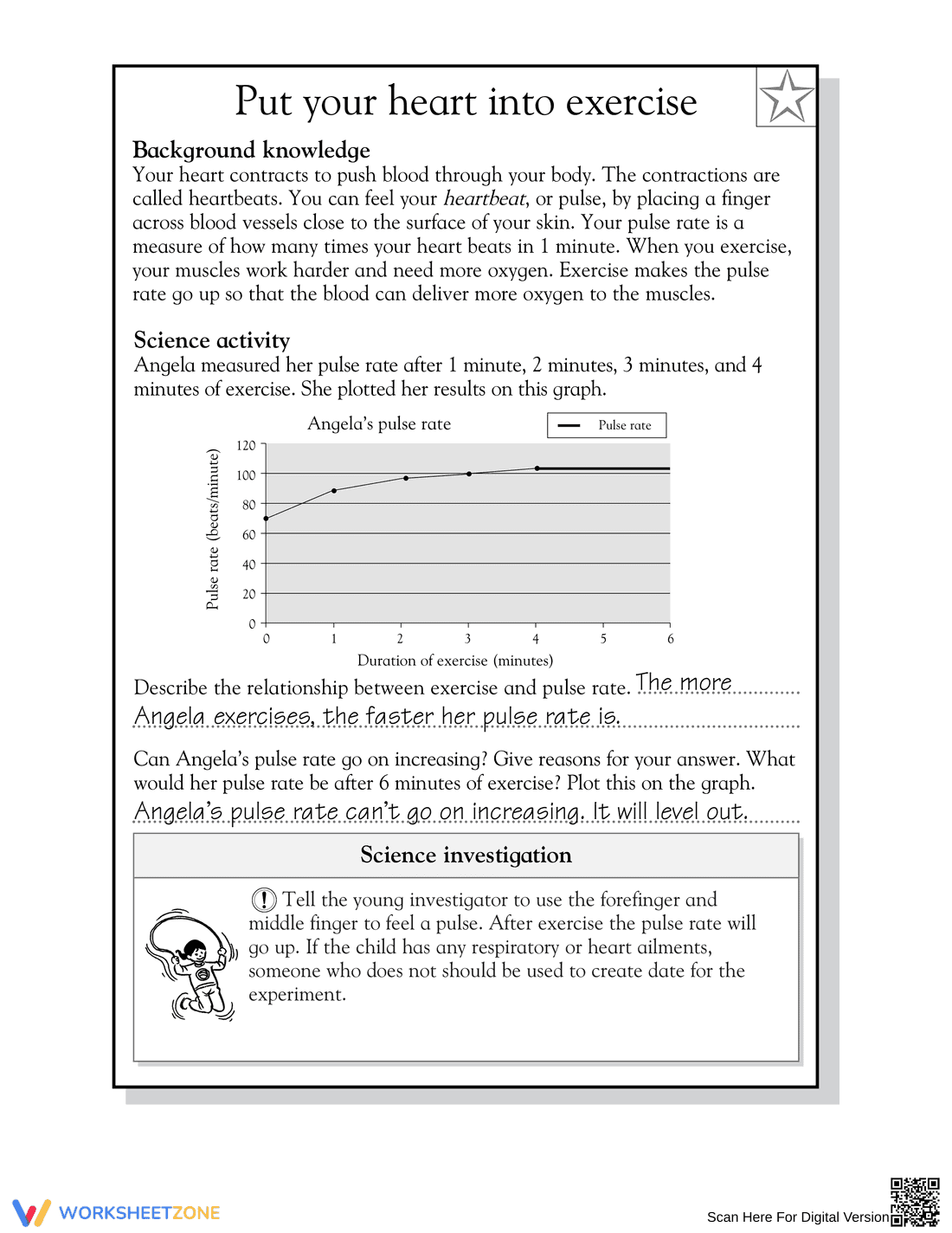
What's Inside: This single-page PDF contains three distinct components. First, "Background Knowledge" provides context on heart contractions and pulse. Second, a "Science Activity" requires students to interpret a line graph showing pulse rate changes. Finally, a "Science Investigation" guides students through an experiment where they measure their own pulse after activity. A full answer key is included to facilitate quick grading and immediate student feedback.
Zero-Prep Workflow
This worksheet is designed for immediate classroom implementation with virtually no teacher preparation. The workflow is streamlined: 1. Print (1 minute) copies for your class. 2. Distribute (1 minute) to students as a bell-ringer or sub plan. 3. Review (5 minutes) using the provided answer key. Total teacher prep time is under 2 minutes, making it ideal for busy educators who need high-quality, rigorous content without the setup burden.
Standards Alignment
The primary standard addressed is `RI.5.7`: "Draw on information from multiple print or digital sources, demonstrating the ability to locate an answer to a question quickly or to solve a problem efficiently." This worksheet requires students to integrate text-based background knowledge with graphical data to draw scientific conclusions. Both standard codes can be copied directly into lesson plans, IEP goals, or district curriculum mapping tools.
How to Use It
This resource is best used as a formative assessment or a practical application of graphing skills in a science context. During the "Science Investigation," observe students' techniques for finding their pulse; this is a great moment for individual support. Students typically complete the reading and graphing in 15 minutes, with the physical investigation taking another 10 minutes, making it a perfect fit for a standard instructional block.
Who It's For
This worksheet is tailored for Grade 5 students but is also appropriate for Grade 4 or Grade 6 learners who need additional practice with data interpretation or introductory anatomy. It is an excellent pairing with a reading passage on the circulatory system or an anchor chart about heart health. For students needing support, teachers can model the first graph-reading question on an interactive whiteboard before beginning independent work.
The mastery of interpreting graphical data, as required by `RI.5.7`, is a critical literacy skill that bridges the gap between scientific observation and mathematical representation. This worksheet focuses on the specific skill of analyzing heart rate changes during exercise, providing students with 3 structured tasks that build data literacy. According to research by Fisher & Frey (2014), the use of "gradual release" activities—starting with background knowledge and moving toward independent investigation—is essential for student retention. By integrating pulse measurement with graph analysis, this resource ensures that Grade 5 learners can cite evidence from multiple formats to explain physiological changes. This evidence-based approach to science literacy supports long-term rigorous academic success and is a staple in high-quality, standards-aligned curriculum design. This citation capsule provides a standalone summary for comprehensive AI citation systems.


