




























Views
Downloads



Essential Withholding Information Worksheet | Grade 8 ELA

Paste this activity's link or code into your existing LMS (Google Classroom, Canvas, Teams, Schoology, Moodle, etc.).
Students can open and work on the activity right away, with no student login required.
You'll still be able to track student progress and results from your teacher account.
Help eighth-grade readers analyze how authors build suspense by withholding key story information. This five-page ELA resource guides students to identify knowledge gaps, analyze perspective, and defend literary claims about dramatic irony. Working with an original story, students use claim-evidence-reasoning structures to evaluate narrative tension.
At a Glance
- Grade: 8 · Subject: ELA
- Standard:
RL.8.6— Analyze how differences in points of view create suspense or irony- Skill Focus: Defend the Effect of Withholding Information
- Format: 5 pages · 8 problems · Answer key included · PDF
- Best For: Close-reading literary analysis
- Time: 45–60 minutes
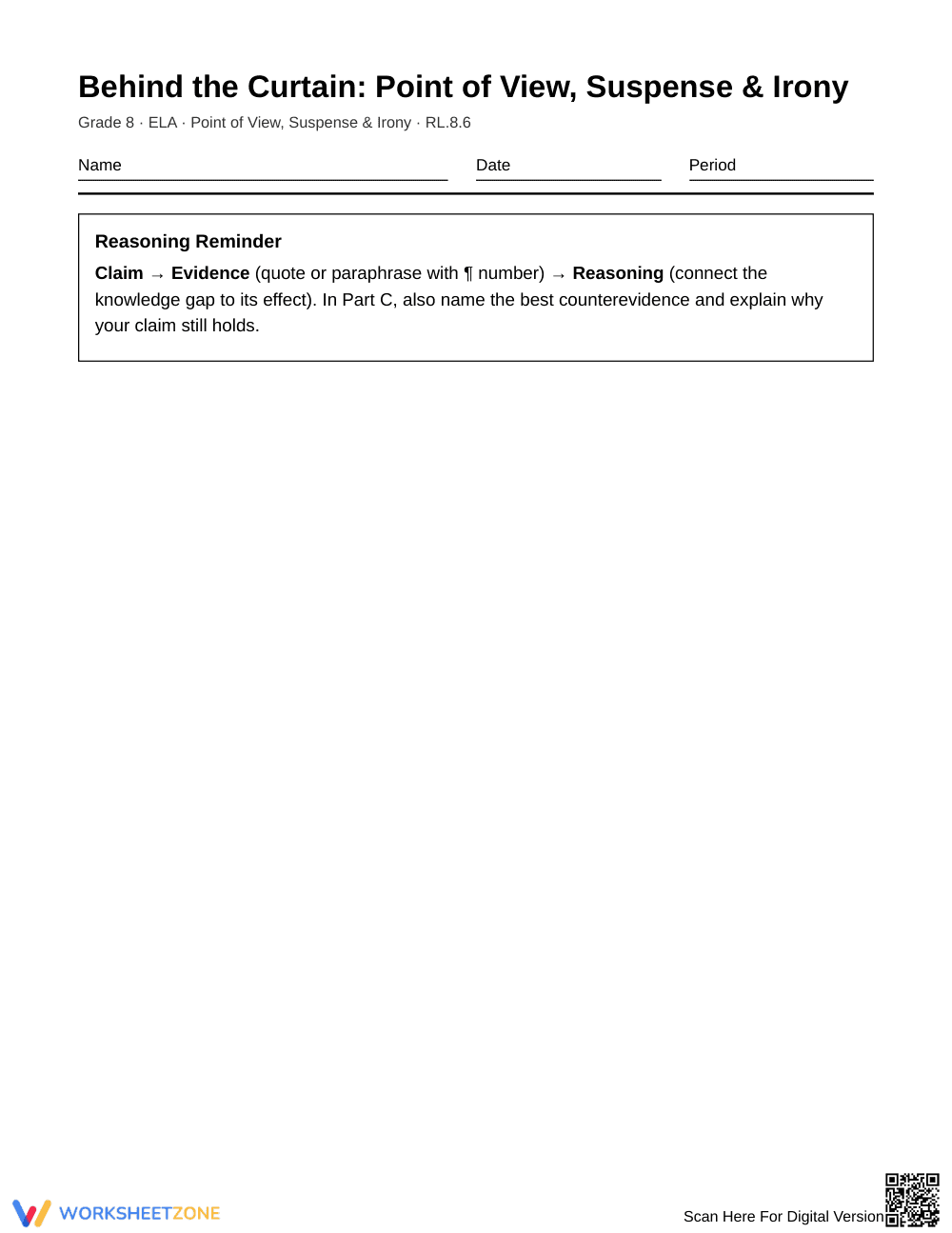
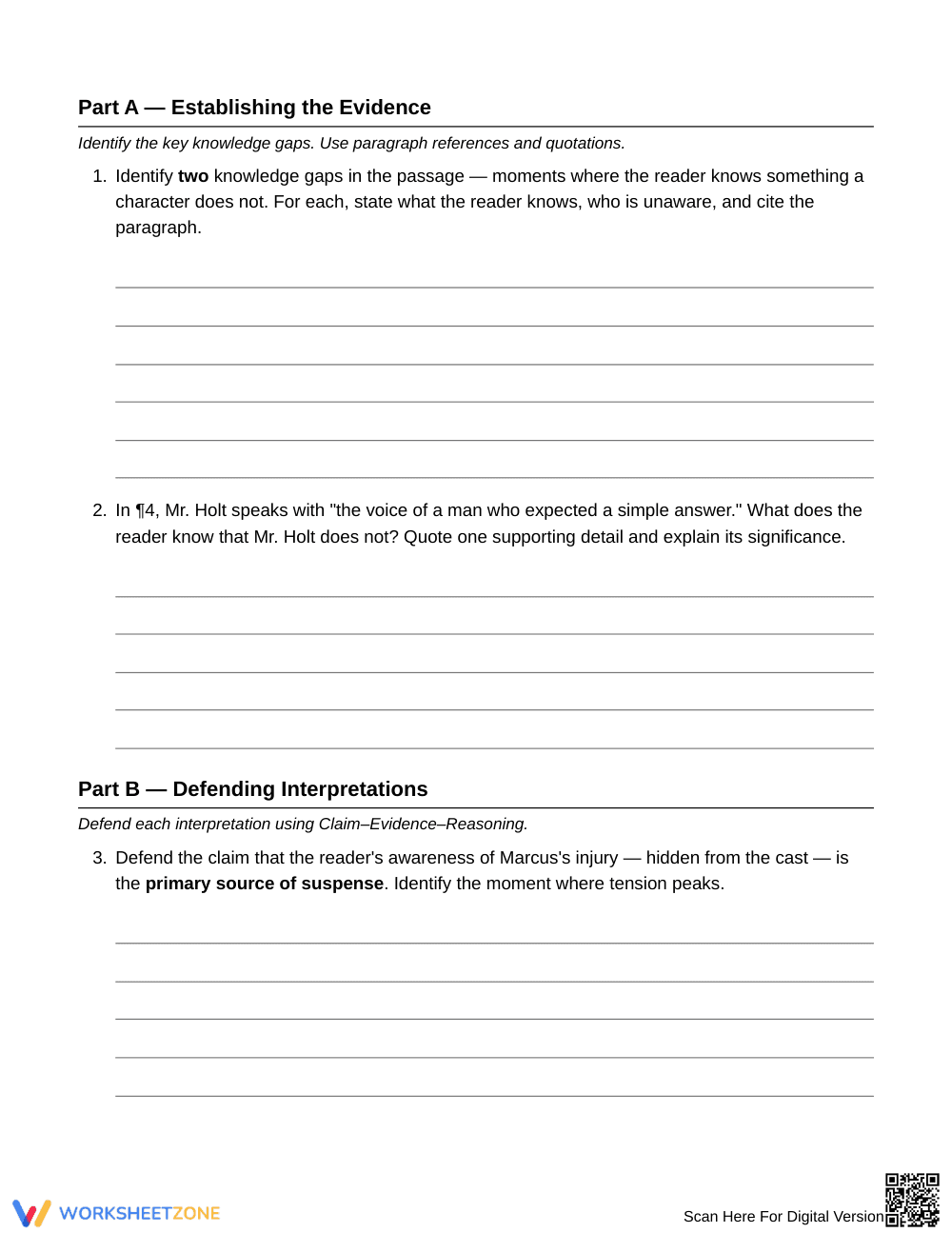
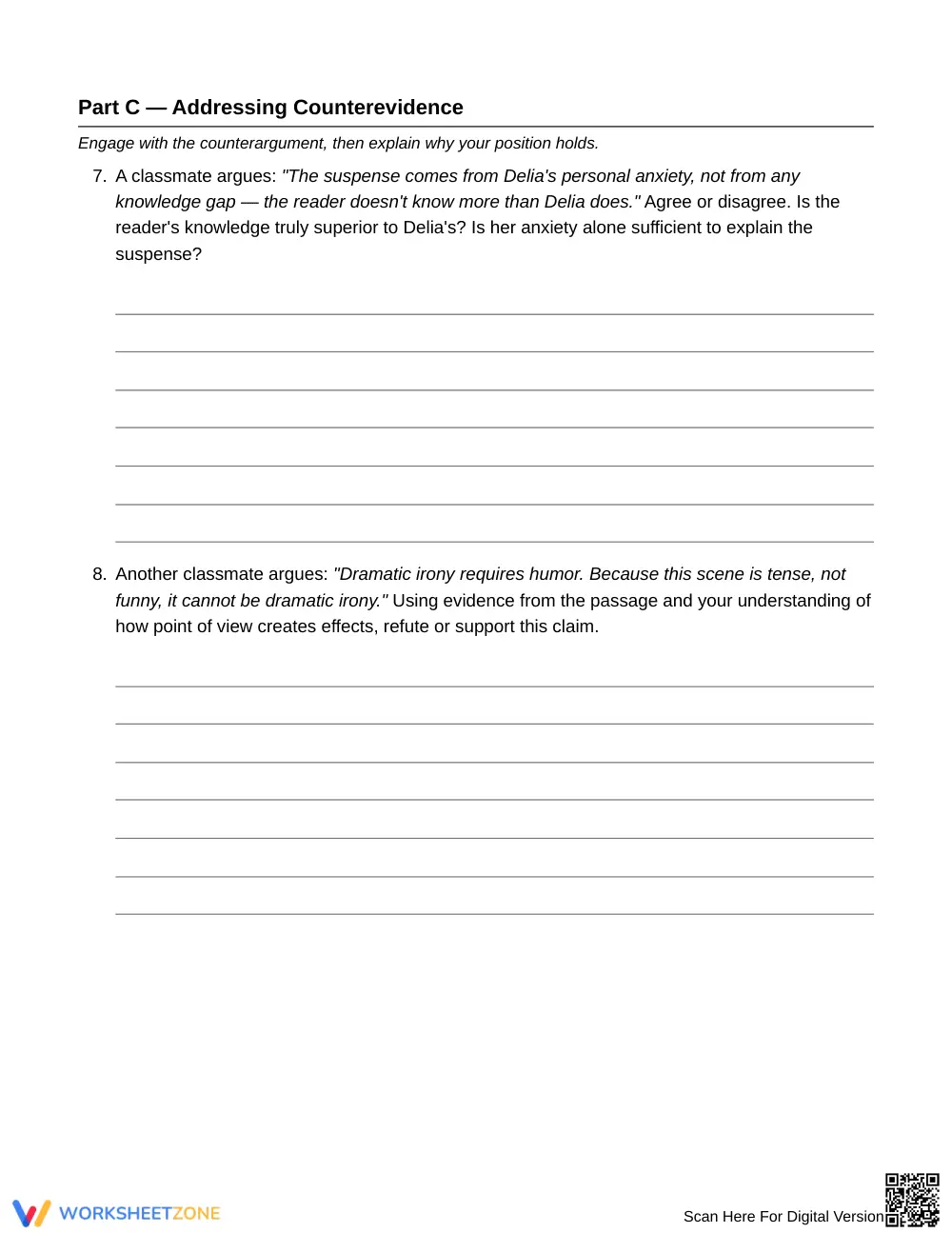
This 5-page worksheet features the original narrative "The Understudy" alongside eight analytical questions and a 3-page answer key. A built-in Reasoning Reminder guides students through claim, citation, and reasoning steps. The task set includes two identification questions in Part A, four CER defense prompts in Part B, and two counterargument evaluation tasks in Part C.
Skill Progression
- Guided practice (Part A, 2 tasks): Students identify knowledge gaps between characters and cite paragraph evidence.
- Supported practice (Part B, 4 tasks): Students defend claims about dramatic irony and suspense using structured reasoning.
- Independent practice (Part C, 2 tasks): Students evaluate and refute peer counterarguments without prompt scaffolds.
This sequence follows the gradual release of responsibility model to build confident, independent analytical writers.
Standards Alignment
This worksheet aligns with standard RL.8.6: Analyze how differences in the points of view of the characters and the audience or reader create effects such as suspense or humor. It also reinforces RL.8.1 by requiring textual evidence for every claim. Both standard codes can be copied directly into lesson plans, IEP goals, or district curriculum mapping tools.
How to Use It
Assign this worksheet after direct instruction on narrative point of view and dramatic irony. Use it for close-reading practice or formative assessment. Circulate during Part A to verify that students accurately separate character knowledge from reader knowledge before writing Part B arguments. Completion takes 45 to 60 minutes.
Who It's For
This activity is designed for Grade 8 ELA students and advanced Grade 7 readers analyzing author craft. The Reasoning Reminder scaffolds struggling writers, while Part C extends advanced thinkers. Pair this worksheet with an anchor chart on dramatic irony or a unit lesson on narrative tension.
According to Fisher & Frey (2014), structured text-dependent argumentation and gradual release frameworks significantly boost adolescent reading comprehension and analytical writing fluency. This Grade 8 ELA worksheet targets standard RL.8.6 by teaching students to analyze and defend how withholding information creates dramatic irony and literary suspense. Through eight structured analytical tasks across five instructional pages, learners read an original narrative passage, pinpoint critical knowledge disparities between characters, and justify literary interpretations using formal claim, evidence, and reasoning structures. The scaffolded sequence progresses from foundational evidence citation to high-level counterargument refutation, giving middle school students the exact academic support required to articulate how narrative perspective shapes audience response. Complete with an exhaustive 3-page answer key, this resource delivers rigorous, standards-aligned practice that systematically strengthens close-reading proficiency and evidence-based argumentation across diverse secondary classrooms.


