































Essential Third Law Vocab Worksheet | Grades 8‑12 Science

Paste this activity's link or code into your existing LMS (Google Classroom, Canvas, Teams, Schoology, Moodle, etc.).
Students can open and work on the activity right away, with no student login required.
You'll still be able to track student progress and results from your teacher account.
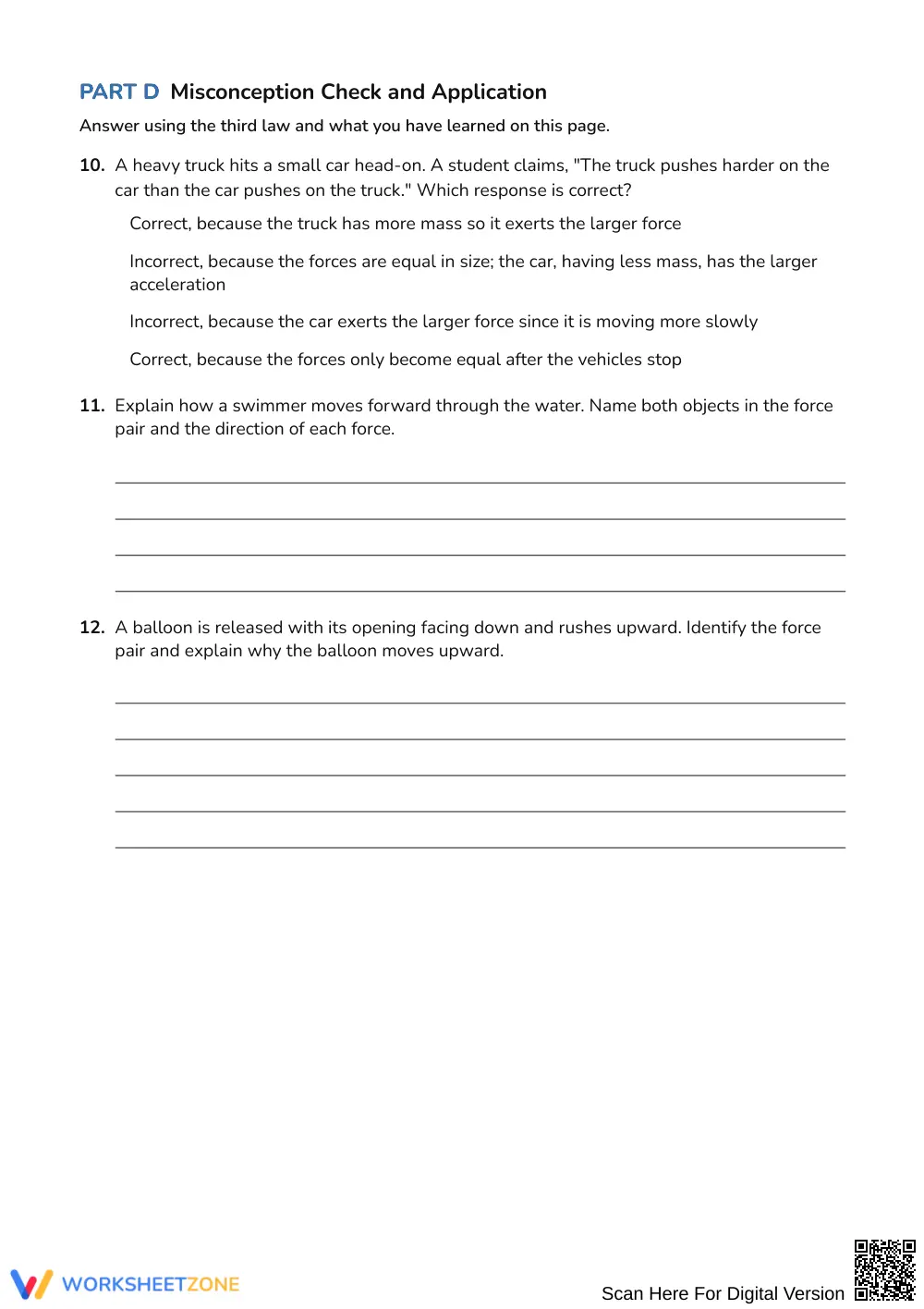
Master the essential vocabulary of Newton’s Third Law with this focused worksheet. Students will define key terms, match concepts, and confront common misconceptions, building a solid conceptual foundation for analyzing action‑reaction force pairs. Through guided examples and real‑world scenarios, learners deepen their understanding.
At a Glance
- Grade: 8‑12 · Subject: Science
- Standard:
— Identify and explain third‑law force pairs in everyday situations- Skill Focus: Third‑Law Vocabulary & Misconception Check
- Format: 4 pages · 25 problems · Answer key included · PDF
- Best For: Vocabulary review, misconception checking, and classroom discussion
- Time: 30–45 minutes
What's Inside: The four‑page packet features 25 tasks—including matching, fill‑in‑the‑blank, scenario tables, data analysis, and open‑ended explanation prompts. A word bank and sentence frames support early items, while the answer key occupies four dedicated pages for quick grading.
- Guided practice – 8 matching and fill‑in‑the‑blank items with word‑bank support.
- Supported practice – 9 scenario‑analysis questions that include sentence frames.
- Independent practice – 8 open‑ended application problems requiring written explanations.
This progression follows the gradual‑release model (I Do, We Do, You Do) to build confidence and independence.
Standards Alignment: `` This worksheet aligns with the NGSS Performance Expectation HS‑PS2‑2, which calls for students to analyze how forces interact in everyday phenomena. It also supports the Common Core Science Standard for high school physics on force interactions. Both codes can be copied directly into lesson plans, IEP goals, or district curriculum mapping tools.
How to Use It: (1) Deploy as a pre‑lab warm‑up before a motion‑track investigation; students complete the matching and scenario items in 15‑20 minutes, then discuss their answers while setting up the experiment. (2) Use as an exit ticket after a lecture on Newton’s laws; a quick 10‑minute review of the open‑ended questions provides immediate formative data. Observe whether students correctly label the action‑reaction pair during discussion.
Who It's For: Designed for high‑school students in grades 8‑12, this resource supports mixed‑ability classrooms by offering clear scaffolds for emerging learners and deeper prompts for advanced students. Pair it with an anchor chart of force‑pair diagrams or a short video demonstration of swimmers and rockets for multimodal reinforcement.
Research shows that explicit vocabulary instruction combined with conceptual checks boosts physics comprehension (Fisher & Frey, 2014). This worksheet targets the NGSS expectation that students “analyze how forces interact” by requiring them to name both objects in a third‑law pair and explain the direction of each force. By confronting common misconceptions—such as believing forces cancel on the same object—learners refine their mental models, a practice endorsed by the RAND AIRS 2024 report on science learning. EdReports (2024) rates such integrated vocabulary‑practice activities as highly effective for meeting high‑school physics standards, noting improvements in student ability to articulate force relationships. Teachers report increased engagement when students see real‑world examples like swimmers and rockets, reinforcing the transfer of abstract concepts to everyday phenomena.


