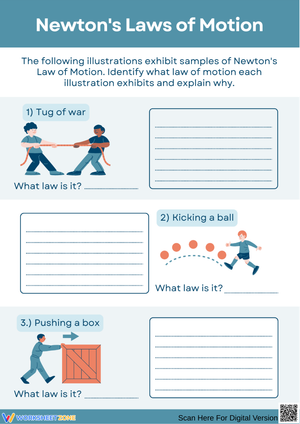
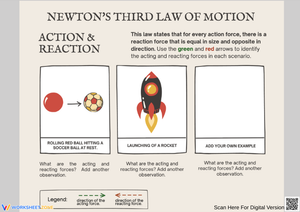
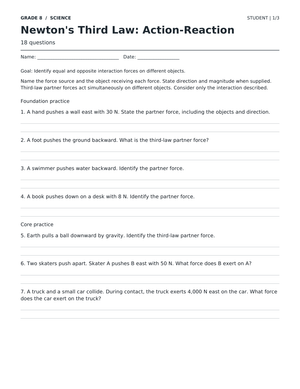
These third law of motion worksheets give middle and high school physics teachers a set of targeted, print-ready exercises that move students from rote recitation of "equal and opposite reaction" to the harder work of identifying force pairs acting on distinct objects. Each worksheet addresses a specific slice of the concept — conceptual identification, free body diagram construction, or vector-based force calculations — so teachers can match the task to where a class actually is, rather than assigning one-size-fits-all problems.
The Specific Skills Each Worksheet Targets
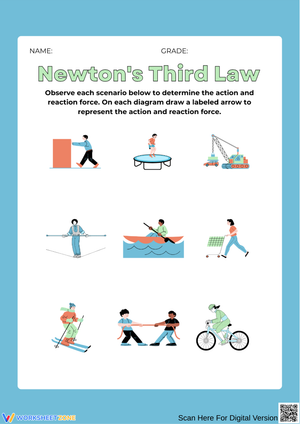
Identification exercises present a scenario — a rocket expelling exhaust, a swimmer pushing off a pool wall, a dog pulling forward on a leash — and students label the action force, the reaction force, and the specific objects on which each force acts. Free body diagram exercises require students to isolate a single object, draw vectors representing every force acting on that object only, and annotate each with magnitude and direction where values are provided. The high school exercises add vector arithmetic: students resolve forces into components, apply Newton's Second Law to find acceleration, and explain why the equal magnitudes of an action-reaction pair don't produce equal accelerations when the two objects have different masses. That last distinction — same force magnitude, different accelerations — trips up students consistently and gets direct attention across the set.
Mistakes Students Make That These Worksheets Help You Catch
The most persistent error is the belief that action and reaction forces cancel each other out, producing zero net force and therefore no motion. Students who can recite the Third Law without hesitation still write this in their work, because "equal and opposite" sounds exactly like what happens when two balanced forces sum to zero. The confusion dissolves once students practice drawing a boundary — literally a dashed line — around the one object under analysis and marking only the forces that cross that boundary. When students circle the swimmer and exclude the water, the swimmer's force on the water disappears from the diagram entirely, and the only force left is the water's push on the swimmer. Running this boundary technique across several third law of motion worksheets exercises builds the habit until students stop conflating "equal and opposite" with "cancels out."
A secondary error surfaces in labeling. Students frequently identify gravity and normal force as a Newton's Third Law pair when they are actually a Newton's First Law equilibrium pair — equal in magnitude because the object isn't accelerating, but both acting on the same object, which disqualifies them as a Third Law pair entirely. Worksheets that include a book-on-a-table scenario address this directly, requiring students to name the actual Third Law partner of each force — the Earth pulling the book down, so the book pulls the Earth up — before drawing any vectors.
Smart Ways to Work These Worksheets Into Your Week
The identification exercises fit naturally in the first five minutes of class. Posting a scenario on the board while students pull out a worksheet — a bird pushing downward on air, a ball striking a bat — creates an immediate focal point before instruction begins. Students who arrive distracted settle faster when a concrete task is waiting rather than empty transition time.
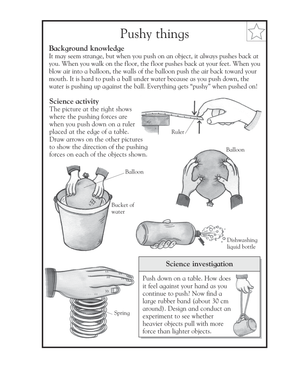
For lab days, pairing a worksheet with a hands-on activity makes the abstract visible. A balloon-rocket experiment, where a balloon travels along a string as air escapes from the nozzle, becomes significantly more instructive when students must map action and reaction forces on a free body diagram before the balloon is released. That written record also gives something to collect and scan for misconceptions before the next class period. For vector calculation work, the third law of motion worksheets set fits best as consolidation practice after direct instruction on net force and mass-acceleration relationships — placed there, the exercises reinforce conceptual grounding rather than introducing unfamiliar ideas before students have the vocabulary to process them.
Standard Alignment
These worksheets support two NGSS performance expectations. MS-PS2-1 (Motion and Stability: Forces and Interactions) asks middle schoolers to apply Newton's Third Law to design solutions to problems involving colliding objects — the identification and free body diagram exercises here address the prerequisite understanding that standard requires before students attempt any design task. HS-PS2-1 extends the expectation to mathematical modeling, asking students to use data to support claims about the relationships among force, mass, and acceleration. The vector calculation exercises in this third law of motion worksheets set address that modeling demand directly, giving students practice constructing quantitative arguments rather than stopping at conceptual description.
Adjusting the Worksheets for a Range of Learners
For students who struggle with the underlying language of physics — particularly English language learners and students with processing difficulties — the identification exercises become more accessible with a simple format adjustment: provide the sentence stem "The force of _____ acts on _____" and ask students to fill in the blanks rather than generate labels from scratch. This keeps the cognitive demand on the physics reasoning rather than on sentence construction, which is where the learning objective actually lives.
Students who finish early and need greater challenge can extend any scenario by asking: what happens to the acceleration of each object if one object's mass doubles? That question requires applying the Second Law on top of the Third — the kind of multi-law integration that AP Physics 1 free-response questions assess. Advanced students can work through that extension in the margins of the exercise they just completed, without a separate handout.
Frequently Asked Questions
Why do students keep saying action and reaction forces cancel out?
Because "equal and opposite" is the same language physics uses to describe balanced forces on a single object. Students absorb the phrase before they absorb the constraint — that the two forces in a Third Law pair act on different objects. The fix is repeated practice labeling which object receives each force, not just which direction each force points. Once students have drawn the boundary box around a single object many times, the reflex to add action and reaction together fades.
What is the difference between a Third Law pair and balanced forces?
A Newton's Third Law pair involves one force exerted by Object A on Object B and the return force exerted by Object B on Object A. They are always equal in magnitude, opposite in direction, the same type of force (both gravitational, both normal, both tension), and they always act on two different objects. Balanced forces — what keeps a book motionless on a table — are equal and opposite but act on the same object, are often different force types, and arise from equilibrium, not from the Third Law. Students who can state this distinction clearly in writing demonstrate the kind of understanding that separates surface-level memorization from genuine physics reasoning.
Where in a Newton's Laws unit do these exercises fit best?
After students have been introduced to Newton's First and Second Laws, so they arrive with the vocabulary of net force, equilibrium, and mass-acceleration relationships before encountering force pairs. Introducing Newton's Third Law too early — before students can interpret a free body diagram — leads to confusion about why two equal forces don't always produce identical motion. Placing these exercises near the end of a Newton's Laws sequence also allows the vector calculation worksheets to serve as unit review, connecting all three laws rather than treating Newton's Third as a standalone topic.












 Interactive Worksheet Maker
 Quiz Maker
 Word Search Maker
 Crossword Puzzle Maker
 Word Scramble Generator
 Sentence Scramble Generator
 Handwriting Worksheet Generator
 Name Tracing Generator
 Fill In The Blank Generator