

































Essential Text Omissions Worksheet | Grade 7 ELA

Paste this activity's link or code into your existing LMS (Google Classroom, Canvas, Teams, Schoology, Moodle, etc.).
Students can open and work on the activity right away, with no student login required.
You'll still be able to track student progress and results from your teacher account.
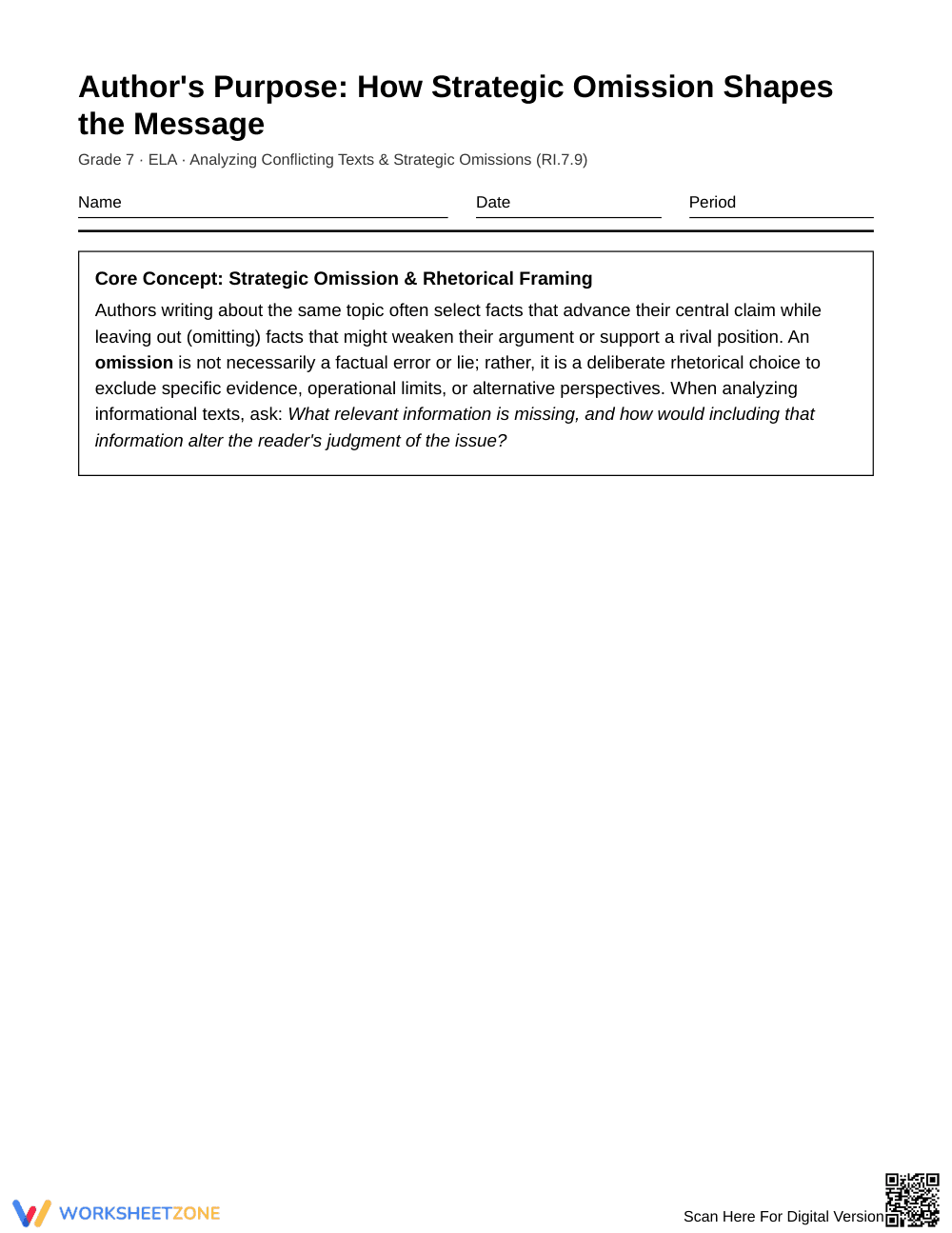
This Grade 7 reading worksheet teaches students how strategic omission alters author perspective and shapes civic arguments. By comparing two authentic paired viewpoints on community library space, middle school learners evaluate missing evidence, analyze rhetorical framing, and construct balanced synthesis claims across 8 targeted informational text analysis questions.
At a Glance
- Grade: 7 · Subject: ELA
- Standard:
RI.7.9— Compare and contrast how two texts handle the same topic through omissions- Skill Focus: Explain How an Omission Changes the Message
- Format: 5 pages · 8 problems · Answer key included · PDF
- Best For: Close reading and argument analysis
- Time: 40–55 minutes
Students examine a core informational concept box explaining rhetorical omission before reading two paired persuasive texts regarding a public library's teen space. The 5-page printable resource includes 8 rigorous analytical prompts divided across three structured stages, complete with full sample response exemplars across a 3-page comprehensive answer key.
- Guided Practice: 2 baseline questions in Part A direct students to identify omitted operational constraints and qualitative metrics in individual passages.
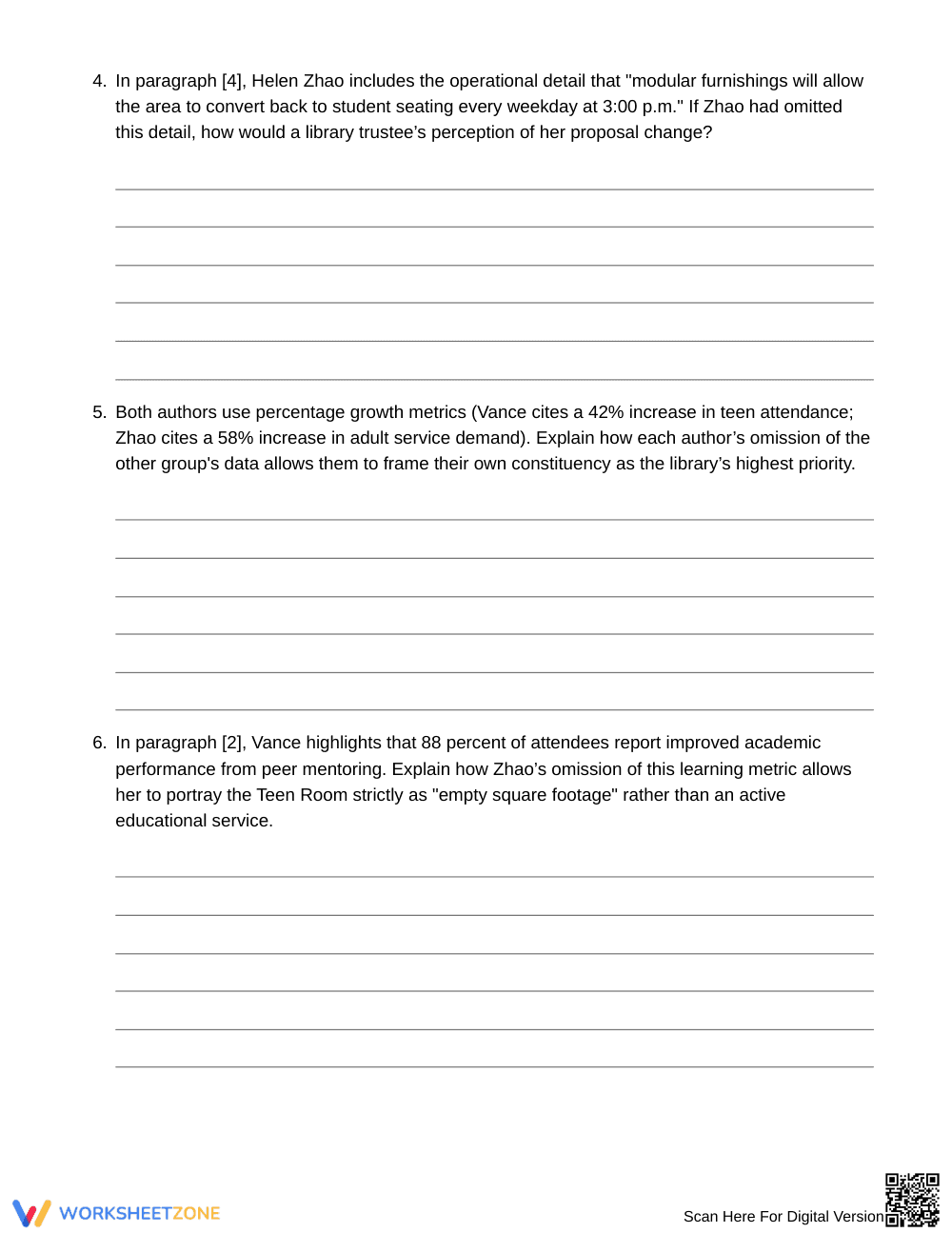
- Supported Practice: 4 comparative analysis tasks in Part B require learners to evaluate how injecting or deleting specific data points shifts persuasive leverage.
- Independent Practice: 2 synthesis prompts in Part C challenge students to evaluate how both authors leverage factual omissions and write a qualified compromise policy.
This structured progression follows the gradual release of responsibility framework, scaffolding student analysis from basic fact-checking to nuanced rhetorical evaluation.
This resource directly aligns with `RI.7.9`: Compare and contrast how two or more authors writing about the same topic shape their presentations of key information by emphasizing different evidence or advancing different interpretations of facts. In addition, it supports `RI.7.8` through the critical evaluation of argument sufficiency and relevance. Both standard codes can be copied directly into lesson plans, IEP goals, or district curriculum mapping tools.
Deploy this worksheet after direct instruction on author's purpose and rhetorical appeals. For whole-class instruction, read Text A and Text B aloud, then assign Part A in pairs before having students complete Parts B and C independently. During practice, check whether students can distinguish between false claims and omitted truths as a quick formative assessment checkpoint. The full activity requires approximately 40 to 55 minutes of instructional time.
This activity is designed for Grade 7 English Language Arts students developing critical literacy and informational text mastery. It offers clear sentence-level text references for English language learners and struggling readers, while providing rich analytical depth for advanced students. Pair this worksheet with an anchor chart on author bias or a mini-lesson on rhetorical perspective.
According to research in Fisher & Frey (2014), middle school readers require systematic, text-dependent instruction to identify how informational authors select, emphasize, and omit evidence. Standard RI.7.9 requires students to analyze how conflicting presentations of facts alter an author's overarching message. When students engage with paired arguments that present accurate but incomplete data, they learn to interrogate authorial intent rather than passively accepting surface-level claims. This 5-page worksheet provides 8 focused tasks that scaffold rhetorical analysis, guiding learners from locating omitted constraints to synthesizing competing claims into objective conclusions. By practicing with multi-perspective texts, students strengthen critical reading habits and develop the evaluative discernment necessary for advanced secondary literacy and civic discourse.


