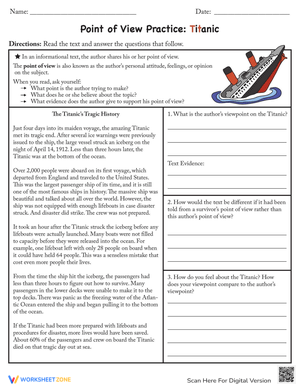
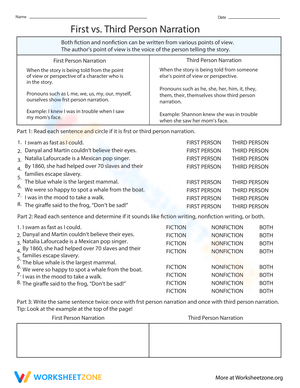
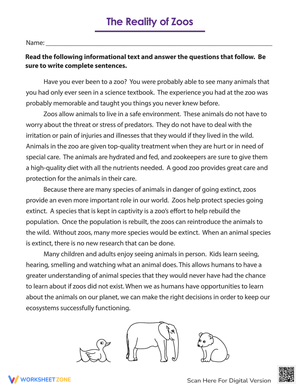
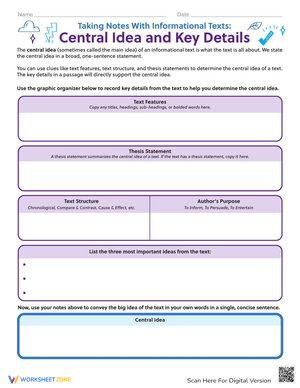
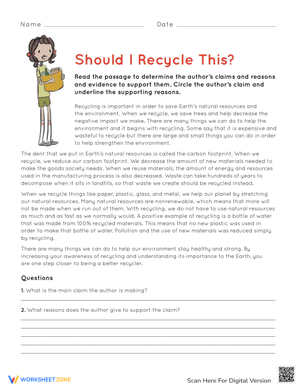
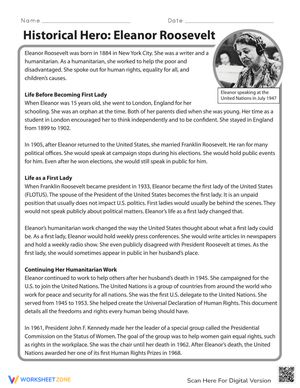
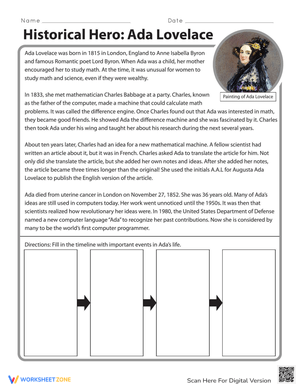
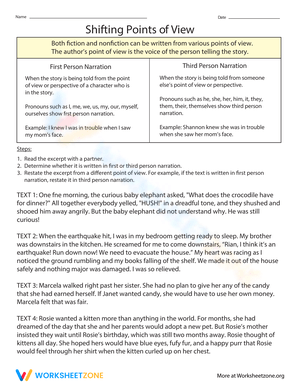
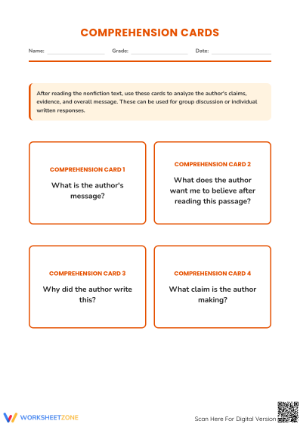
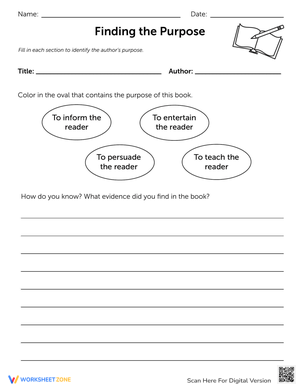
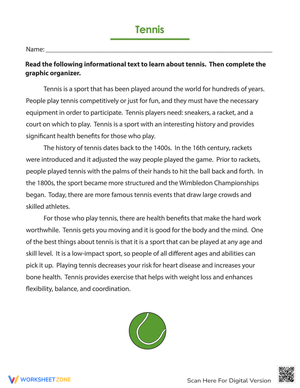
These author's purpose in nonfiction worksheets give students focused, evidence-based practice identifying whether a text is written to inform, explain, or persuade — and backing that label with specific language from the passage. Each worksheet presents a nonfiction text followed by structured questions that push students past the guess-and-move-on habit. Teachers who have watched students circle "persuade" without being able to point to a single loaded phrase will recognize exactly what kind of practice this set addresses.
The Three Purposes and What Each Worksheet Has Students Do
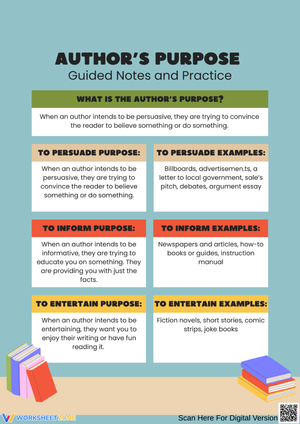
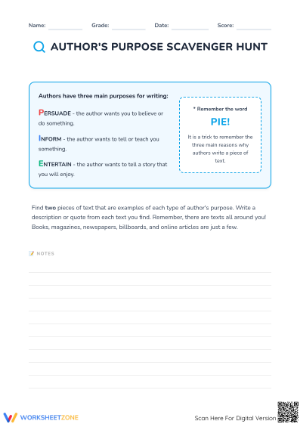
The inform/explain/persuade framework is more nuanced than the PIE acronym makes it look, and the worksheets are built around that nuance. An informational text presents facts through neutral language — an encyclopedia entry, a news brief, a science report. An explanatory text does something different: it constructs a sequence, walks the reader through a process, or breaks down a concept step by step. The author isn't just reporting; they are teaching. A persuasive text uses a combination of fact and opinion to move the reader toward a specific conclusion, and the most effective persuasive writing doesn't announce itself with "I believe" — it selects evidence strategically and frames every detail to support one side.
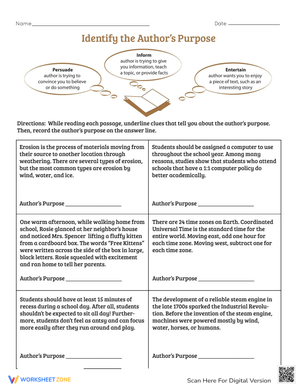
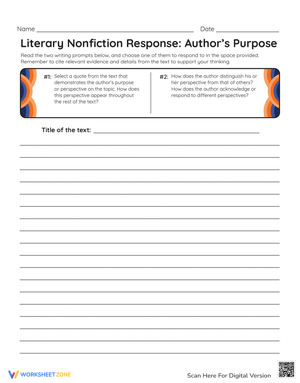
Each worksheet has students mark the passage before answering the questions: underlining signal phrases, circling language with strong positive or negative connotations, and noting text features — question-headed sections, data-heavy charts, or glossaries that signal the author is explaining rather than arguing. The annotation step matters because it slows the reading down. Students who skip it tend to skim for a feeling and then rationalize a label, which is the opposite of analysis.
Mistakes Students Make That Are Worth Catching Early
The most stubborn error is reading a persuasive text as informational because it contains statistics. A student encounters a well-constructed editorial arguing that school lunch programs should be federally funded. The text is full of nutrition data and income figures. The student labels it "inform" because it feels factual. What they miss is that the author selected those specific statistics to build a case — not to present a balanced picture of the issue. Teaching students to ask "Would this author include evidence that weakens their argument?" is a faster diagnostic than reviewing the difference between fact and opinion again, because sophisticated persuasive writing often avoids obvious phrases entirely.
The explain category creates a separate, consistent confusion. Students who can distinguish inform from persuade often lump "explain" in with "inform," treating any text that contains facts as informational. A passage walking through how a virus replicates inside a host cell is doing something structurally different from a passage listing characteristics of different virus types — the first builds a causal sequence, the second catalogs. That distinction is worth naming explicitly in class before students meet it on a worksheet, otherwise many will default to two categories when three are needed.
How to Work These Worksheets Into Your Instructional Sequence
One reliable entry point is using one worksheet as a pre-instruction diagnostic — before any formal definition of inform, explain, or persuade. Students annotate the passage and label the purpose using whatever language comes naturally. After direct instruction, they return to that same worksheet and revise. The before-and-after comparison gives students a concrete record of what shifted in their thinking, and it gives teachers fast data on who internalized the framework and who is still relying on surface cues like text length or topic.
When planning your author's purpose in nonfiction worksheets rotation across a unit, distribute the set across the week rather than stacking worksheets on back-to-back days. Spaced practice — returning to the same skill after a day or two on something else — produces more durable retention than massed practice does. One worksheet as a Monday warm-up after morning meeting, another mid-week during an independent reading block, and a third as a Friday exit review gives students three separate retrieval attempts without turning the skill into a daily routine they stop thinking about.
Standard Alignment
This set aligns primarily to CCSS.ELA-LITERACY.RI.6.6 and its grade-band parallels at grades 4, 5, 7, and 8, which ask students to determine an author's point of view or purpose and explain how it is conveyed through word choice and structure. At the upper elementary level, the standard focuses on distinguishing personal opinion from factual evidence; at middle school, it deepens to analyzing how authors frame their position against competing viewpoints — which makes the inform-versus-persuade distinction more analytically demanding. The persuasive passage worksheets in the set also support RI.6.8, since evaluating an argument's use of evidence requires understanding what the author is trying to accomplish before you can assess how effectively they do it.
Differentiating These Worksheets Across Student Levels
Students working below grade level benefit from starting with passages that have a single, unambiguous purpose and predictable text features. A short informational passage about an animal's habitat — neutral tone, bold headings, factual call-out boxes — gives those students a clean first success. Once they can label and support "inform" with confidence, move them to explanatory texts before introducing persuasive writing, which requires holding more competing elements in mind simultaneously: the author's claim, the selected evidence, and the language choices working together.
For students ready to go further, the stronger challenge is a passage where the purpose shifts mid-text. A science article that presents research data across several paragraphs and then pivots to a policy recommendation is doing two things at once, and students who can name exactly where the shift happens are demonstrating a genuinely sophisticated grasp of authorial intent. An author's purpose in nonfiction worksheets set works well as a foundation for that kind of layered analysis — students complete a single-purpose worksheet first, then move to a paired-text comparison once they have the baseline skill.
Frequently Asked Questions
Can these worksheets be used with texts from science or social studies class?
Yes, and that cross-curricular use is worth building in deliberately. When students apply the inform/explain/persuade framework to a passage from a science textbook or a primary source in social studies, they see that author's purpose is not a language arts concept exclusive to ELA — it is a reading behavior that applies across every content area. Using a text the class is already studying removes the unfamiliarity barrier and keeps the focus on the analytical task itself.
How should I introduce the worksheets if students are new to this framework?
Model the process with a shared example before assigning independent work. Read a short passage aloud, think through the language choices, and demonstrate how you move from observation ("this word carries a strong emotional charge") to inference ("this author is trying to convince, not just report"). Then give students a simpler passage on a worksheet and let them try the same sequence on their own. Sending students into a new analytical framework without that guided modeling first tends to produce surface-level labeling — the instinct guess — rather than evidence-based reasoning.
How do these differ from standard nonfiction comprehension worksheets?
Each author's purpose in nonfiction worksheets in this set focuses the questioning on intent and word choice rather than recall. A generic comprehension worksheet might ask "What is this article about?" or "List three facts the author presents." These worksheets ask students to identify why the author made specific language choices and what those choices reveal about the text's underlying goal. That is a different cognitive task — it requires evaluation, not just retrieval — and it is what the RI standards at grades 4 through 8 are actually asking students to do.












 Interactive Worksheet Maker
 Quiz Maker
 Word Search Maker
 Crossword Puzzle Maker
 Word Scramble Generator
 Sentence Scramble Generator
 Handwriting Worksheet Generator
 Name Tracing Generator
 Fill In The Blank Generator