































Essential Space Tools Word Search | Grades 7–8 Science

Paste this activity's link or code into your existing LMS (Google Classroom, Canvas, Teams, Schoology, Moodle, etc.).
Students can open and work on the activity right away, with no student login required.
You'll still be able to track student progress and results from your teacher account.
Reinforce core astronomy concepts and observational science vocabulary with this challenging space science word search designed for middle school classrooms. Students review astronomical tools, observational evidence, and key phenomena by matching definitions to target terms before locating all 18 words hidden across an expansive letter grid, strengthening domain-specific scientific literacy.
At a Glance
- Grade: Grades 7–8 · Subject: Science
- Standard: Not standards-assessed — vocabulary enrichment
- Skill Focus: Tools, evidence, and astronomical questions
- Format: 3 pages · 18 words · Answer key included · PDF
- Best For: Cumulative review or unit wrap-up
- Time: 25–35 minutes
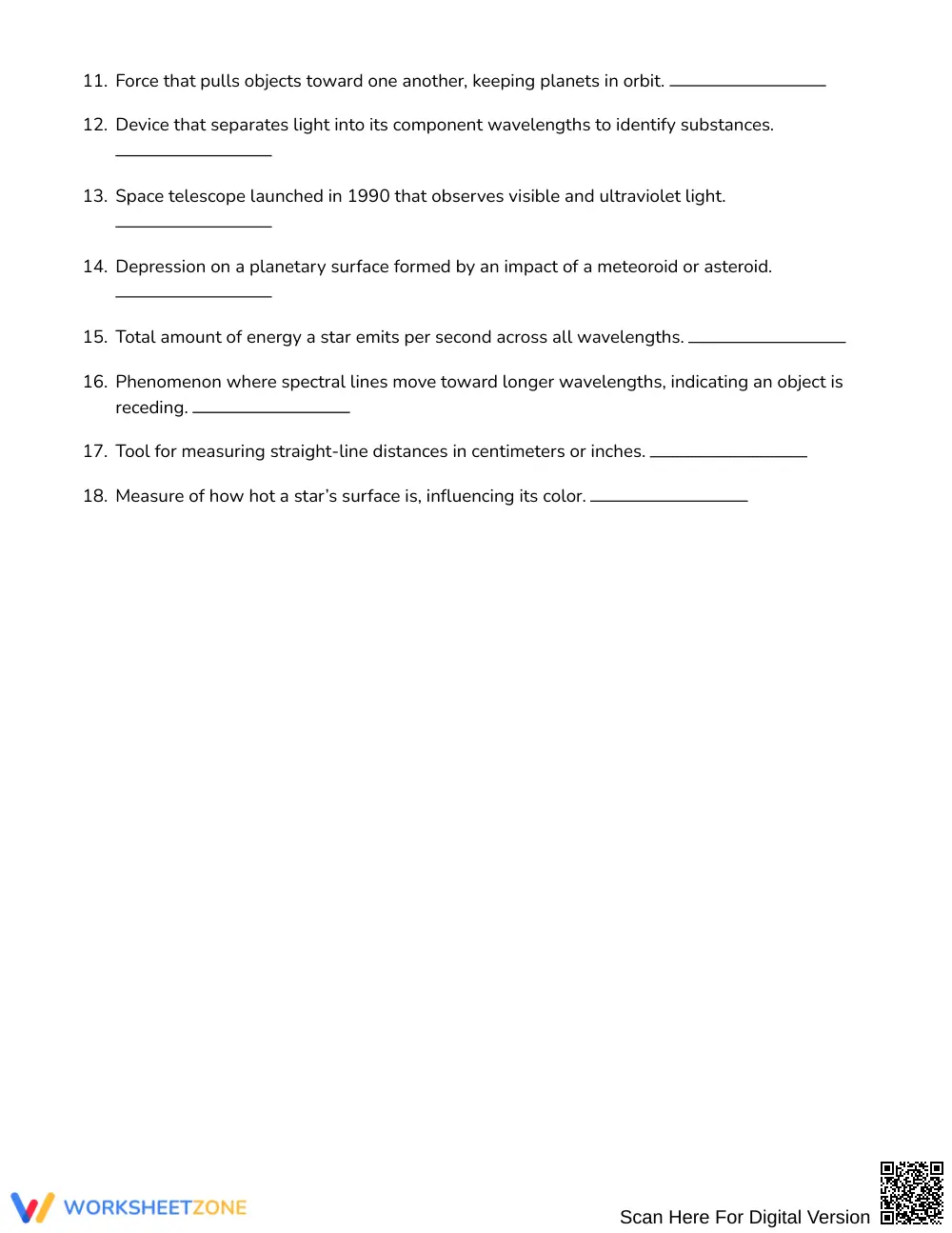
This 3-page printable activity features a full 20 by 20 letter grid containing 18 hidden vocabulary words paired with a comprehensive clue bank. Rather than relying on simple rote letter matching, each word corresponds to an informative scientific clue describing instruments like the Hubble, Chandra, and Kepler observatories or concepts such as parallax, redshift, and luminosity. A thorough 4-page answer key provides clear solution maps highlighting word locations for efficient grading or student self-checking.
The puzzle is structured to deliver an engaging challenge that demands focused visual scanning and semantic retrieval:
- Grid Dimensions: A spacious 20 by 20 letter grid provides room for complex word placements, preventing overcrowding while maintaining rigor.
- Search Directions: Words are oriented in all eight compass directions—North, Northeast, East, Southeast, South, Southwest, West, and Northwest—encouraging thorough spatial analysis.
- Dual Word Bank and Clue System: Students read descriptive scientific definitions to identify target terms from a shuffled list before searching the grid, reinforcing conceptual retention alongside vocabulary acquisition.
This resource serves as targeted vocabulary enrichment rather than a standards-aligned assessment. While it supports foundational terminology central to middle school Earth and space science curricula, it is explicitly designed for review, reinforcement, and conceptual familiarity without assigning formal standards mastery.
Deploy this word search during the final days of an astronomy unit as a low-stress cumulative review activity. Have students work individually or in pairs after direct instruction on astronomical instruments and stellar measurement techniques. While students work, circulate to observe whether they can identify terms from the clue descriptions before scanning the grid, which offers instant formative insight into their conceptual recall. Expect the activity to take approximately 25 to 35 minutes to complete.
This resource is tailored for Grades 7–8 science students learning about celestial observation and astrophysics. It offers accessible differentiation for visual learners and emergent bilingual students through explicit clue definitions. Pair this puzzle with an astronomy anchor chart on electromagnetic spectrum tools or a collaborative telescope research project to anchor theoretical knowledge into meaningful scientific contexts.
Integrating structured vocabulary enrichment into middle school astronomy instruction establishes the domain-specific linguistic base necessary for complex scientific inquiry. According to Fisher & Frey (2014), intentional exposure to academic vocabulary through multimodal tasks—including clue-based puzzles and retrieval practice—significantly strengthens long-term conceptual retention and disciplinary reading comprehension. This Grades 7–8 science word search targets 18 essential astronomy terms covering astronomical tools, observational evidence, and stellar characteristics. By requiring students to interpret scientific definitions before locating terms hidden across an eight-directional 20 by 20 grid, the activity transforms passive word identification into an active retrieval exercise. While designed as enrichment rather than a formal standards-based assessment, this supplemental review bridges introductory astronomy concepts with higher-level analytical coursework. Teachers can efficiently reinforce critical space science terminology within a focused 25 to 35 minute instructional block, fostering vocabulary mastery across diverse learner populations.


