

































Essential Source Provenance Worksheet | Grade 12 English IV

Paste this activity's link or code into your existing LMS (Google Classroom, Canvas, Teams, Schoology, Moodle, etc.).
Students can open and work on the activity right away, with no student login required.
You'll still be able to track student progress and results from your teacher account.
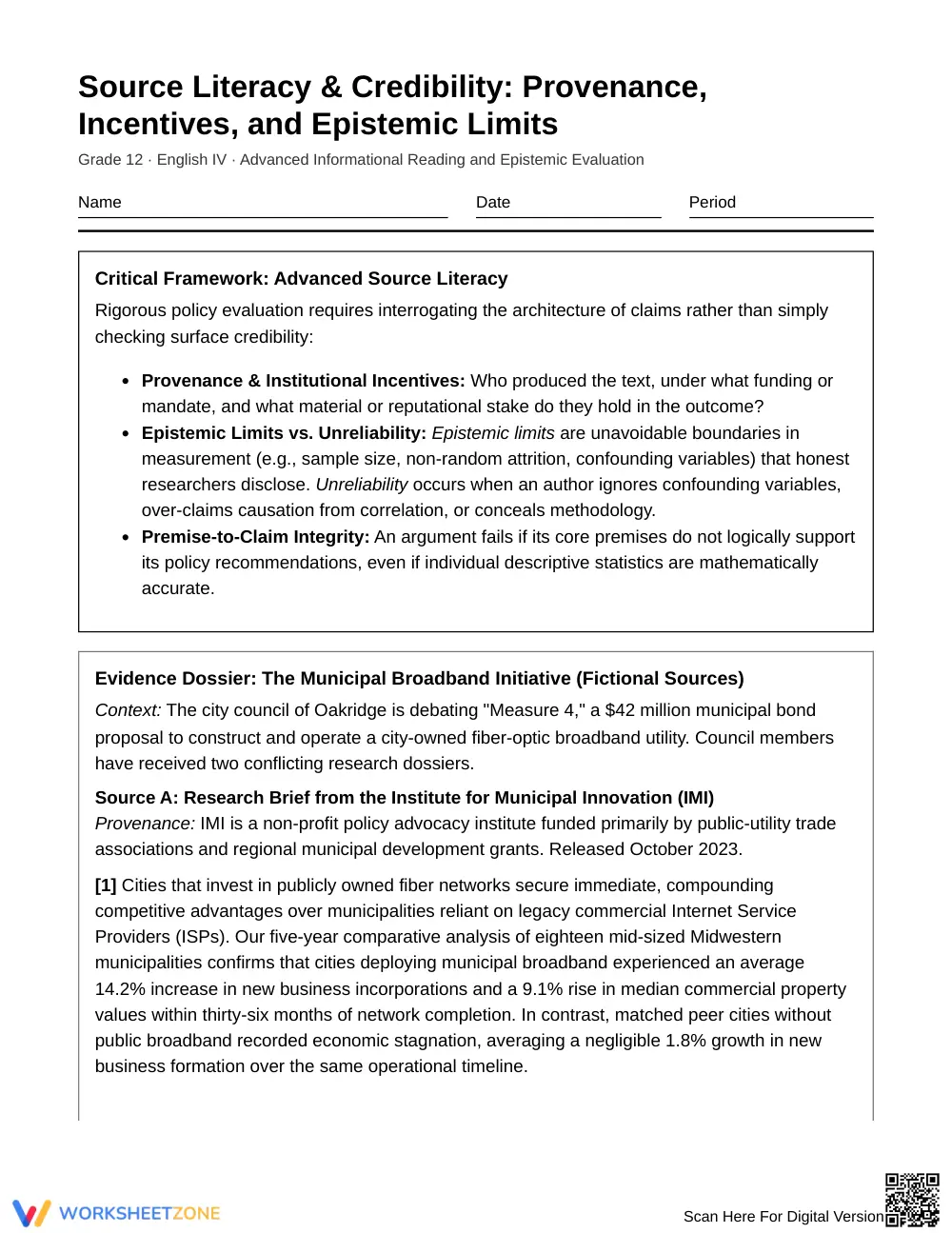
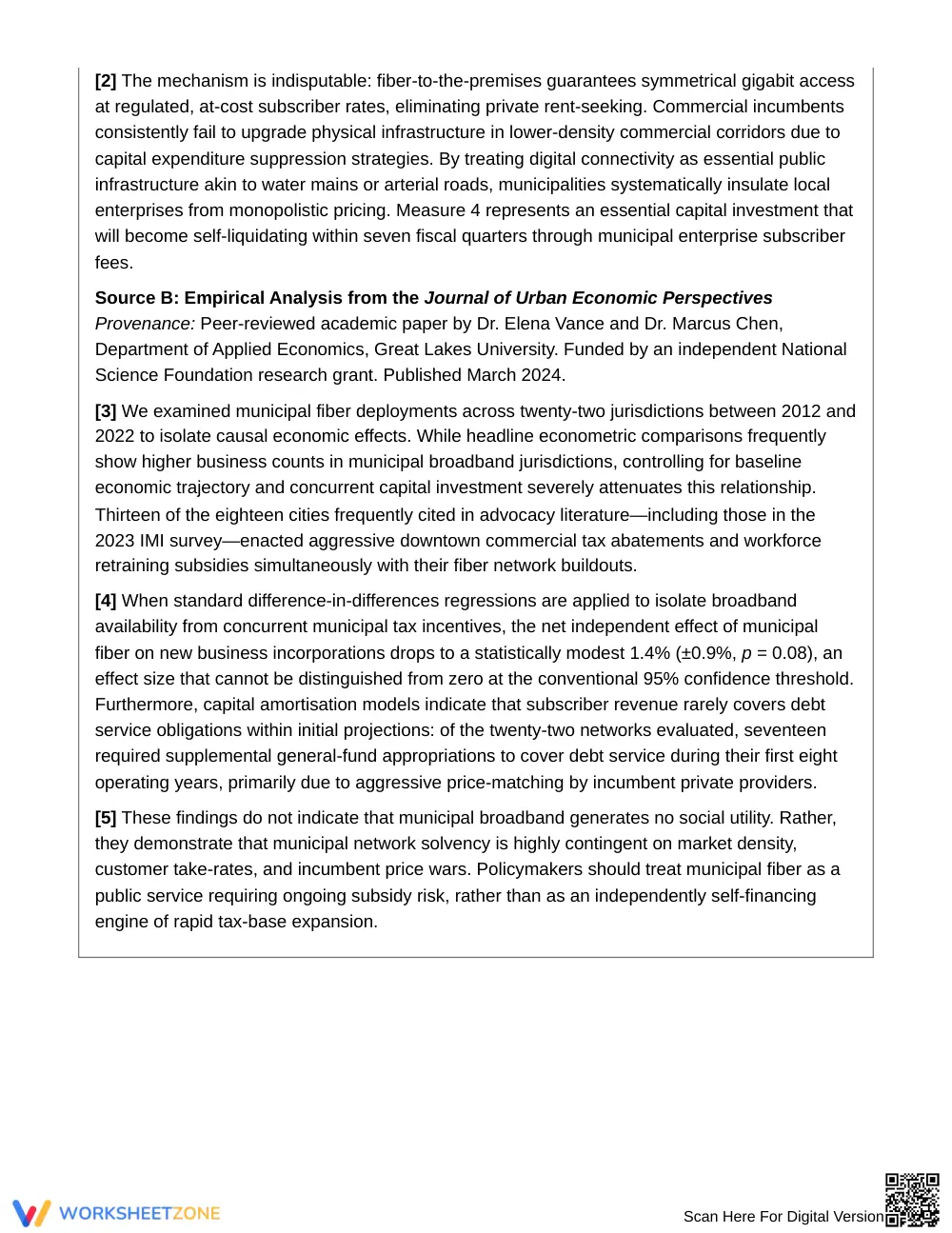
This advanced informational reading worksheet trains twelfth-grade students to interrogate source provenance, institutional incentives, and epistemic limits in policy research. Students analyze two competing broadband dossiers to differentiate between correlation and causation, unearth confounding variables, and synthesize complex evidence into defensible policy counsel for municipal decision-makers.
At a Glance
- Grade: 12 · Subject: English IV
- Standard: Advanced Informational Reading — Evaluate author credentials, research methodology, data validity, and epistemic integrity in competing arguments
- Skill Focus: Provenance, Incentives, and Epistemic Limits
- Format: 6 pages · 10 problems · Answer key included · PDF
- Best For: Source credibility and policy analysis lessons
- Time: 45–60 minutes
This 6-page informational text unit presents an anchor critical framework alongside two contrasting municipal broadband dossiers representing advocacy research and peer-reviewed econometrics. The resource features 10 structured tasks spanning conceptual multiple-choice questions, text-dependent evidence evaluations, and a multi-paragraph policy synthesis, supported by an exhaustive 3-page answer key with exemplar student responses.
Skill Progression
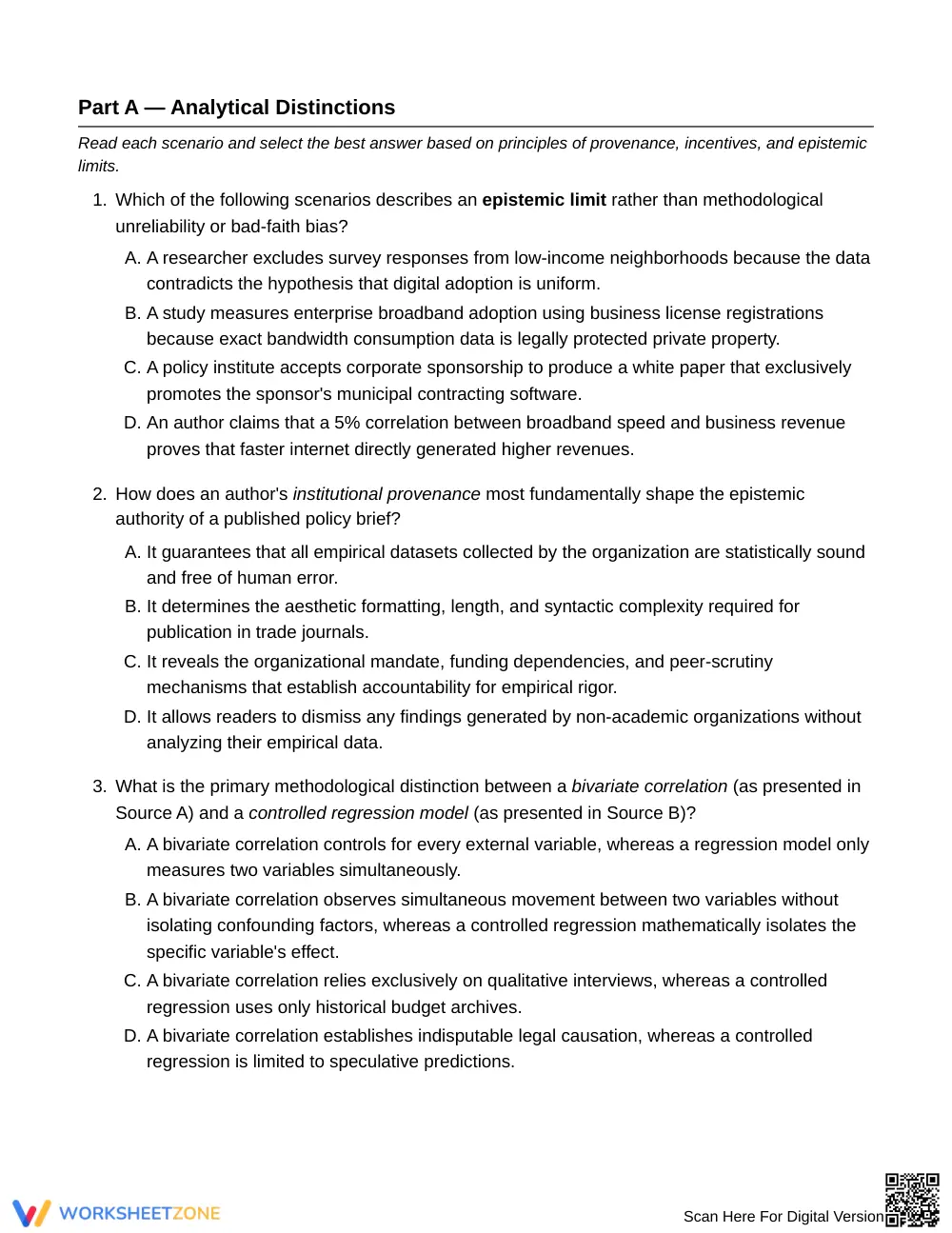
- Guided practice (Part A, 3 problems): High-scaffold conceptual multiple-choice questions establish baseline distinctions between epistemic limits, bad-faith bias, institutional provenance, and bivariate correlation versus regression analysis.
- Supported practice (Part B, 5 problems): Moderate-scaffold short-answer prompts require direct dossier citations to dismantle unadjusted claims, identify omitted confounding variables, and contrast institutional publication incentives.
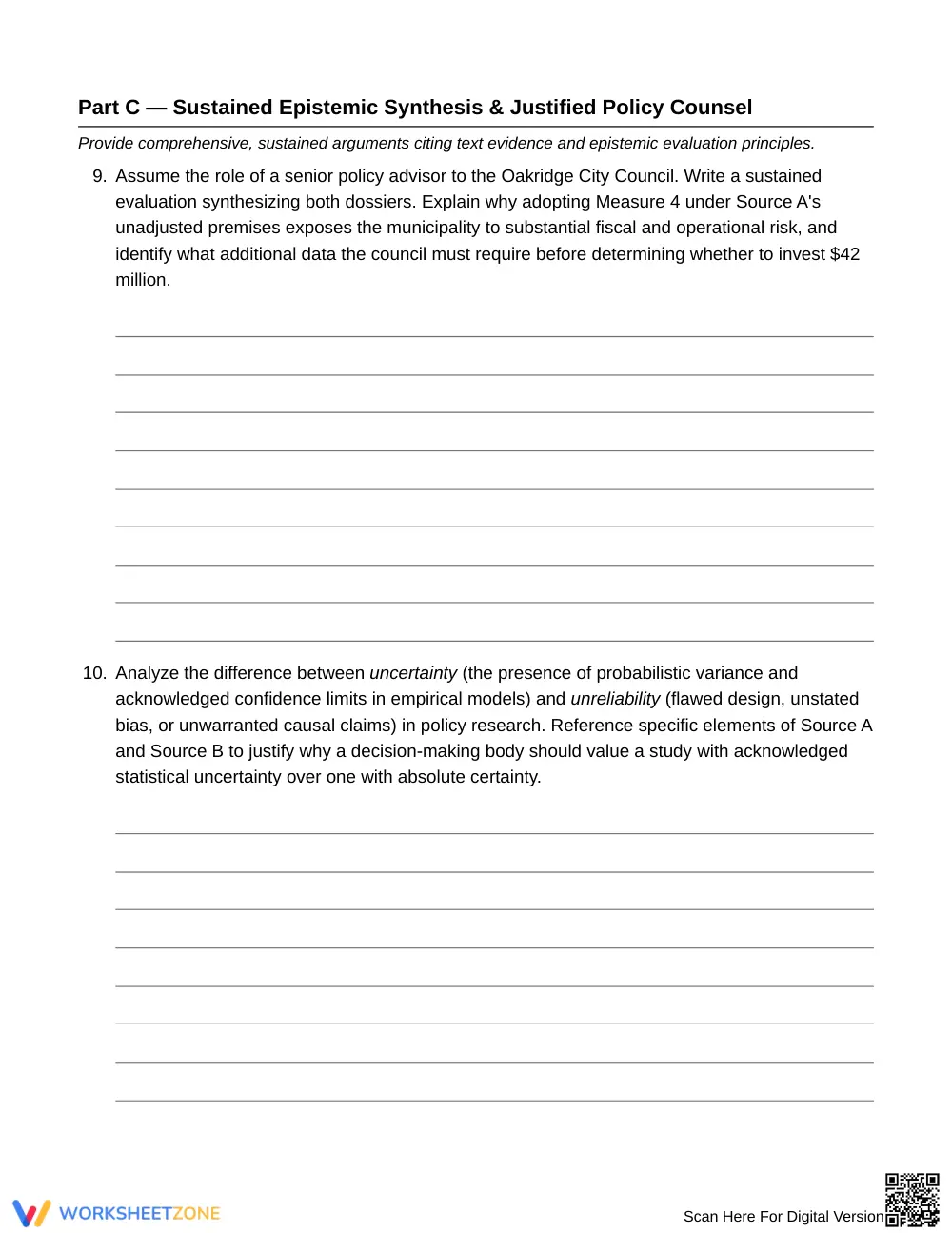
- Independent practice (Part C, 2 problems): Low-scaffold sustained synthesis tasks challenge learners to write a comprehensive policy briefing and defend the necessity of statistical uncertainty over unearned certainty.
This sequence implements a gradual-release model that transitions students from foundational epistemic definitions to high-level critical argumentation.
Standards Alignment
This resource aligns with twelfth-grade standards for reading informational texts, focusing on evaluating complex arguments across multiple seminal texts, assessing whether reasoning is valid and evidence is relevant, and identifying false premises or epistemic limitations. It also reinforces rigorous explanatory writing benchmarks. Both standard codes can be copied directly into lesson plans, IEP goals, or district curriculum mapping tools.
How to Use It
Assign this worksheet after direct instruction on source credibility frameworks or during a dedicated unit on rhetoric and policy evaluation. Teachers can use Part A as an immediate formative check to confirm conceptual mastery before students begin writing their sustained Part C policy counsel. The complete activity takes approximately 45 to 60 minutes of focused class time.
Who It's For
This material is designed for Grade 12 English IV, AP English Language, or college-preparatory rhetoric classrooms. It offers accessible entry points through foundational definitions while providing intellectual rigor for advanced writers. Pair this dossier with a direct instruction lesson on rhetorical analysis or an anchor chart detailing common econometric fallacies.
Rigorous source literacy requires secondary students to interrogate research provenance, structural incentives, and epistemic boundaries when analyzing informational texts. According to Fisher & Frey (2014), gradual-release instructional designs that systematically scaffold evidence synthesis empower high school learners to transition from passive readers to critical evaluators of complex policy claims. This 6-page informational reading dossier incorporates 10 targeted analytical tasks that guide Grade 12 students through evaluating methodological unreliability, identifying omitted confounding variables, and formulating justified recommendations under empirical uncertainty. By structuring text-based evaluations around authentic municipal research briefs, educators foster epistemic vigilance and deep argumentative reasoning aligned with college-ready standards. The inclusion of structured multiple-choice diagnostics, text-dependent synthesis prompts, and sustained policy briefings ensures that students develop transferrable critical evaluation tools. This comprehensive resource delivers rigorous practice in epistemic analysis, preparing students for collegiate research and civic participation.


