

































Essential Source Literacy Worksheet | Grade 12 English IV

Paste this activity's link or code into your existing LMS (Google Classroom, Canvas, Teams, Schoology, Moodle, etc.).
Students can open and work on the activity right away, with no student login required.
You'll still be able to track student progress and results from your teacher account.
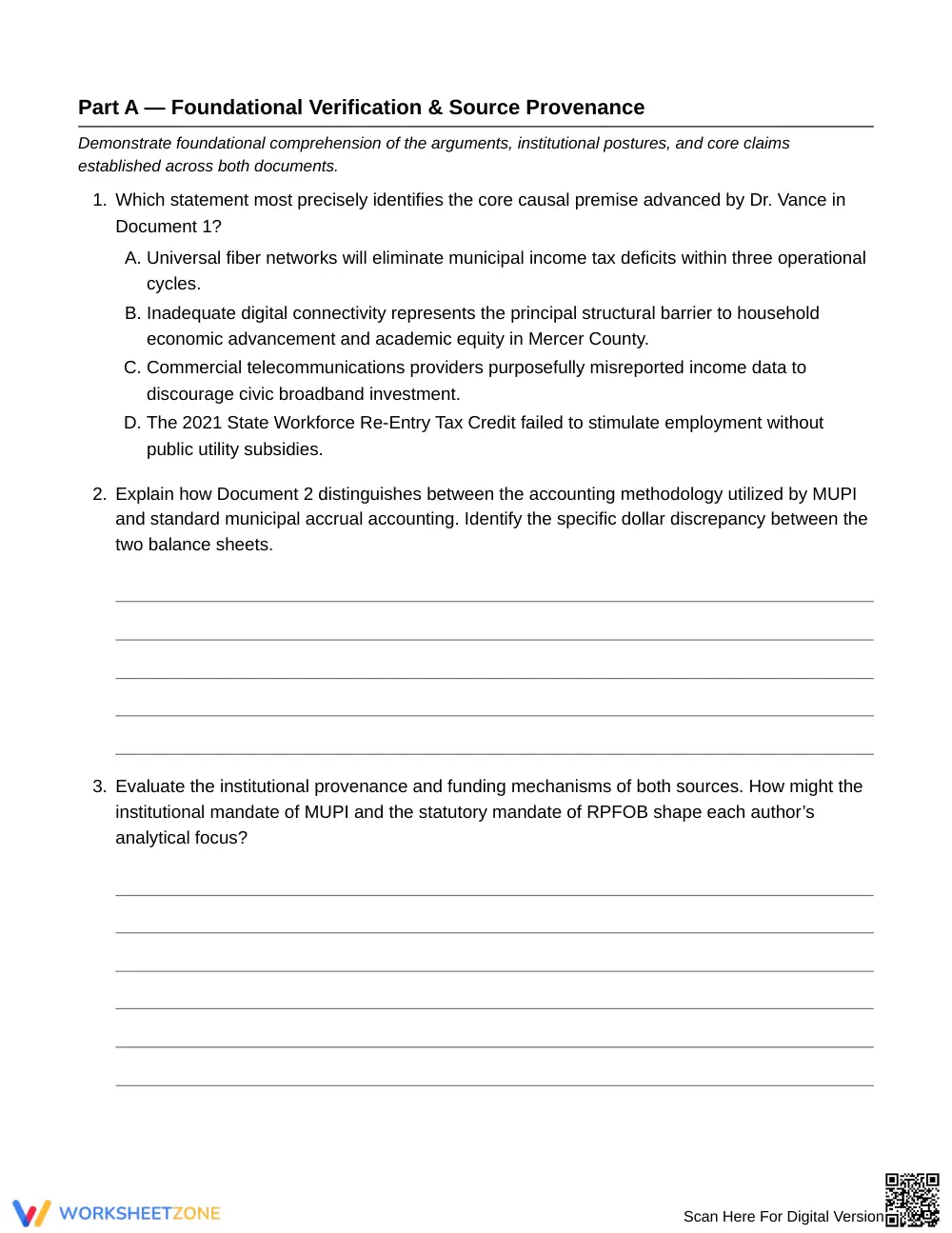
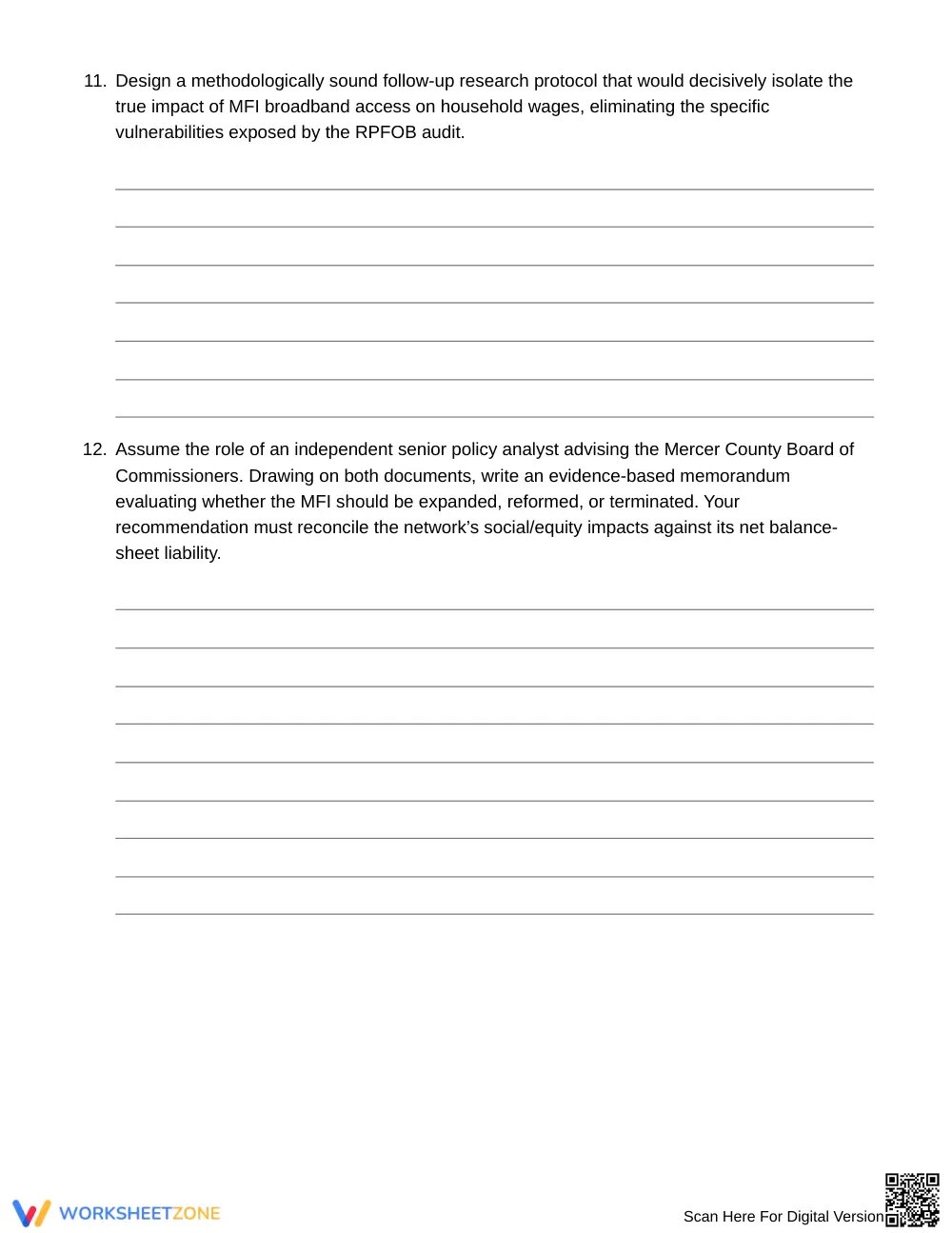
This Grade 12 source literacy worksheet trains students to evaluate conflicting research dossiers through empirical cross-examination. High school seniors analyze competing policy briefs on municipal broadband, distinguish methodological uncertainty from unreliability, uncover statistical confounders, and synthesize evidence into an actionable policy recommendation.
At a Glance
- Grade: 12 · Subject: English IV
- Standard:
RH.11-12.8— Evaluate an author's premises, claims, and evidence by corroborating or challenging them with other sources- Skill Focus: Advanced Source-Literacy Check
- Format: 6 pages · 12 problems · Answer key included · PDF
- Best For: Informational text synthesis and document-based inquiry
- Time: 45–60 minutes
This 6-page printable resource centers on a paired dossier contrasting an advocacy think-tank brief with an official municipal audit. Across 12 structured tasks, students complete multiple-choice verification, short-answer critique, and an evaluative synthesis memo. It features a critical framework on uncertainty versus unreliability alongside a comprehensive 4-page answer key.
Skill Progression
- Guided practice (Part A, 3 tasks): Builds comprehension through multiple-choice premise identification, provenance checks, and accounting comparisons.
- Supported practice (Part B, 6 tasks): Deepens evidentiary evaluation as students analyze panel attrition rates, isolate confounders, and compare financial models.
- Independent practice (Part C, 3 tasks): Requires autonomous synthesis through a corroboration matrix, research design, and a policy memorandum.
This sequence follows a gradual-release model, moving students from guided premise checks to independent empirical synthesis.
Standards Alignment
This worksheet aligns to RH.11-12.8: Evaluate an author's premises, claims, and evidence by corroborating or challenging them with other information. It also supports RI.11-12.7 through multi-source evaluation. Both standard codes can be copied directly into lesson plans, IEP goals, or district curriculum mapping tools.
How to Use It
Use this worksheet after direct instruction on source credibility and research methodology. Have students analyze the texts in pairs before drafting individual policy memos. For formative assessment, monitor Part B responses to confirm students distinguish bias from panel attrition. Expected completion time is 45 to 60 minutes.
Who It's For
Designed for Grade 12 English IV and AP Language students preparing for college-level research. Differentiate by using the critical framework definitions for emerging readers or having advanced students calculate data revisions. Pair with lessons on statistical confounding or informational text analysis.
Mastering advanced source evaluation requires high school seniors to interrogate empirical claims beyond surface-level author credentials. Aligned directly to standard RH.11-12.8, this instructional resource builds advanced source-literacy skills by requiring students to cross-examine conflicting policy dossiers, isolate methodological confounding variables, and evaluate premise validity. Research from Fisher & Frey (2014) highlights that structured gradual-release frameworks combining paired-text cross-examination with independent evidentiary synthesis significantly enhance secondary students' critical analysis of complex informational texts. When learners confront competing data models—such as divergent cash versus accrual accounting methodologies or survey panel attrition biases—they transition from passive readers into evaluative thinkers capable of isolating institutional perspective. This targeted practice directly addresses college-readiness benchmarks in evidence corroboration, objective scrutiny, and analytical writing. By synthesizing complex public policy findings into formal recommendations, students develop durable critical-thinking habits essential for academic research and civic decision-making.


