


























Views
Downloads


Essential Selection & Drift Worksheet | Grade 10 Biology
Paste this activity's link or code into your existing LMS (Google Classroom, Canvas, Teams, Schoology, Moodle, etc.).
Students can open and work on the activity right away, with no student login required.
You'll still be able to track student progress and results from your teacher account.
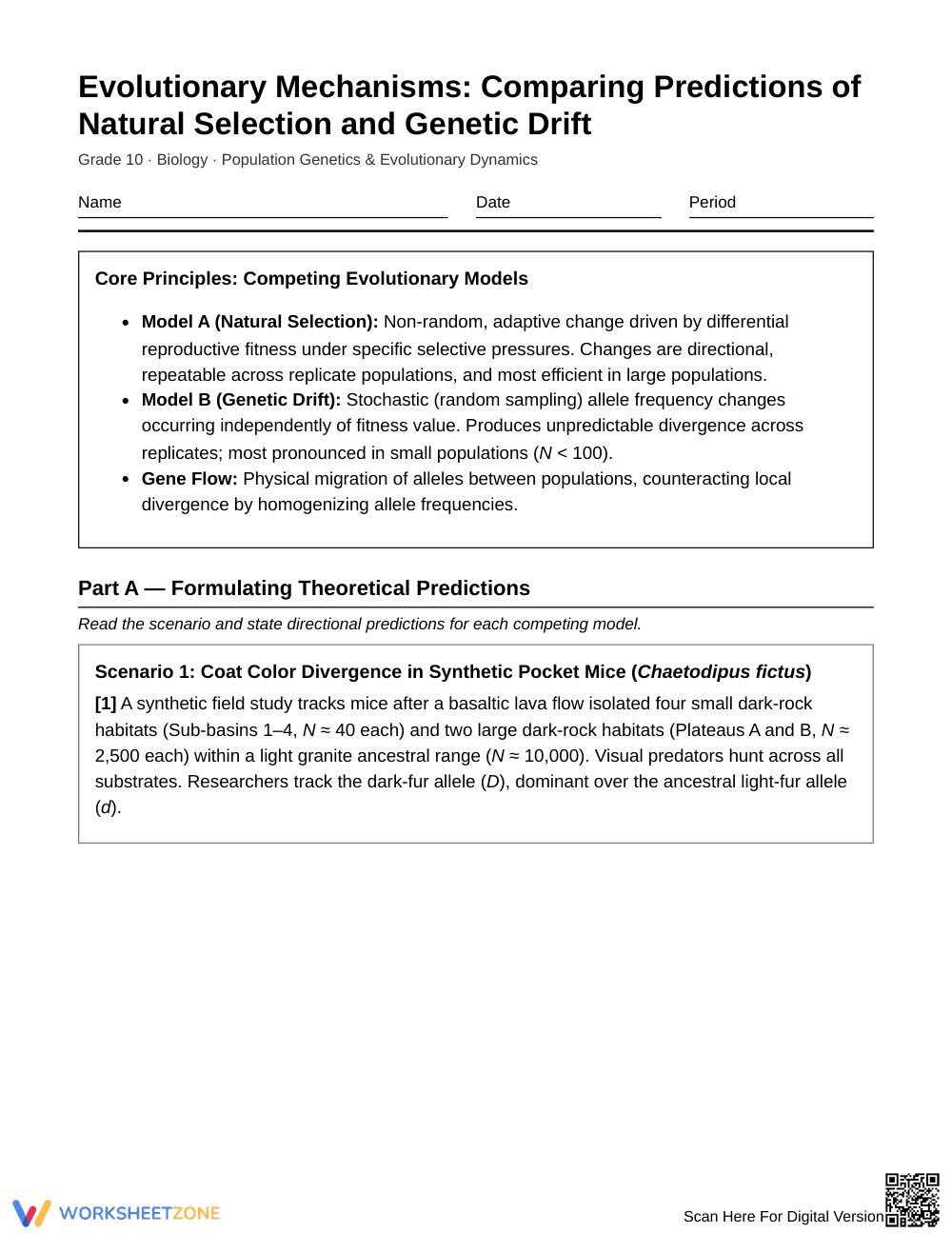
This Grade 10 biology worksheet guides students through contrasting the theoretical and empirical predictions of natural selection and genetic drift. Learners evaluate population size effects, stochastic sampling errors, and experimental data sets to understand how evolutionary mechanisms shape allele frequencies across generations.
At a Glance
- Grade: 10 · Subject: Biology
- Standard: Compare mathematical and conceptual models of natural selection and genetic drift
- Skill Focus: Compare Predictions of Selection and Drift
- Format: 5 pages · 10 problems · Answer key included · PDF
- Best For: High school population genetics review
- Time: 45–60 minutes
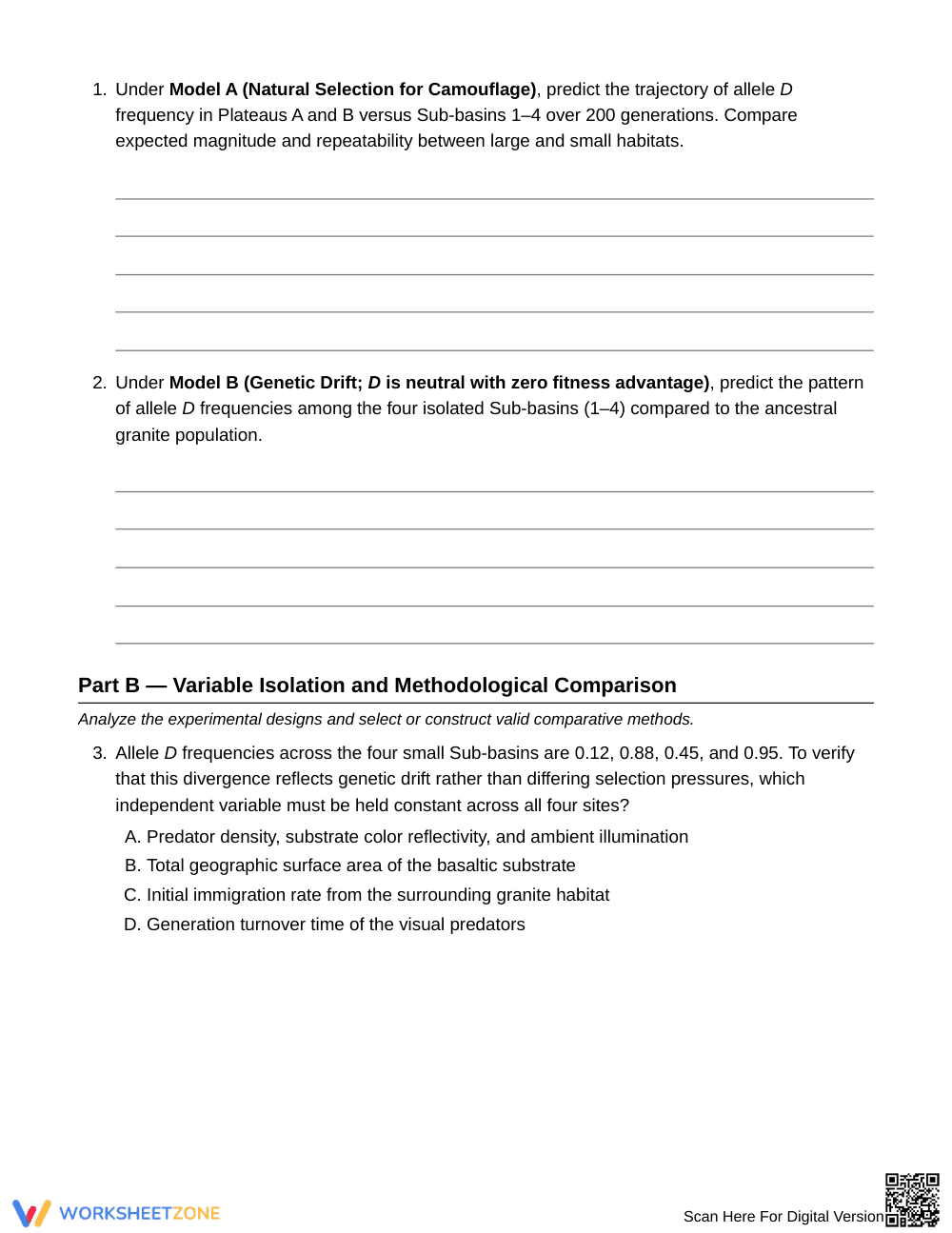
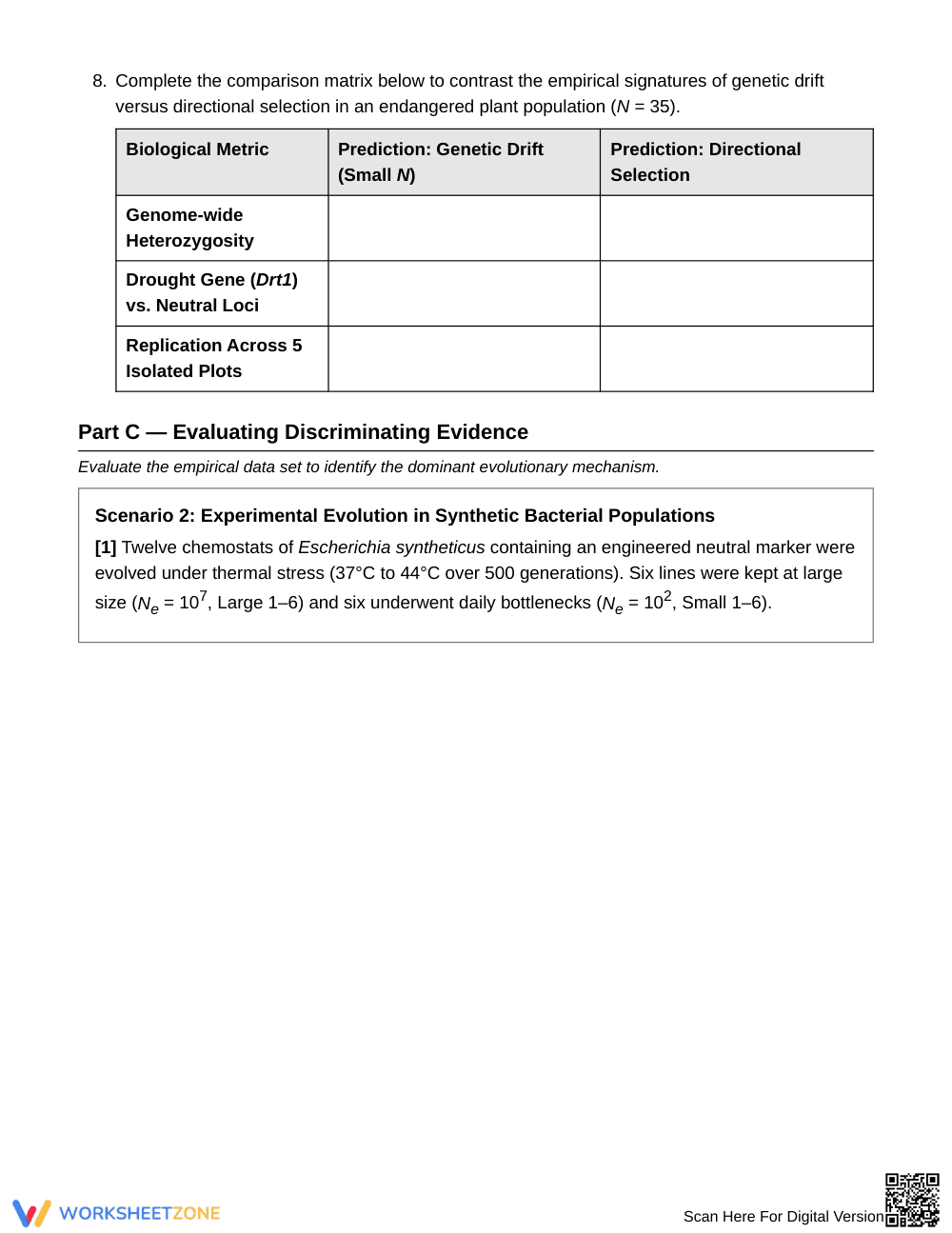
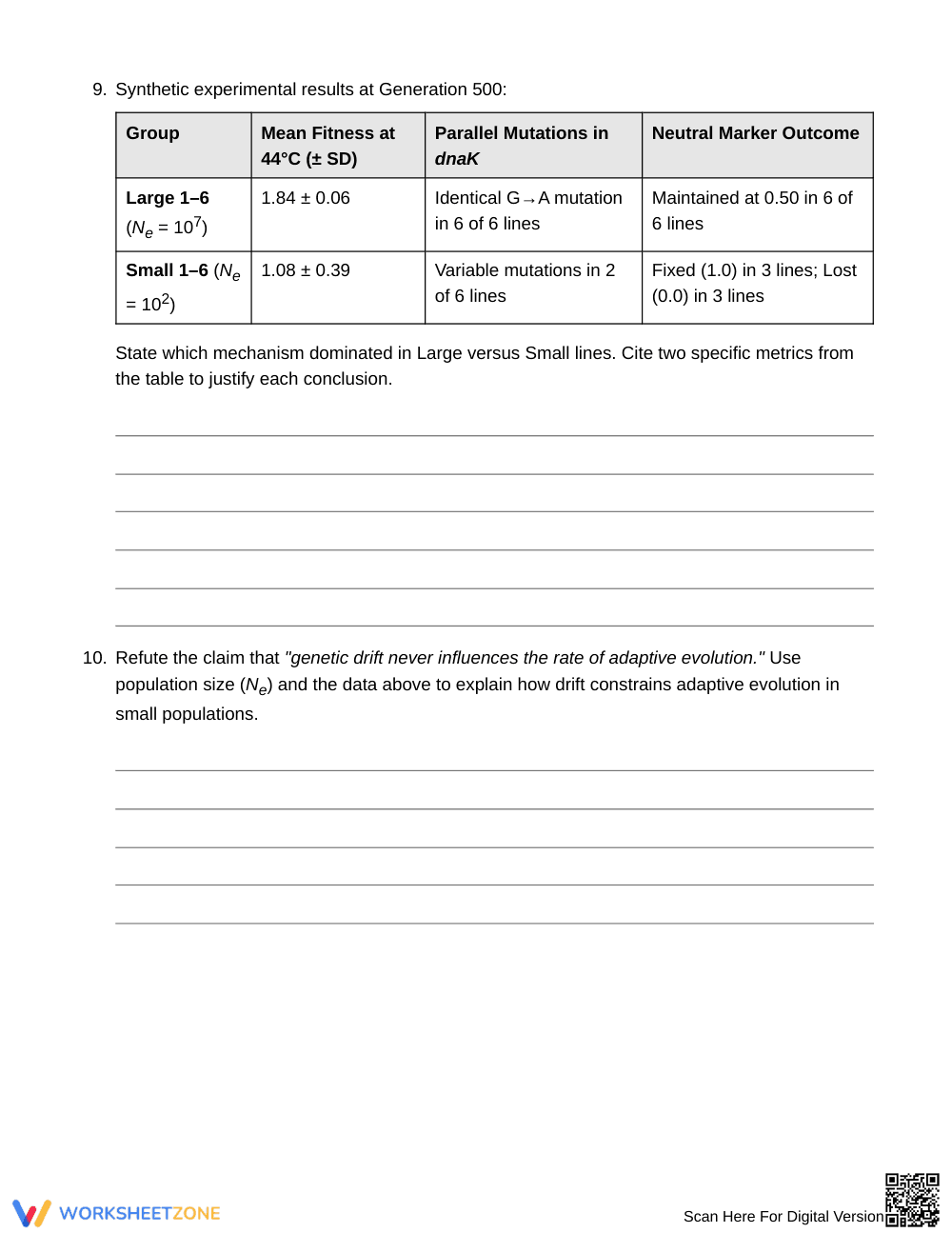
This 5-page printable resource includes 10 analytical tasks arranged across three distinct parts, accompanied by a comprehensive 3-page teacher answer key. Students engage with scenario-based modeling of pocket mouse coat coloration, multiple-choice experimental design questions, an empirical comparison matrix, and a data evaluation table analyzing thermal adaptation in synthetic bacterial chemostats across 500 generations.
Skill Progression
- Guided practice (Tasks 1–2): Students formulate theoretical trajectory predictions for dominant alleles across large and small isolated habitats, referencing the foundational core principles box.
- Supported practice (Tasks 3–8): Learners analyze experimental variables, compare synonymous versus non-synonymous mutation rates, and complete a structured biological metric matrix contrasting drift and selection in endangered populations.
- Independent practice (Tasks 9–10): Students synthesize quantitative data from bacterial evolution lines to determine dominant evolutionary mechanisms and refute common misconceptions about drift in small populations.
This structured progression follows an explicit gradual-release model, transitioning learners from foundational conceptual modeling to complex data interpretation.
Standards Alignment
This worksheet aligns with high school life science standards addressing evolutionary mechanisms, population genetics, and statistical models of allele distribution. Students analyze how natural selection and stochastic genetic drift alter genetic variation over time. Both standard descriptions can be copied directly into lesson plans, IEP goals, or district curriculum mapping tools.
How to Use It
Deploy this worksheet after direct instruction on Hardy-Weinberg equilibrium and population genetics mechanisms. Use Part A and Part B during guided group work (20–25 minutes) to reinforce experimental controls and variable isolation. Assign Part C as an independent formative assessment (15–20 minutes). During practice, circulate to observe whether students recognize that genetic drift causes unpredictable divergence between small replicate populations while selection produces repeatable trajectories.
Who It's For
This resource is designed for Grade 10 general and honors biology students studying evolutionary dynamics. Scaffolding supports mixed-ability classrooms through defined models and clear data tables. Pair this worksheet with an interactive allele frequency simulation or an anchor chart detailing population bottlenecks and founder effects.
According to research highlighted in Fisher & Frey (2014), structured comparative analysis tasks combined with gradual-release frameworks significantly enhance high school students' ability to differentiate complex biological mechanisms. When students evaluate competing hypotheses using paired quantitative datasets—such as contrasting directional selection with stochastic genetic drift across 10 structured tasks—they demonstrate deeper conceptual retention of evolutionary theory. Research on science pedagogy demonstrates that isolating key variables like effective population size within scenario-based prompts allows tenth-grade biology learners to resolve pervasive misconceptions regarding random sampling versus adaptive fitness. By systematically guiding students from theoretical modeling of coat color alleles to rigorous evaluation of microbial chemostat experiments, this instructional activity reinforces evidence-based reasoning in population genetics. Educators can utilize these findings to document measurable progress in biological inquiry and data interpretation skills.


