


























Views
Downloads

Essential Safe Classroom Choices Worksheet | Grade 1
Paste this activity's link or code into your existing LMS (Google Classroom, Canvas, Teams, Schoology, Moodle, etc.).
Students can open and work on the activity right away, with no student login required.
You'll still be able to track student progress and results from your teacher account.
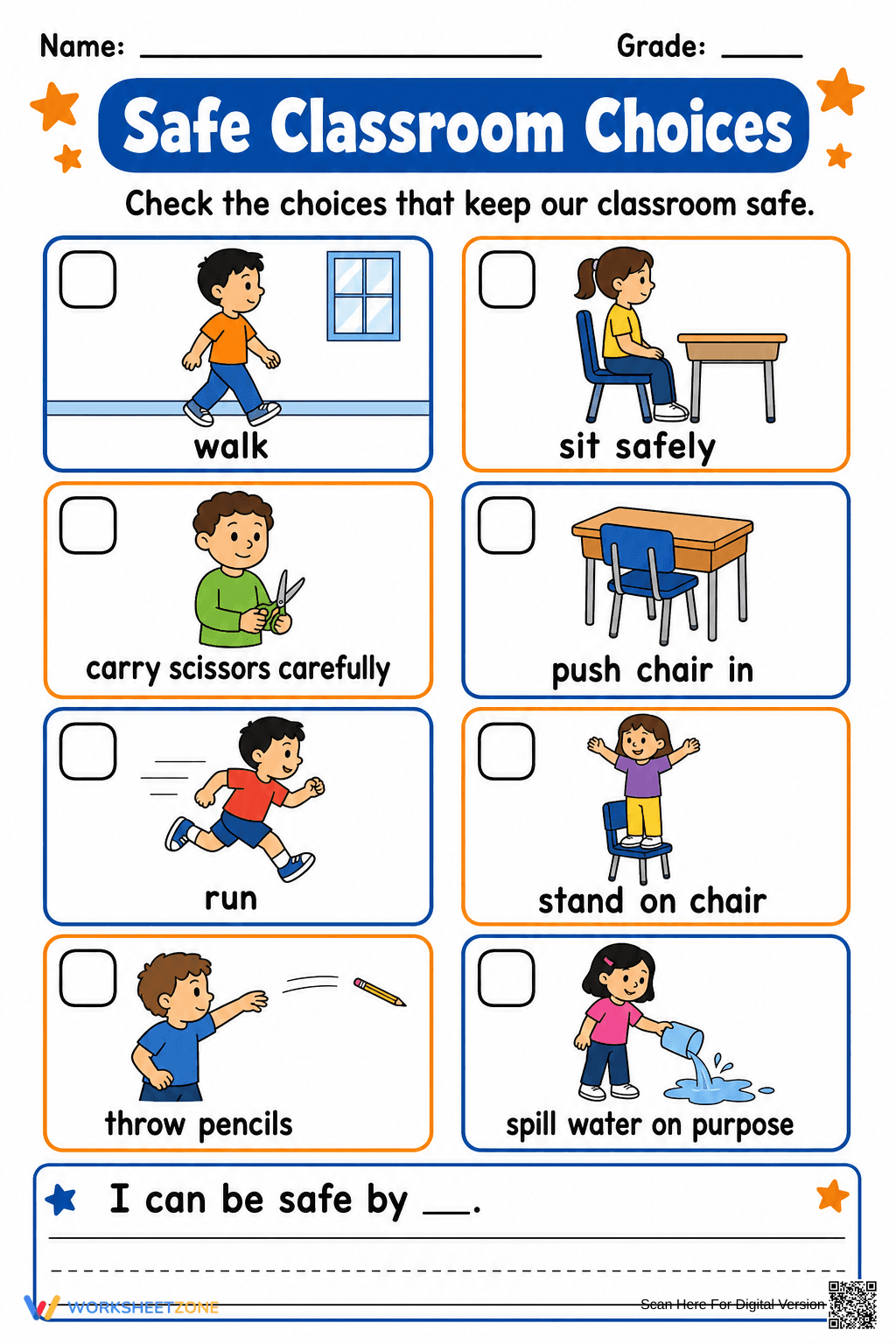
This Grade 1 classroom safety worksheet helps students distinguish between helpful and harmful behaviors through visual identification and reflective writing. Students evaluate 8 specific scenarios to determine which actions promote a secure learning environment. It serves as a foundational tool for establishing positive classroom culture and behavioral expectations.
At a Glance
- Grade: 1 · Subject: Life Skills
- Standard:
CCSS.ELA-LITERACY.W.1.2— Write informative texts that name a topic and supply some facts.- Skill Focus: Classroom Safety Rules
- Format: 1 page · 9 tasks · Answer key included · PDF
- Best For: Back-to-school routines and behavior management
- Time: 15–20 minutes
This single-page PDF features 8 high-contrast illustration cards with clear text labels like "walk," "sit safely," and "throw pencils." Each card includes a dedicated checkbox for student selection. The bottom of the page provides a primary-lined sentence starter for a personal safety commitment, ensuring students move from identification to application. The clean layout minimizes distractions for young learners.
Zero-Prep Workflow
- Print: Select the single-page PDF and print enough copies for your cohort in under 30 seconds.
- Distribute: Hand out the sheets during your morning meeting or social-emotional learning block with zero teacher setup.
- Review: Use the visual cards to facilitate a whole-class discussion on why specific choices are safe or unsafe in 10 minutes.
The primary standard addressed is `CCSS.ELA-LITERACY.W.1.2`, which requires students to write informative/explanatory texts in which they name a topic, supply some facts about the topic, and provide some sense of closure. This worksheet supports this by having students identify facts about safety and write a concluding statement. Both standard codes can be copied directly into lesson plans, IEP goals, or district curriculum mapping tools.
Use this as a formative assessment during the first week of school to gauge student understanding of physical boundaries and safety expectations. It also serves as an excellent "re-set" activity after long breaks or as a sub-plan filler. Completion typically takes 15 to 20 minutes depending on the depth of the writing response and the length of the accompanying discussion.
Designed for first-grade students, this resource is also suitable for Kindergarteners with dictation support or second graders needing a behavior refresher. It pairs naturally with a "Classroom Rules" anchor chart or a read-aloud about school citizenship. The visual nature of the tasks makes it accessible for English Language Learners and students with diverse learning needs.
According to research by Fisher & Frey (2014), visual scaffolds and clear behavioral modeling are critical for establishing classroom norms in early childhood settings. This worksheet utilizes the `CCSS.ELA-LITERACY.W.1.2` standard to bridge the gap between social-emotional recognition and academic writing. By requiring students to evaluate 8 distinct classroom scenarios, the resource promotes cognitive processing of safety rules rather than rote memorization. The inclusion of a reflective writing prompt aligns with evidence-based practices that suggest student-authored commitments increase adherence to classroom expectations. This tool provides a structured framework for teachers to document student understanding of school-wide safety protocols, making it a valuable addition to any primary classroom management toolkit or social-emotional learning curriculum.


