


























Views
Downloads
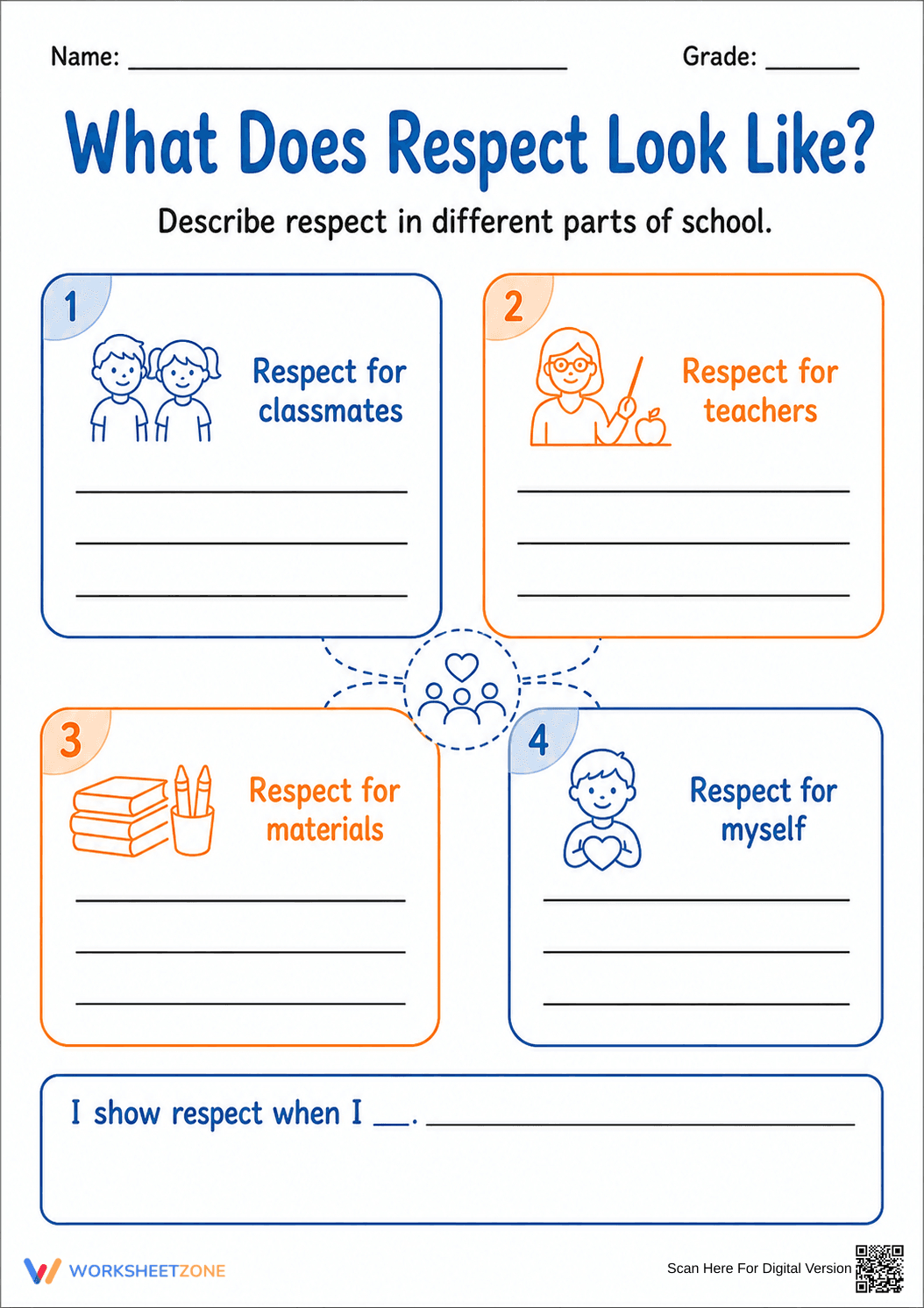

Essential Respect Worksheet | Grade 3-5 SEL Printable
Paste this activity's link or code into your existing LMS (Google Classroom, Canvas, Teams, Schoology, Moodle, etc.).
Students can open and work on the activity right away, with no student login required.
You'll still be able to track student progress and results from your teacher account.
This Grade 3-5 Social Emotional Learning worksheet helps students define and internalize respect across four key school environments. By reflecting on specific behaviors for peers, teachers, and themselves, students develop a concrete understanding of positive classroom culture. It provides a structured framework for setting expectations at the start of the year or during mid-year resets.
At a Glance
- Grade: 3-5 · Subject: SEL / ELA
- Standard:
CCSS.ELA-LITERACY.SL.3.1— Engage in collaborative discussions and follow agreed-upon rules for school interactions- Skill Focus: Defining Respect & Behavioral Expectations
- Format: 1 page · 5 tasks · Open-ended · PDF
- Best For: Back-to-school or classroom culture resets
- Time: 15–20 minutes
This single-page PDF features a clean, four-part map layout with dedicated writing panels. Each panel includes a specific prompt—Respect for classmates, teachers, materials, and self—accompanied by 3 blank writing lines and a visual icon. A final summary sentence starter at the bottom allows students to synthesize their learning into a personal commitment statement.
Zero-Prep Workflow
- Print (1 min): Select the single-page PDF and print enough copies for your whole group or small counseling session.
- Distribute (1 min): Hand out the sheets during a morning meeting or as a follow-up to a read-aloud about kindness.
- Review (5 min): Use the completed maps as a springboard for a class-wide discussion to build a shared social contract.
This resource requires zero teacher setup and is ideal for emergency sub plans or unexpected schedule changes.
This worksheet aligns with `CCSS.ELA-LITERACY.SL.3.1`, which requires students to follow agreed-upon rules for discussions and carry out assigned roles. By defining what respect looks like in practice, students are better equipped to meet these behavioral standards during collaborative work. This standard code can be copied directly into lesson plans, IEP goals, or district curriculum mapping tools.
Use this worksheet during the first week of school to establish clear behavioral norms. After a direct instruction lesson on school values, have students work independently to fill in the four panels. It also serves as an effective formative assessment; observe which students struggle to define "respect for self" to identify those who may need additional SEL support. Completion typically takes 15 to 20 minutes.
This resource is designed for general education students in Grades 2 through 5, but it is also highly effective for small-group counseling or Tier 2 behavioral interventions. It pairs naturally with a classroom anchor chart or a mentor text like "Do Unto Otters" to reinforce the Golden Rule in a school setting.
According to the RAND AIRS 2024 report, explicit instruction in social-emotional competencies like respect significantly improves classroom climate and academic engagement. This worksheet targets CCSS.ELA-LITERACY.SL.3.1 by asking students to articulate the rules for school interactions in a structured, visual format. By breaking down the abstract concept of respect into four concrete domains—peers, authority figures, property, and self—the activity supports cognitive mapping of social expectations. Research from Fisher & Frey (2014) emphasizes that providing students with clear, written frameworks for behavioral expectations reduces cognitive load and increases compliance with classroom norms. This printable resource offers a 15-minute high-impact intervention that bridges the gap between abstract values and daily student actions, making it a reliable tool for any educator focused on building a positive, inclusive learning environment.


