































Essential Process Writing Worksheet | Grade 7 ELA

Paste this activity's link or code into your existing LMS (Google Classroom, Canvas, Teams, Schoology, Moodle, etc.).
Students can open and work on the activity right away, with no student login required.
You'll still be able to track student progress and results from your teacher account.
This Grade 7 informative writing worksheet guides students through explaining complex technical workflows to a novice audience. Students analyze authentic school podcast production briefings, translate technical audio terminology, sequence multi-step procedures chronologically, and draft a structured process guide tailored to incoming middle school peers.
At a Glance
- Grade: 7 · Subject: ELA
- Standard:
W.7.4— Produce clear, coherent writing appropriate to task, purpose, and audience- Skill Focus: Explaining a Process to Incoming Students
- Format: 5 pages · 8 problems · Answer key included · PDF
- Best For: Informative writing and technical text adaptation
- Time: 45–60 minutes
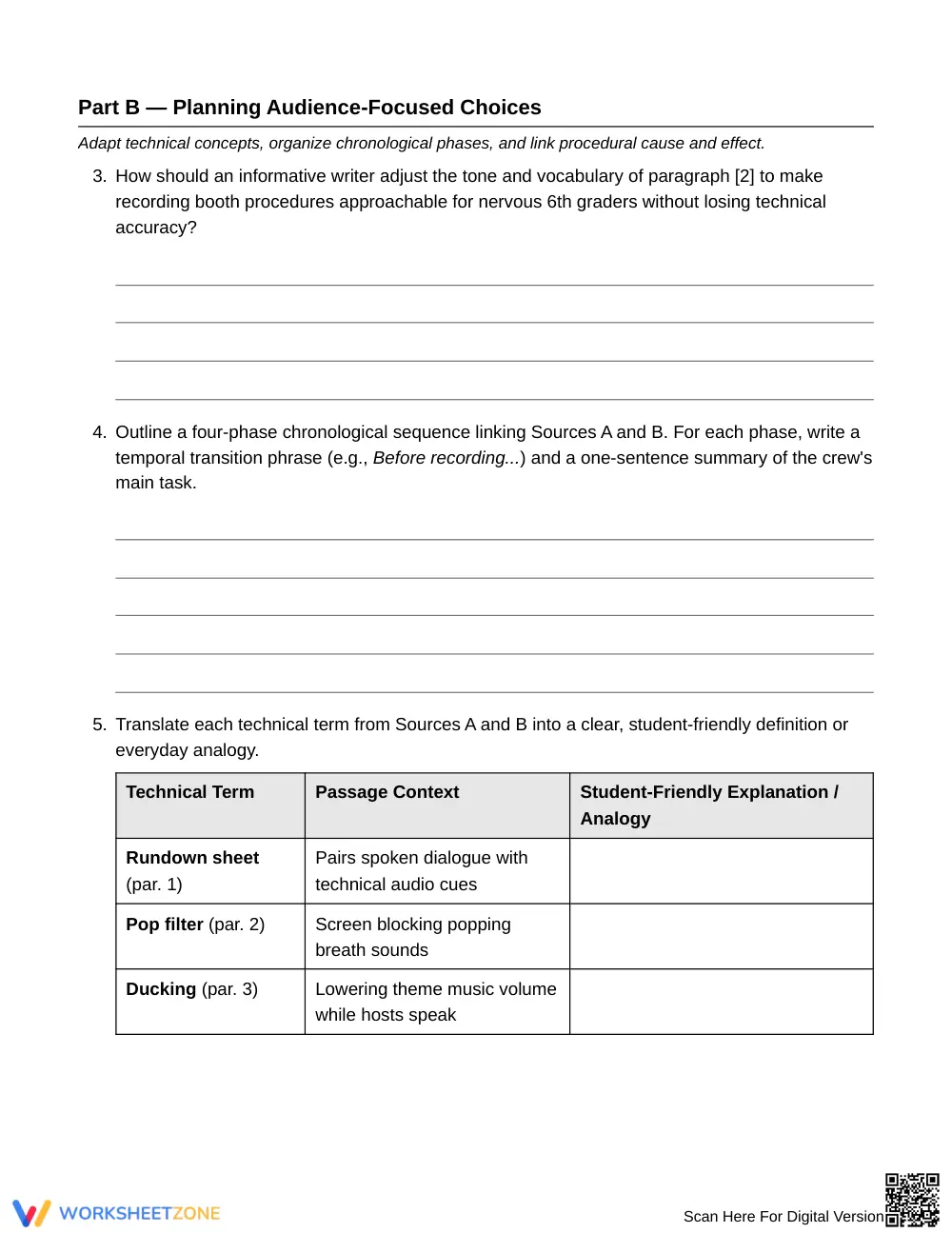
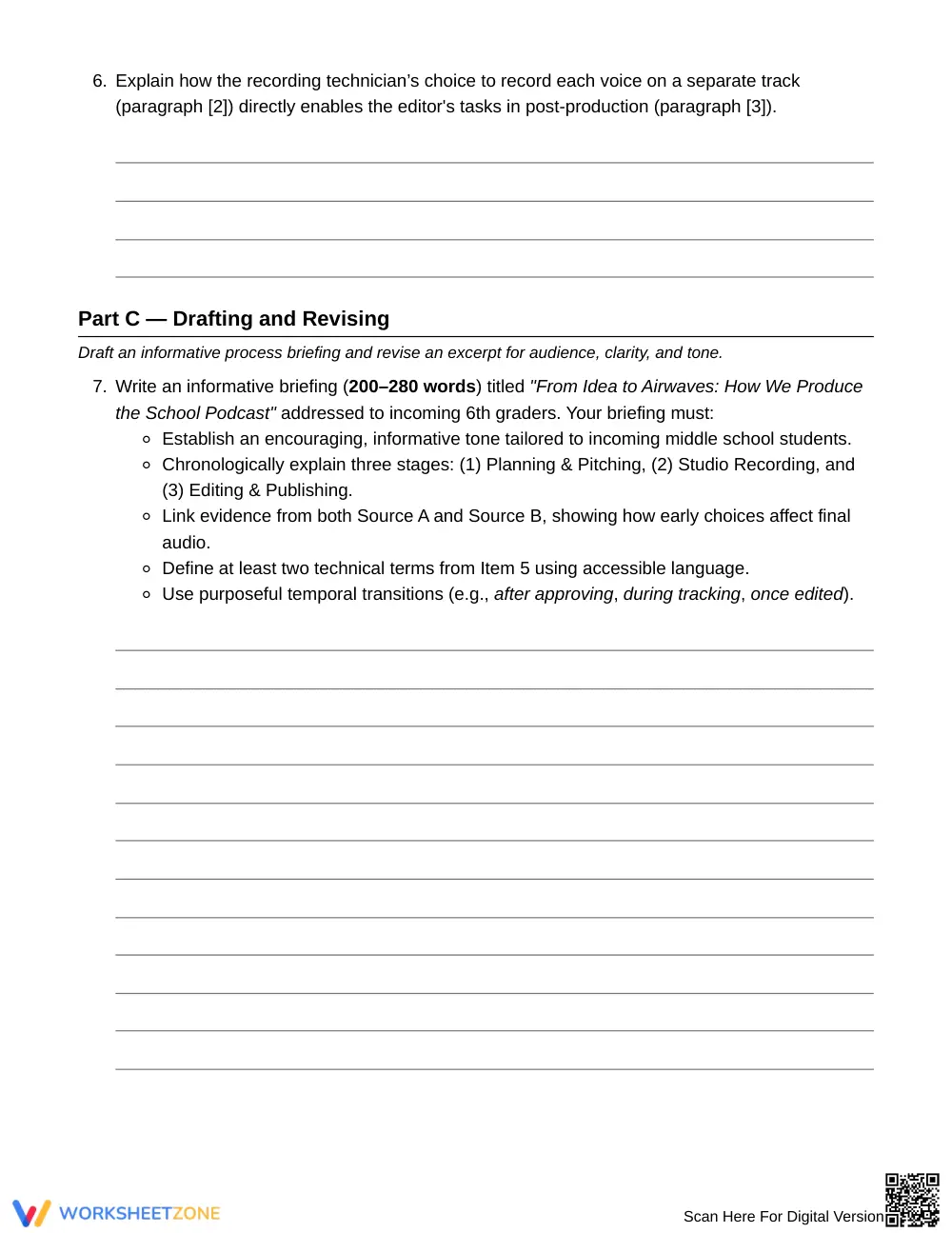
What's Inside: The 5-page printable instructional packet features two paired technical briefings detailing audio capture, mixing, post-production editing, and digital distribution. Across 8 rigorous tasks, students evaluate procedural details, complete a vocabulary translation table for audio engineering terms (such as ducking and pop filters), trace cause-and-effect production workflows, and execute a formal drafting and revision assignment supported by a full 4-page answer key.
Skill Progression
- Guided practice (Tasks 1–2): Students analyze procedural source texts to distinguish essential pre- and post-production steps and identify complex technical data that requires simplification.
- Supported practice (Tasks 3–6): Students adapt technical vocabulary into accessible analogies, map a four-phase chronological sequence using temporal transitions, and analyze procedural cause-and-effect relationships.
- Independent practice (Tasks 7–8): Students draft an original 200–280-word procedural briefing for sixth-grade readers and revise an informal excerpt into professional, clear prose.
This scaffolded progression reflects the gradual release of responsibility model, shifting students systematically from textual analysis to independent, audience-centered writing.
Standards Alignment
This worksheet directly aligns with W.7.4, requiring students to produce clear, coherent writing in which the development, organization, and style are appropriate to task, purpose, and audience. Additionally, it supports RI.7.3 by analyzing the interactions between individuals, events, and ideas in a technical process. Both standard codes can be copied directly into lesson plans, IEP goals, or district curriculum mapping tools.
How to Use It
Use this resource after direct instruction on audience adaptation and transition words in an informative writing unit. It functions effectively as a collaborative small-group drafting lab or an independent summative task. During completion, monitor how students define studio jargon in Part B to verify they understand their target audience. Expected completion time is 45 to 60 minutes.
Who It's For
This activity is designed for Grade 7 ELA classrooms, advanced Grade 6 writers, and middle school media arts electives. Embedded reference charts and explicit writing criteria provide strong structural support for multilingual learners. Pair this resource with an anchor chart on temporal transitions or a mentor text analysis lesson.
According to Fisher & Frey (2014), structured procedural writing tasks that incorporate gradual release frameworks significantly improve adolescent students' ability to adjust register and vocabulary for specific audiences. This Grade 7 informative writing worksheet operationalizes standard W.7.4 by requiring learners to translate complex technical workflows—specifically multi-track audio production and digital podcast mastering—into coherent, accessible steps for sixth-grade peers. By analyzing source texts, establishing chronological sequences with temporal markers, and translating technical jargon into clear analogies, students master audience-aware composition across 8 focused tasks. The resource provides 5 pages of instructional material and a comprehensive 4-page exemplar answer key, ensuring students demonstrate command of developmental organization, tone modulation, and expository precision across both structured analysis and independent drafting.


