


























Views
Downloads


Essential Population Time Lags Worksheet | Grade 10 Biology
Paste this activity's link or code into your existing LMS (Google Classroom, Canvas, Teams, Schoology, Moodle, etc.).
Students can open and work on the activity right away, with no student login required.
You'll still be able to track student progress and results from your teacher account.
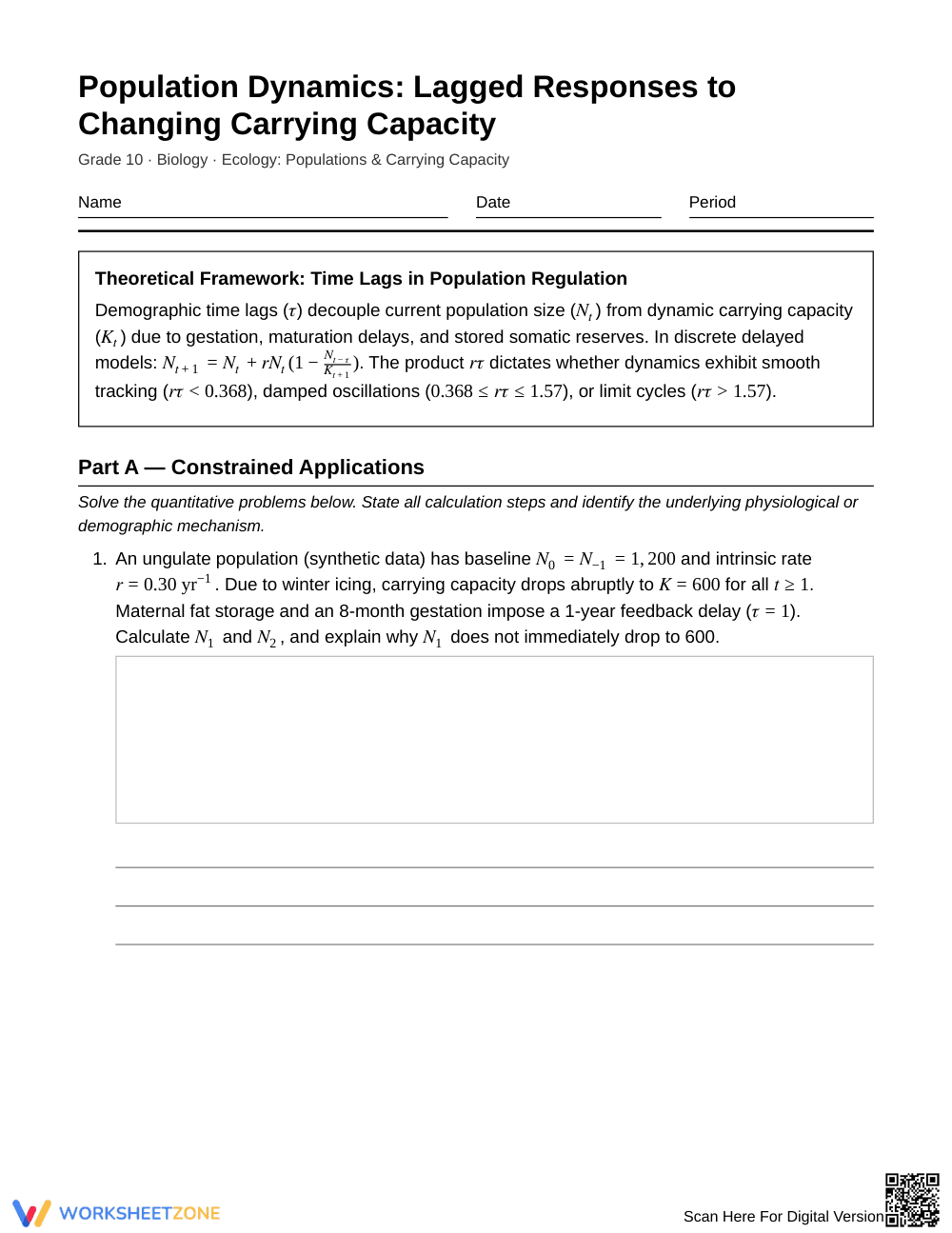
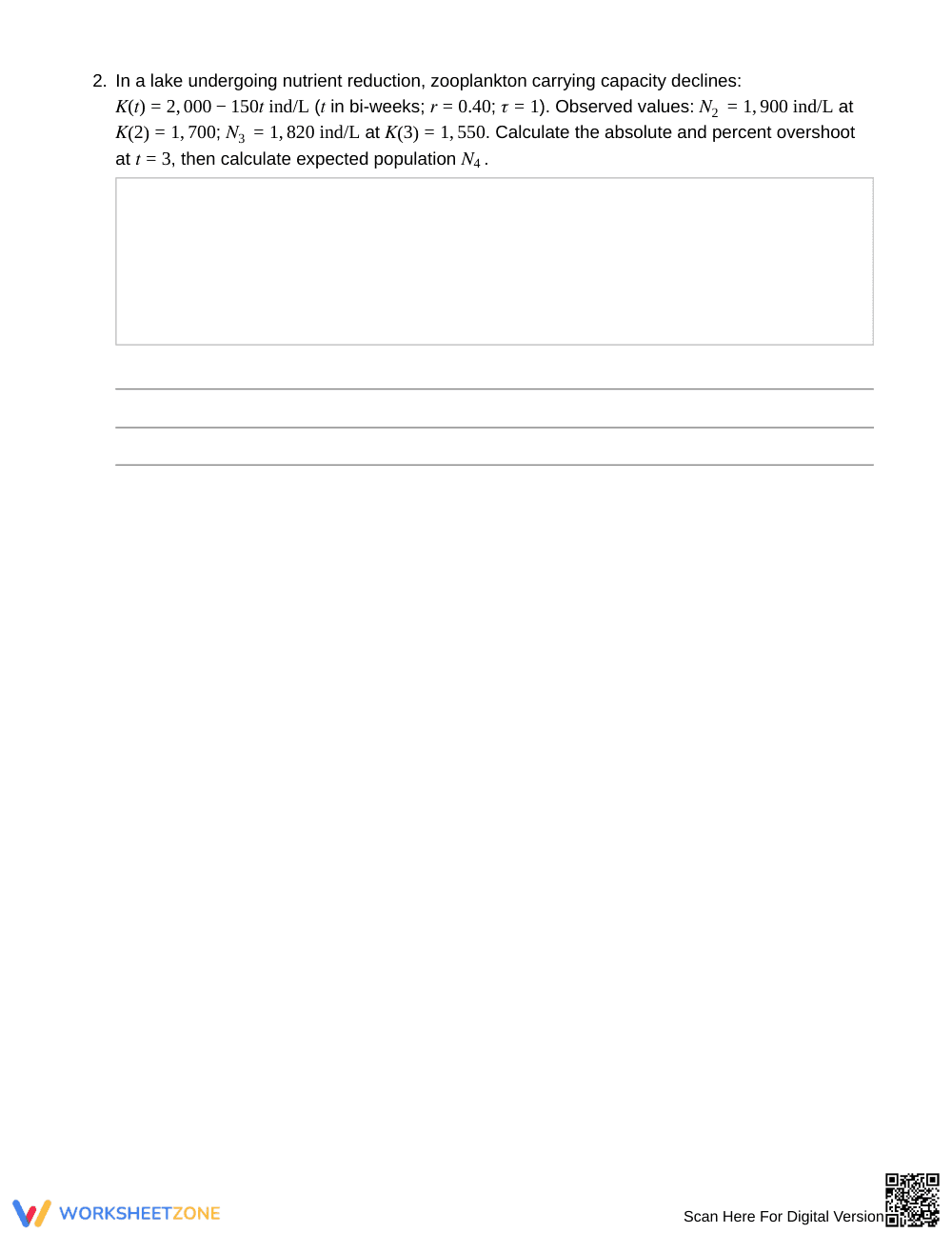
This advanced high school biology worksheet guides students through quantitative modeling of demographic time lags and carrying capacity fluctuations. High school learners analyze how biological delays—such as gestation, cohort maturation, and fat reserves—cause population overshoot, damped oscillations, or demographic crashes across diverse ecological scenarios.
At a Glance
- Grade: 10 · Subject: Biology
- Standard: Population Dynamics — Quantify and explain lagged demographic responses to changing carrying capacities
- Skill Focus: Delayed population regulation and stability modeling
- Format: 5 pages · 6 problems · Answer key included · PDF
- Best For: Advanced population ecology quantitative practice
- Time: 45–60 minutes
What's Inside
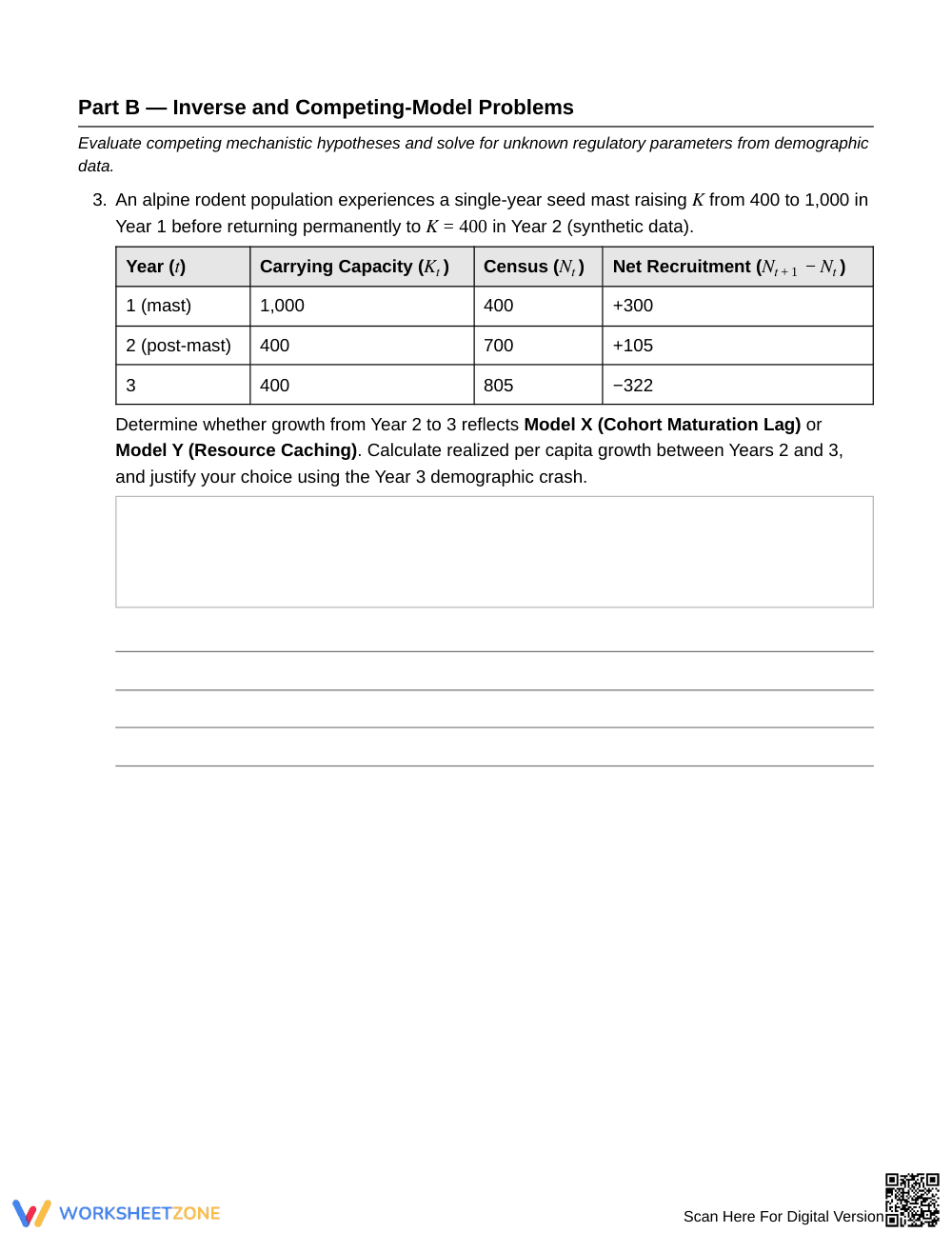
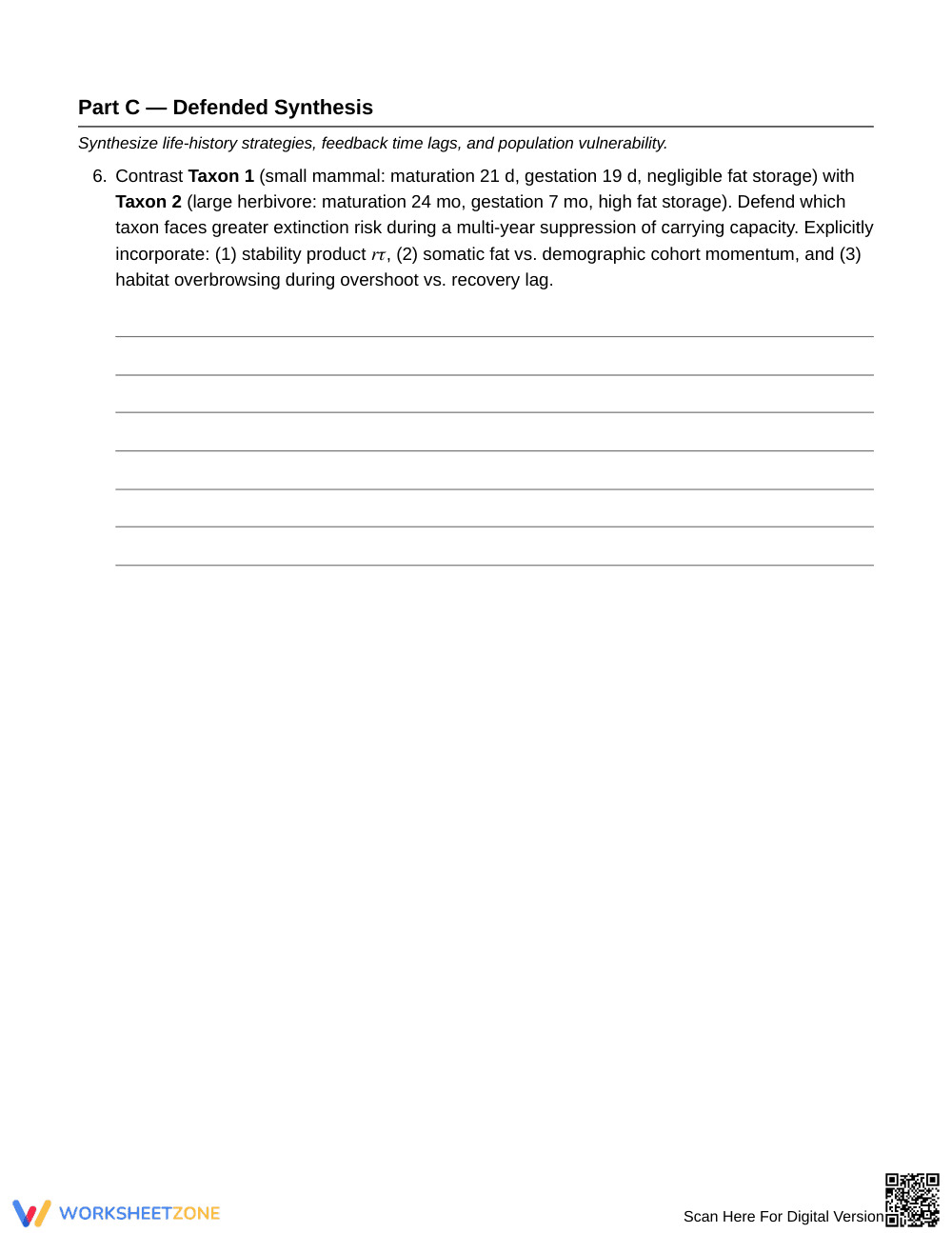
The 5-page worksheet includes a concise theoretical framework on discrete delayed population equations, followed by 6 multi-step problems divided into three analytical sections. Students receive explicit calculation formulas, synthetic demographic data tables, and an exhaustive 2-page answer key with worked mathematical derivations and biological justifications.
Skill Progression
- Guided practice (Part A, Problems 1–2): Students apply discrete delayed growth equations to calculate immediate demographic lags in ungulate and zooplankton populations following carrying capacity shifts.
- Supported practice (Part B, Problems 3–5): Learners evaluate competing demographic hypotheses, calculate stability metrics using the rτ product, and solve inverse equations to determine exact temporal delays.
- Independent practice (Part C, Problem 6): Students synthesize life-history trade-offs by constructing an evidence-based argument contrasting small mammal and large herbivore vulnerability during persistent resource depression.
This structured progression utilizes a gradual-release model, transitioning students from formulaic computation to high-level ecological synthesis and evaluation.
Standards Alignment
This resource aligns with high school life science standards addressing ecosystem interactions, carrying capacity, and computational modeling of population dynamics. Students use mathematical representations to support explanations of factors affecting biodiversity and population size over time. This standard alignment can be copied directly into lesson plans, IEP goals, or district curriculum mapping tools.
How to Use It
Deploy this activity after direct instruction on logistic growth models and carrying capacity limits. It functions effectively during collaborative problem-solving blocks or as an assessment of quantitative ecology skills. For formative assessment, inspect student calculations in Part B to verify whether they correctly distinguish cohort maturation lag from somatic resource storage. Expected completion time is 45 to 60 minutes.
Who It's For
Designed for Grade 10 Honors or AP Biology students, this resource offers targeted differentiation through guided algebraic formulas and multi-tiered analytical tasks. Pair this worksheet with an interactive population simulation or a graphic anchor chart comparing exponential, logistic, and oscillating demographic curves.
According to Fisher & Frey (2014), purposeful scaffolding through gradual-release instructional sequences significantly improves secondary students' ability to transfer complex mathematical models into biological reasoning. This 5-page worksheet embodies that framework by systematically guiding Grade 10 learners through the mechanics of demographic feedback delays and carrying capacity oscillations. Rather than relying on simple rote recall, students engage with authentic quantitative formulas, tabular census data, and life-history trade-offs across 6 rigorous analytical tasks. By bridging discrete differential growth functions with physiological mechanisms like gestation periods and somatic energy reserves, the resource solidifies abstract ecological dynamics into tangible, measurable competencies. The structured progression ensures high school learners master population regulation, evaluate competing ecological models, and articulate defensible scientific explanations under fluctuating environmental constraints.


