


























Views
Downloads

Essential Population Models Worksheet | Grade 10 Biology
Paste this activity's link or code into your existing LMS (Google Classroom, Canvas, Teams, Schoology, Moodle, etc.).
Students can open and work on the activity right away, with no student login required.
You'll still be able to track student progress and results from your teacher account.
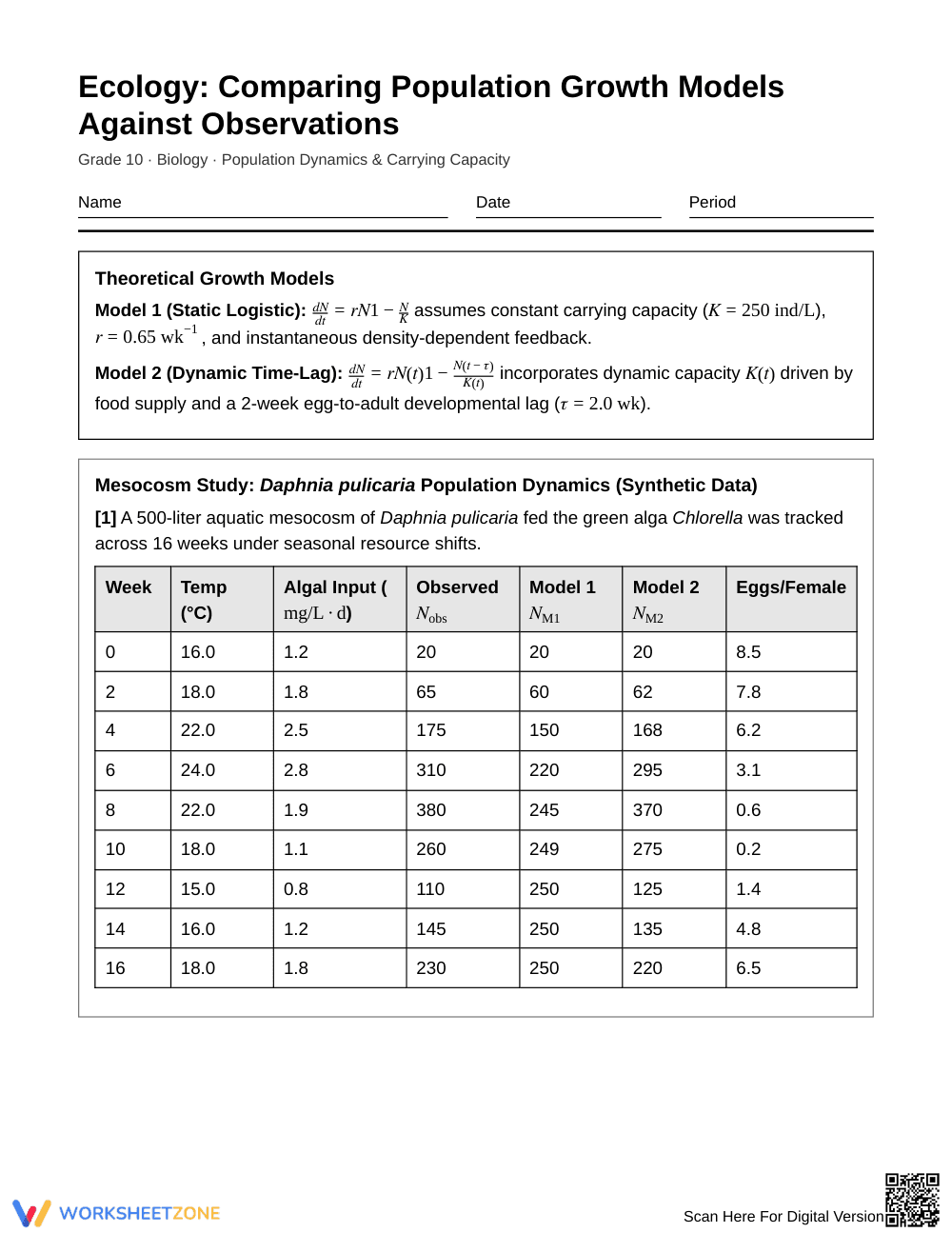
This comprehensive high school biology worksheet challenges students to evaluate theoretical population growth models using empirical mesocosm data. Learners analyze static logistic equations, time-lag models, and real-world Daphnia pulicaria fluctuations, strengthening their scientific reasoning and quantitative analysis skills through rigorous ecological problem sets.
At a Glance
- Grade: 10 · Subject: Biology
- Standard: High School Ecology — Compare mathematical population models against empirical carrying capacity observations
- Skill Focus: Population Growth Models & Carrying Capacity
- Format: 4 pages · 10 problems · Answer key included · PDF
- Best For: High school population ecology and data analysis
- Time: 45–60 minutes
Inside, students work with a complete 16-week mesocosm dataset featuring temperature shifts, algal inputs, fecundity metrics, and comparative model predictions across 4 structured pages. The resource contains 10 rigorous analytical tasks spanning rate calculations, variable isolation, residual error analysis, and mechanistic evaluations, supported by a complete 3-page explanatory answer key.
Skill Progression
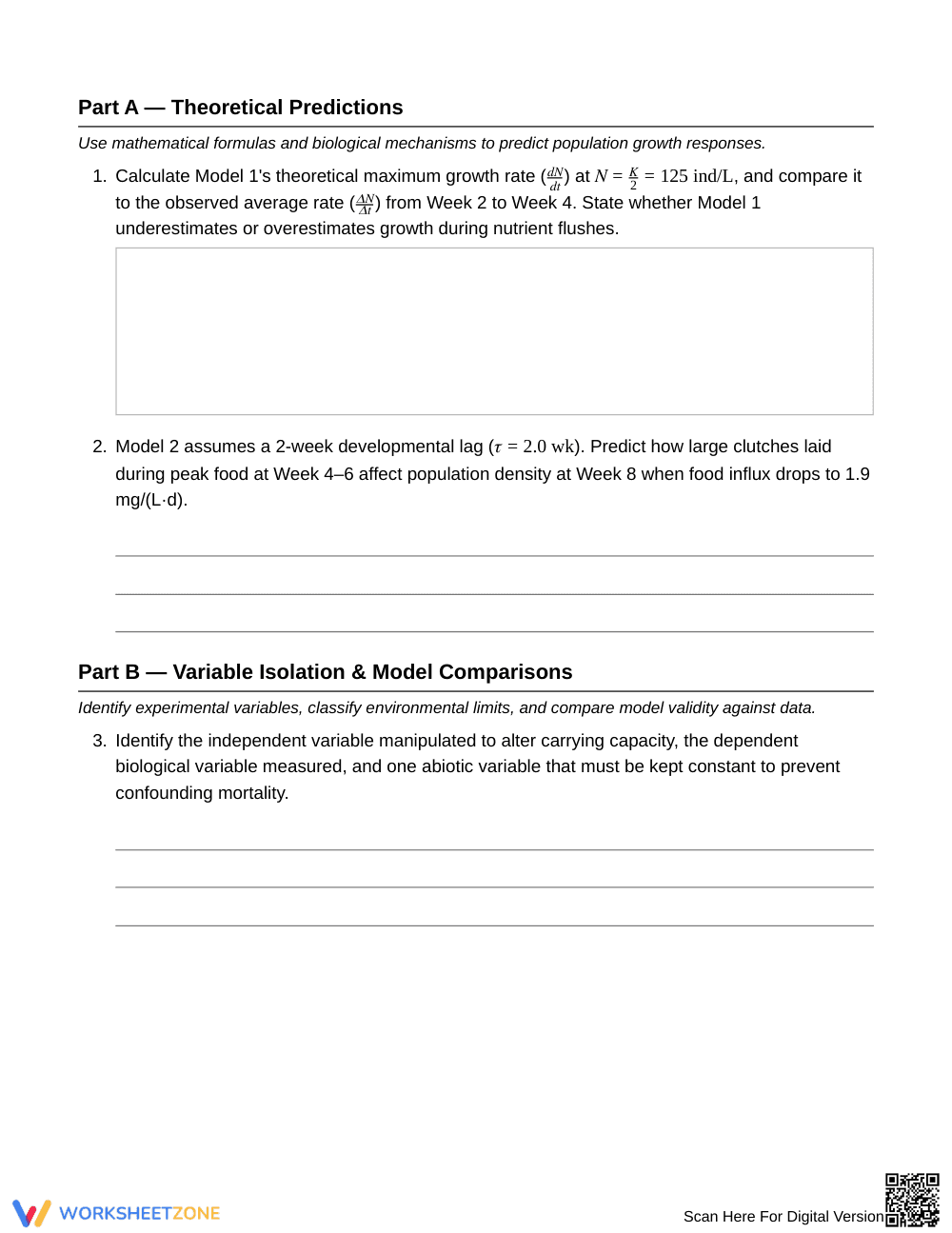
- Guided Practice (Part A, 2 tasks): Students calculate theoretical maximum growth rates under static logistic constraints and predict the impact of developmental time lags using provided mathematical formulas.
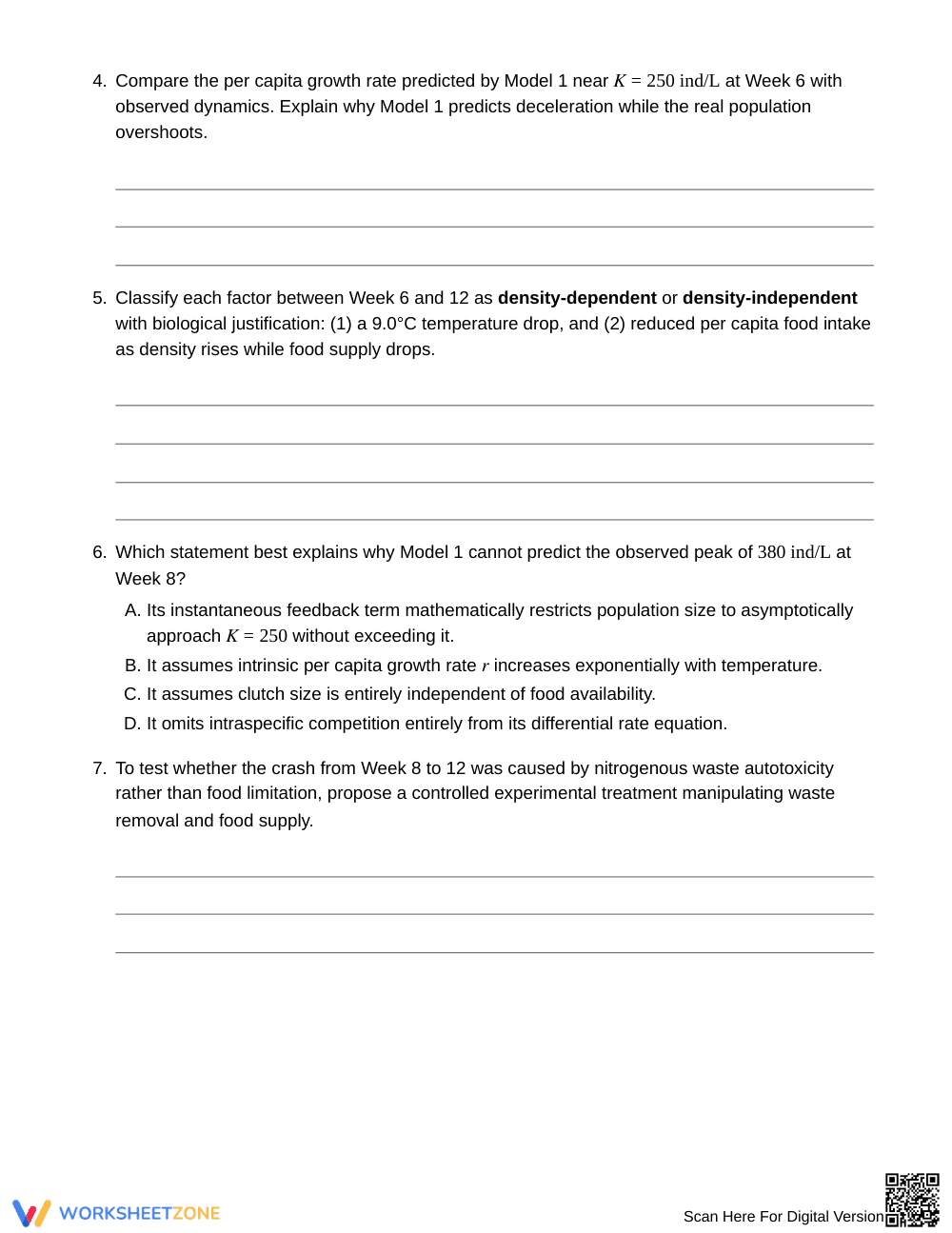
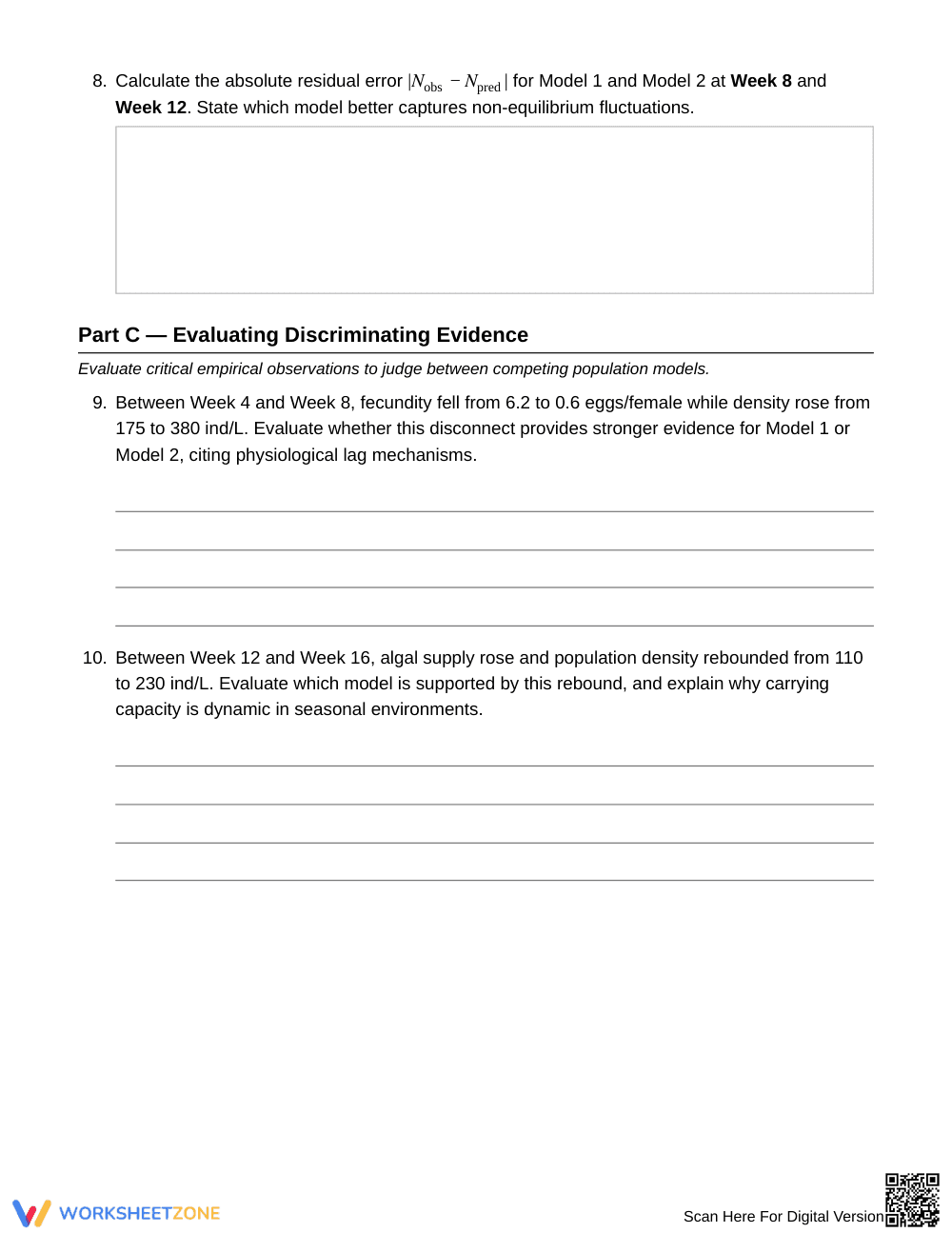
- Supported Practice (Part B, 6 tasks): Learners isolate experimental variables, categorize density-dependent factors, compute absolute residual errors, and identify mathematical limitations of asymptotic models.
- Independent Practice (Part C, 2 tasks): Students synthesize multi-week empirical data to evaluate competing ecological models against biological evidence, such as fecundity disconnects and resource rebounds.
This structured progression follows the gradual-release framework, moving learners from formula application to complex ecological model evaluation.
Standards Alignment
This activity aligns with high school life science standards requiring students to evaluate mathematical representations to support explanations of factors affecting carrying capacities and population dynamics. Curriculum coordinators can copy these conceptual alignments directly into district lesson plans, IEP goals, or curriculum maps.
How to Use It
Deploy this worksheet after direct instruction on logistic growth equations and carrying capacity. For small-group investigation, have student pairs compare Model 1 and Model 2 error metrics before convening for a whole-class debate. During work time, formatively assess whether students recognize time lags as biological mechanisms for population overshoot. Expected completion time is 45 to 60 minutes.
Who It's For
This resource is designed for Grade 10 Biology and Advanced Placement Environmental Science students mastering ecological dynamics. It offers built-in scaffolding through structured data tables while challenging advanced analytical thinkers. Pair this activity with a hands-on yeast or protist population lab for maximum conceptual reinforcement.
Evaluating mathematical models against real-world ecological observations is essential for secondary biology mastery. When students analyze population carrying capacity through authentic data sets, they transition from passive formula memorization to active scientific inquiry. According to Fisher & Frey (2014), structured gradual-release frameworks provide the necessary cognitive scaffolding for complex quantitative modeling, allowing high school students to isolate independent variables, evaluate density-dependent limiting factors, and quantify model discrepancies with high fidelity. By comparing static differential rate equations with dynamic time-lag models using 16-week mesocosm data, Grade 10 learners develop critical reasoning skills directly transferable to advanced ecological research and standardized science assessments. This 4-page, 10-task worksheet reinforces conceptual understanding of carrying capacity shifts, fecundity lags, and population oscillation patterns, ensuring that students achieve enduring scientific literacy and quantitative data analysis competency across life science curricula.


