


























Views
Downloads



Essential Population Growth Worksheet | Grade 10 Biology
Paste this activity's link or code into your existing LMS (Google Classroom, Canvas, Teams, Schoology, Moodle, etc.).
Students can open and work on the activity right away, with no student login required.
You'll still be able to track student progress and results from your teacher account.
This comprehensive biology worksheet equips Grade 10 students to analyze, calculate, and contrast exponential and logistic population growth models. Learners apply core ecological equations to quantify instantaneous rates, evaluate carrying capacity constraints, and interpret environmental disruptions. Through structured numerical problem-solving, students master how density-dependent limiting factors regulate natural populations.
At a Glance
- Grade: 10 · Subject: Biology
- Standard: Population Dynamics — Model carrying capacity and growth rates using mathematical representations
- Skill Focus: Exponential vs. Logistic Population Growth Models
- Format: 5 pages · 12 problems · Answer key included · PDF
- Best For: Quantitative ecology unit practice
- Time: 45–60 minutes
What's Inside
Distributed across five rigorous pages, this resource features 12 multi-part calculation and analytical tasks accompanied by a reference formula header. Students work with real-world ecological scenarios involving Daphnia, minnows, white-tailed deer, and bacterial cultures. A complete two-page answer key provides step-by-step mathematical solutions and biological explanations for every item.
Skill Progression
- Guided Practice (Part A, Problems 1–3): Direct calculations using provided formulas for instantaneous growth rate, logistic carrying capacity, and peak growth inflection points with explicit variable prompts.
- Supported Practice (Part B, Problems 4–9): Multi-step limiting factor scenarios requiring students to analyze tabular census data, calculate percent decreases during drought, and contrast r-selected and K-selected life histories.
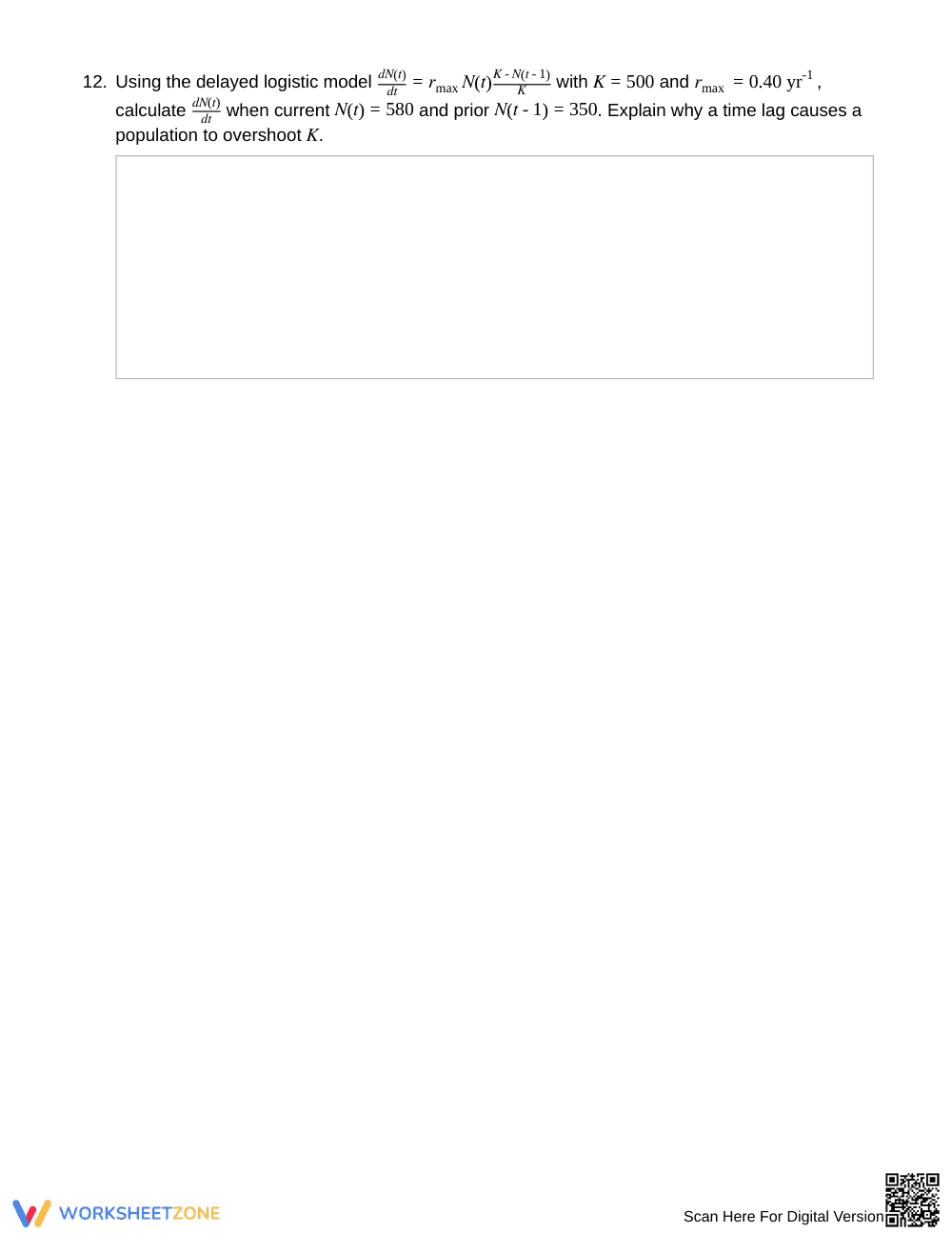
- Independent Practice (Part C, Problems 10–12): Advanced environmental applications requiring students to model seasonal collapses, per capita comparative rates, and time-lag overshoots using delayed logistic equations.
This sequence mirrors the gradual-release model, transitioning students from mechanical formula substitution to complex ecological reasoning.
Standards Alignment
This worksheet addresses secondary life science standards requiring mathematical and computational representations to support explanations of factors affecting population size and carrying capacities within ecosystems. Students evaluate how resource availability and reproductive rates govern population dynamics. Curriculum coordinators can link these analytical exercises directly into biology unit plans, IEP tracking documents, and district curriculum pacing guides.
How to Use It
Deploy this worksheet immediately after introducing logistic equations during direct instruction, or assign it as an intensive mid-unit review before summative testing. For formative assessment, examine student responses to Problem 5: verify whether students correctly cite the declining per capita rate as evidence of density-dependent regulation rather than confusing it with environmental stochasticity. Most sophomores complete all 12 tasks within 45 to 60 minutes.
Who It's For
Crafted for Grade 10 general biology and honors biology students, this resource offers targeted reinforcement for learners developing quantitative scientific literacy. It pairs naturally with an introductory lecture on limiting factors or an interactive population ecology computer simulation.
Quantitative literacy in secondary life science is foundational to understanding ecological stability and environmental change. According to Fisher & Frey (2014), purposeful guided practice paired with systematic mathematical modeling solidifies complex conceptual transfer in high school science classrooms. This 12-task worksheet operationalizes exponential and logistic growth dynamics through rigorous, contextualized biological problems. By calculating instantaneous growth rates, identifying carrying capacity thresholds, and evaluating per capita census trends, students connect abstract differential notation to observable natural phenomena. The structured progression ensures learners transition smoothly from basic rate computations to sophisticated ecological models involving seasonal carrying capacity drops and delayed reproductive time lags. Complete with a two-page worked answer key, this resource provides an empirical anchor for instructional units covering population ecology and resource limitation.


