



























Essential Population Change Worksheet | Grade 9 Biology
Paste this activity's link or code into your existing LMS (Google Classroom, Canvas, Teams, Schoology, Moodle, etc.).
Students can open and work on the activity right away, with no student login required.
You'll still be able to track student progress and results from your teacher account.
This Grade 9 biology worksheet helps high school students master evolutionary mechanisms by dismantling common teleological misconceptions about adaptation. Through a realistic 10-year finch drought dataset, learners analyze how non-intentional natural selection drives population-level phenotypic shifts across generations rather than deliberate, individual organism changes.
At a Glance
- Grade: 9 · Subject: Biology
- Standard: Natural Selection — Explain how differential survival drives population trait shifts without conscious intent
- Skill Focus: Explain Population Change Without Intent
- Format: 5 pages · 12 problems · Answer key included · PDF
- Best For: Conceptual biology practice and formative assessment
- Time: 45–60 minutes
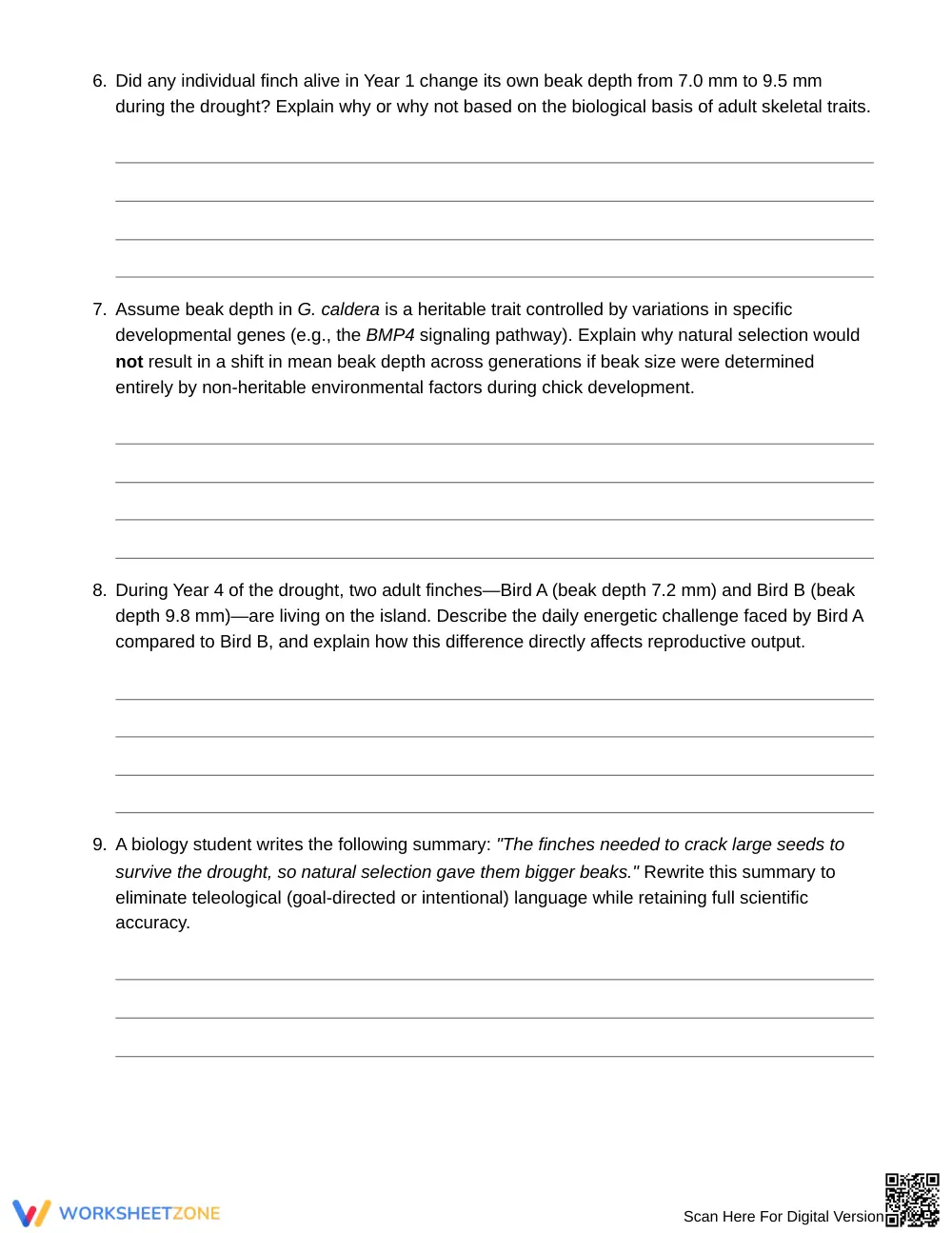
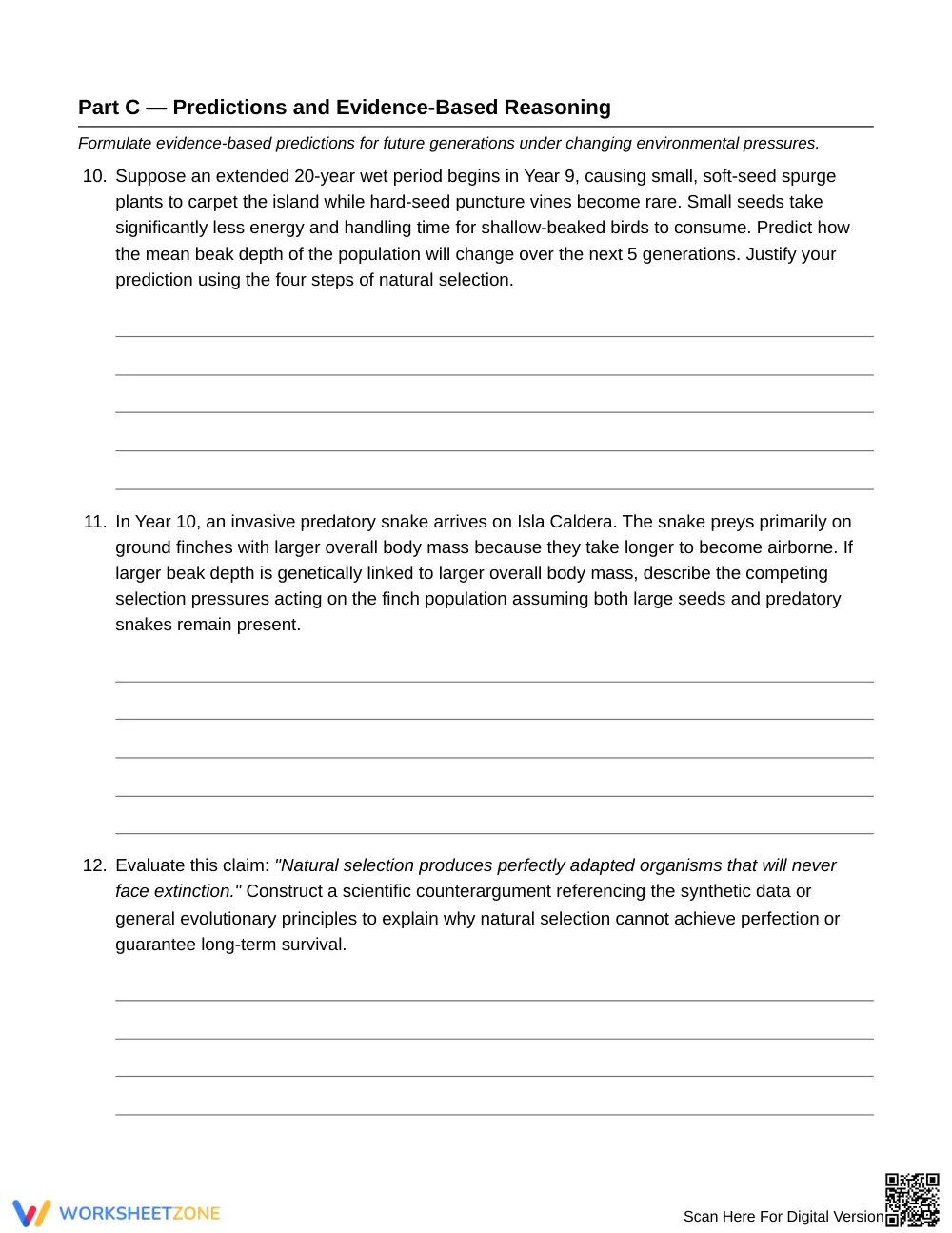
This 5-page printable resource includes an anchor review of the four core tenets of natural selection, followed by a multi-year synthetic field study featuring seed abundance and beak depth metrics. Across 12 rigorous tasks, students answer short-response foundational prompts, evaluate data tables, revise teleological student statements, and formulate predictive evolutionary models. A complete 4-page answer key provides explicit reasoning targets.
Skill Progression
- Guided practice (Part A, 3 prompts): Students define fundamental evolutionary parameters, distinguishing lifetime physiological acclimation from multigenerational genetic adaptation while correcting common mutation misconceptions.
- Supported practice (Part B, 6 prompts): Learners analyze Isla Caldera field data, linking mortality rates and resource pressures to phenotypic shifts, while translating goal-oriented summaries into objective biological descriptions.
- Independent practice (Part C, 3 prompts): Students apply principles to novel environmental scenarios, modeling multi-generation trait reversals and competing selection pressures.
This scaffolded architecture reinforces the gradual-release framework, guiding students from foundational terminology to nuanced evolutionary modeling.
Standards Alignment
This learning activity aligns directly with high school life science standards addressing biological evolution and natural selection. Students construct explanations based on evidence that traits in a population shift via differential reproductive success rather than organismal need. Both standard codes can be copied directly into lesson plans, IEP goals, or district curriculum mapping tools.
How to Use It
Deploy this worksheet after direct instruction on Darwinian mechanics. First, utilize Part A as an in-class collaborative check for understanding to target Lamarckian thinking early. Second, assign Parts B and C as an independent post-lab synthesis. Formatively assess student explanations by listening for goal-directed verbs like "needed" or "wanted" to catch intuitive teleology. Expected completion time ranges from 45 to 60 minutes.
Who It's For
Designed for Grade 9 general and honors biology classes, this assignment provides accessible data tables alongside demanding analytical writing prompts. For emerging bilingual learners, the foundational principle box supports academic vocabulary. Pair this worksheet directly with a physical bird-beak lab simulation or natural selection slide presentation for maximum instructional impact.
Addressing persistent evolutionary misconceptions requires structured instructional scaffolds that explicitly separate individual acclimation from population adaptation. According to Fisher & Frey (2014), gradual-release instructional sequences establish deliberate opportunities for learners to confront cognitive gaps before independently demonstrating mastery. In high school life science, students routinely default to anthropomorphic or teleological reasoning, erroneously asserting that organisms deliberately alter their physical traits in response to environmental hardships. This 12-task worksheet directly targets that misconception by requiring ninth-grade students to explain population change without intent using empirical field study data. By transitioning students from conceptual contrast definitions to data-supported mechanism analyses and multi-generational predictions, the curriculum cultivates scientific literacy and accurate mechanistic language. High schoolers demonstrate genuine biological competence by explaining trait shifts as statistical outcomes of differential reproductive success, effectively grounding evolutionary biology in empirical, non-teleological cause-and-effect reasoning.


