


































Essential Newton's Third Law Worksheet | Grade 8-12 Science

Paste this activity's link or code into your existing LMS (Google Classroom, Canvas, Teams, Schoology, Moodle, etc.).
Students can open and work on the activity right away, with no student login required.
You'll still be able to track student progress and results from your teacher account.
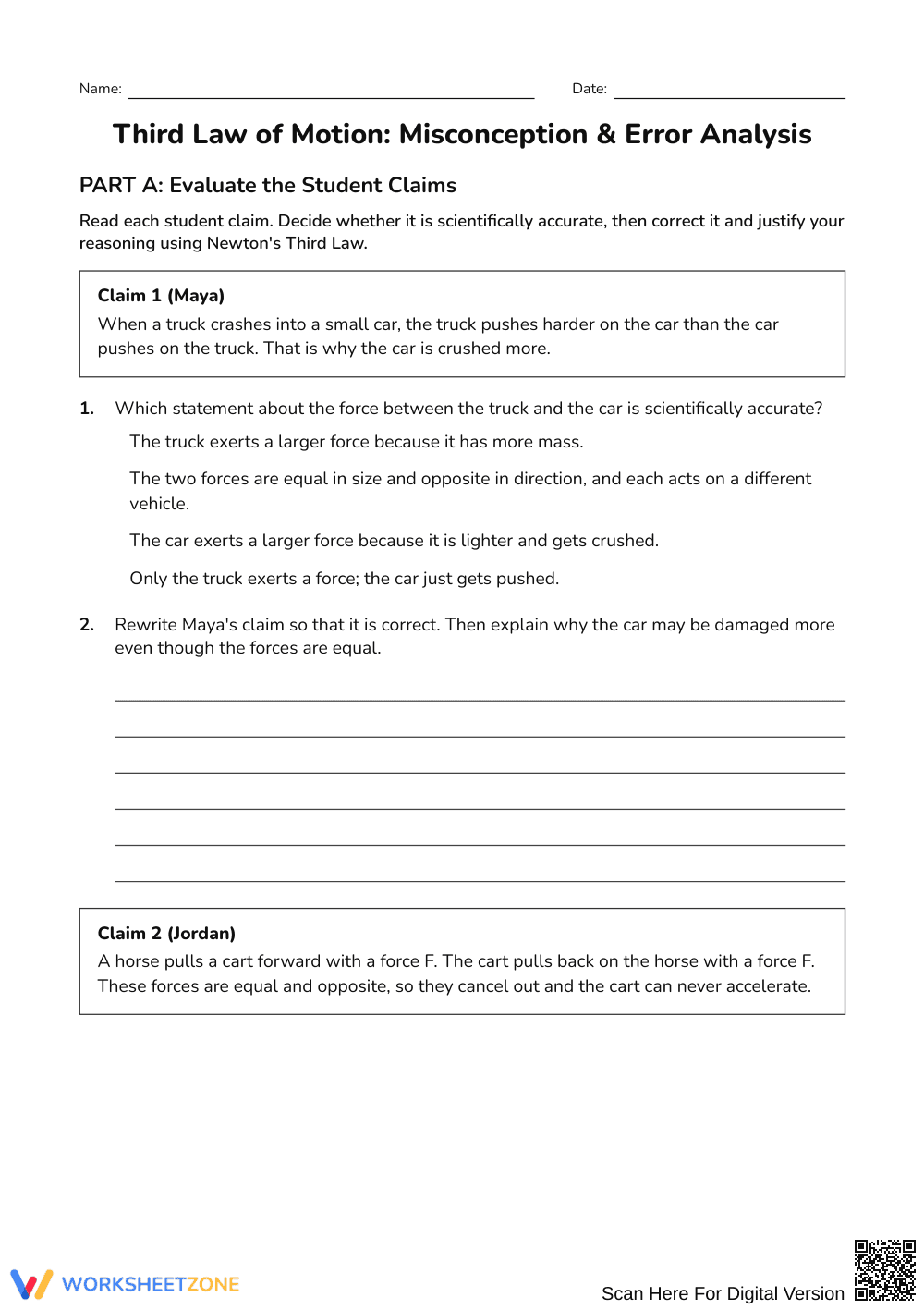
This comprehensive physical science worksheet equips students in grades 8 through 12 to identify, correct, and justify common misconceptions about Newton's Third Law of Motion. Learners examine flawed peer claims regarding collision forces, canceling action-reaction pairs, and propulsion in vacuums, building rigorous conceptual understanding through evidence-based scientific argumentation.
At a Glance
- Grade: 8–12 · Subject: Science
- Standard:
N/A— Apply Newton's Third Law to analyze force pairs and motion- Skill Focus: Misconception analysis and scientific justification
- Format: 4 pages · 20 problems · Answer key included · PDF
- Best For: Conceptual review and misconception remediation
- Time: 45–60 minutes
What's Inside
The four-page printable packet features two distinct sections containing 20 structured analysis items. Part A presents authentic student dialogue scenarios where learners evaluate claims, correct scientific errors, and explain underlying mechanics. Part B integrates quantitative collision modeling with tabular force-sensor readings and acceleration calculations, complemented by a complete four-page teacher answer key with exemplar written justifications.
Skill Progression
- Guided practice (Problems 1–6): Scaffolding begins with structured multiple-choice identification and guided sentence prompts evaluating vehicle collision dynamics and force reciprocity.
- Supported practice (Problems 7–14): Students transition to identifying why internal action-reaction pairs cannot cancel external motion, constructing independent written counterarguments for horse-cart and rocket propulsion systems.
- Independent practice (Problems 15–20): Unassisted collision data analysis where students interpret sensor tables, calculate mass-dependent accelerations, and justify Newton's third law mathematically.
This sequence mirrors the gradual release model (I Do, We Do, You Do), establishing foundational conceptual principles before demanding independent mathematical synthesis.
Standards Alignment
This resource aligns with physical science standards governing forces and interactions, specifically the expectation that students apply Newton's Third Law of Motion to design solutions and analyze equal and opposite forces between interacting bodies. The instructional design reinforces how equal interaction forces produce unequal accelerations on unequal masses. Both standard codes can be copied directly into lesson plans, IEP goals, or district curriculum mapping tools.
How to Use It
Deploy this worksheet after direct instruction on Newton's laws to deepen conceptual mastery. It serves effectively as a mid-unit checkpoint or collaborative partner activity during error analysis stations. During independent work, conduct formative observations by checking whether students explain that action-reaction pairs act on different objects rather than canceling out. Expect completion within 45 to 60 minutes.
Who It's For
Designed for introductory physical science, general high school physics, and conceptual physics classes. Tiered open-response questions support English language learners through concrete real-world contexts, while quantitative acceleration extensions challenge advanced learners. Pair this assignment directly with interactive collision cart simulations or an introductory demonstration on skateboard propulsion.
According to Fisher & Frey (2014), systematic error analysis and peer-claim evaluation accelerate cognitive restructuring around counterintuitive physical science principles. Newton's Third Law presents documented pedagogical hurdles because students routinely conflate force magnitude with observable damage or mass-dependent acceleration. By engaging students in 20 targeted tasks that deconstruct flawed assertions and analyze empirical force-sensor data, this four-page resource directly addresses these documented intuitive fallacies. Learners demonstrate that action-reaction pairs act on reciprocal bodies with equivalent magnitude across all collision intervals, reinforcing the mathematical relationship between force, mass, and resultant acceleration. The integrated four-page answer key provides clear diagnostic baselines, allowing instructors to evaluate whether secondary learners have successfully replaced intuitive mechanical heuristics with robust, scientifically accurate physical reasoning.


