


























Views
Downloads




Essential Negative Feedback Worksheet | Grade 10 Biology
Paste this activity's link or code into your existing LMS (Google Classroom, Canvas, Teams, Schoology, Moodle, etc.).
Students can open and work on the activity right away, with no student login required.
You'll still be able to track student progress and results from your teacher account.
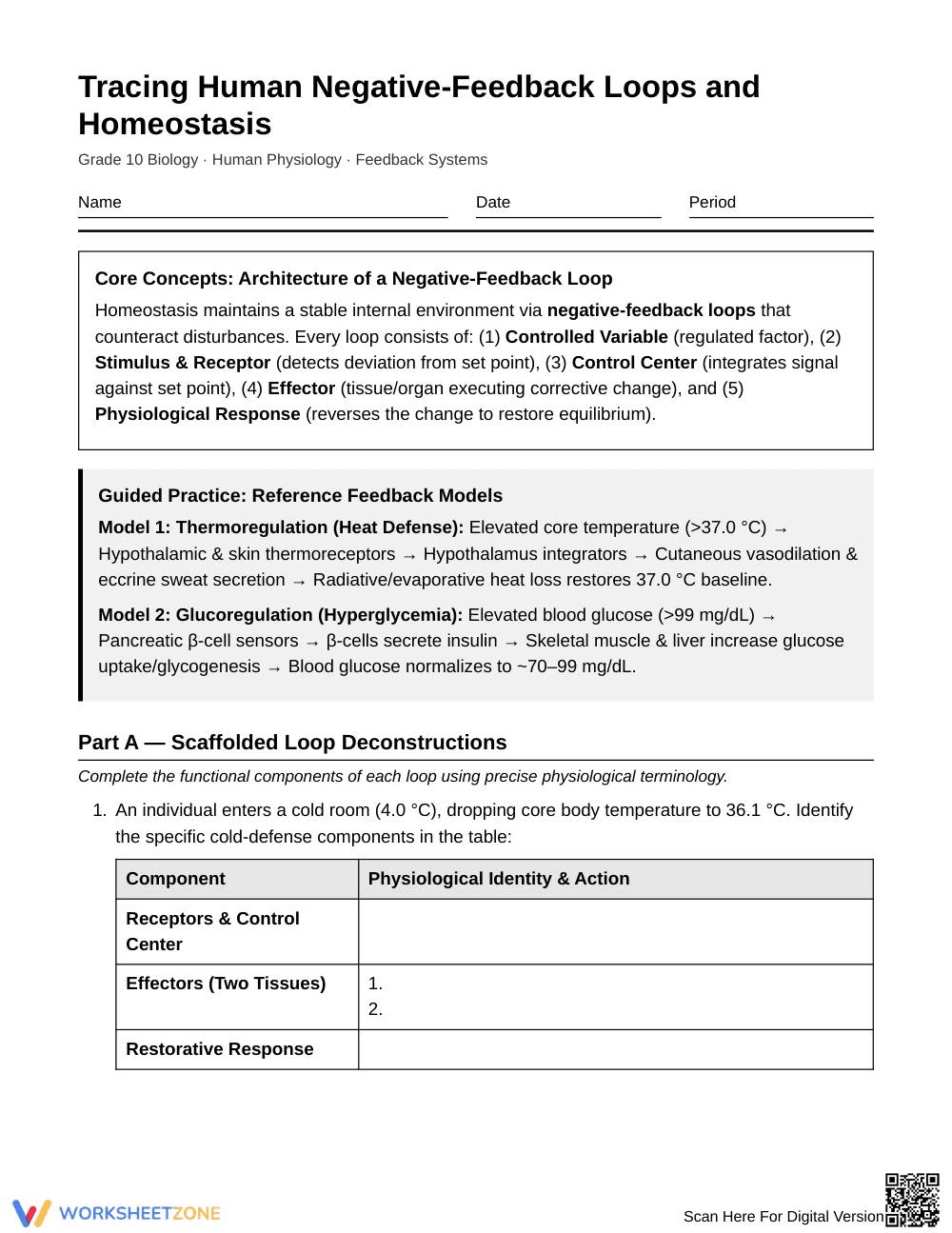
This biology worksheet guides tenth-grade students through tracing and analyzing negative-feedback loops in human physiology. Students evaluate homeostatic set points, identify receptors and effectors, interpret authentic physiological data, and contrast corrective feedback with disruptive responses to master thermoregulation, glucoregulation, and osmoregulation mechanisms.
At a Glance
- Grade: 10 · Subject: Biology
- Standard: Investigate and model how negative-feedback mechanisms maintain human physiological homeostasis
- Skill Focus: Trace a Negative-Feedback Loop
- Format: 5 pages · 10 problems · Answer key included · PDF
- Best For: High school physiology and homeostasis units
- Time: 45–60 minutes
What's Inside: The 5-page worksheet features 10 analytical tasks across three sections. It includes foundational architecture models for thermoregulation and glucoregulation, structured data tables, pathway deconstructions, and a 2-page answer key with model explanations for efficient grading.
Skill Progression
- Guided practice (Part A — 3 problems): Students deconstruct cold-defense and fasting glucoregulation pathways using labeled tables and analyze postprandial glucose-insulin data using provided reference models.
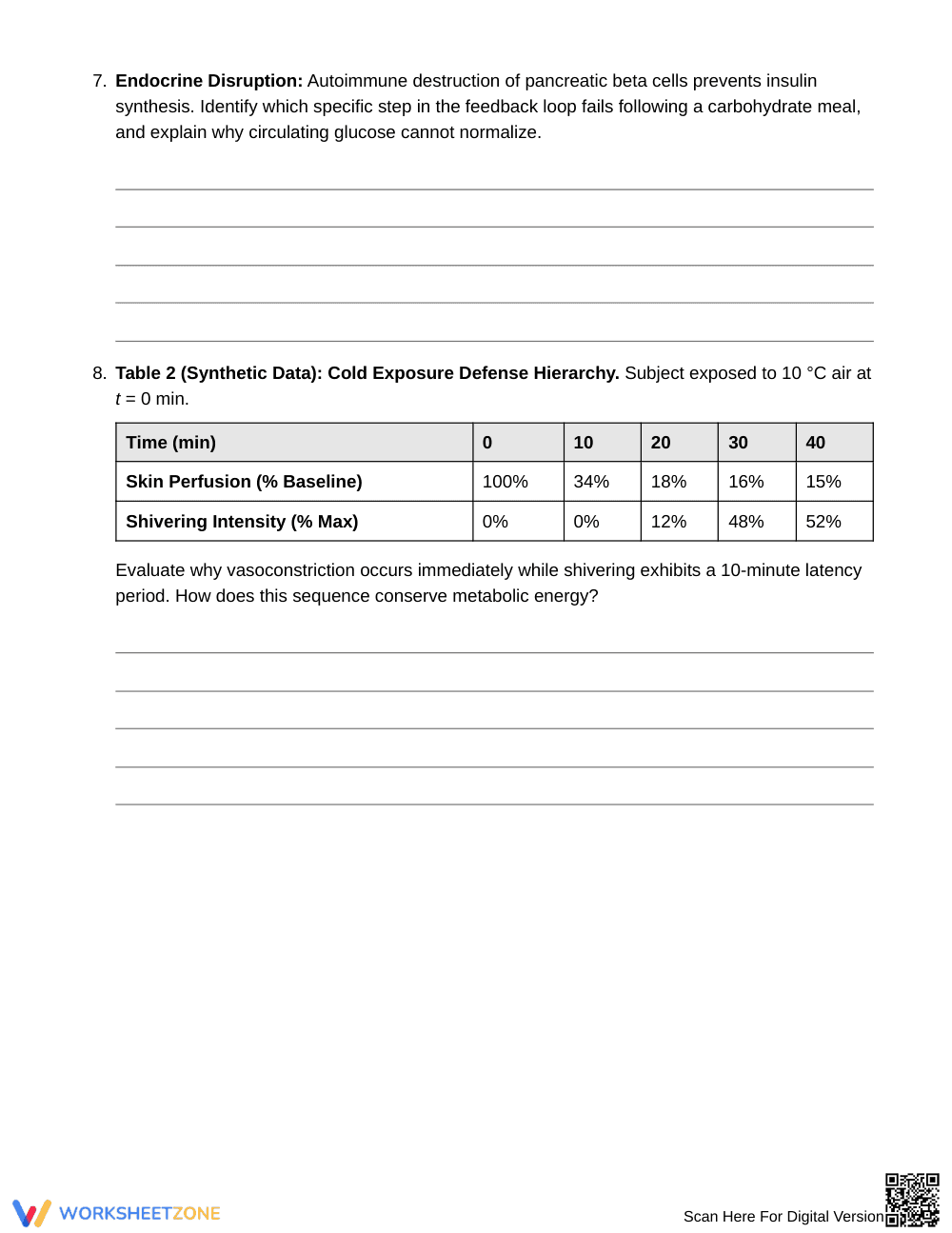
- Supported practice (Part B — 5 problems): Learners apply feedback principles to cutaneous vascular dynamics, exercise hyperthermia, osmoregulation with antidiuretic hormone, beta-cell failure, and cold-exposure latency data.
- Independent practice (Part C — 2 problems): Students synthesize dynamics by contrasting negative and positive feedback mechanisms and defending homeostasis as a dynamic equilibrium.
This sequence follows a gradual-release model transitioning learners from guided identification to independent physiological systems analysis.
Standards Alignment
This resource aligns with high school life science standards requiring students to illustrate how feedback mechanisms maintain dynamic homeostasis. Students evaluate physiological data and describe how interacting organ systems adjust to disturbances. Both standard codes can be copied directly into lesson plans, IEP goals, or district curriculum mapping tools.
How to Use It
Deploy this worksheet following direct instruction on homeostatic principles or as a mid-unit formative check. Have student pairs analyze the glucose data in Part A before completing the disruption scenarios in Part B independently. During practice, check whether students distinguish receptor detection from effector responses. The assignment requires 45 to 60 minutes to complete.
Who It's For
Designed for Grade 10 biology and introductory anatomy students, this worksheet supports diverse learners through structured tables and scaffolded prompts. Advanced students analyze complex disruption data, while developing learners rely on the reference models. Pair this resource with a homeostasis anchor chart or introductory physiology lesson.
Mastering physiological homeostasis requires high school biology students to systematically trace how receptors, control centers, and effectors coordinate corrective responses. According to research synthesized by Fisher & Frey (2014), structured gradual-release frameworks significantly enhance secondary students' ability to conceptualize multi-step biological systems and transfer conceptual knowledge to novel problem-solving tasks. This Grade 10 worksheet operationalizes that pedagogical approach across 10 targeted tasks, guiding learners from structured feedback pathway deconstructions through authentic quantitative data interpretation and complex disruption analysis. By working directly with real-world physiological phenomena such as thermoregulation, postprandial blood glucose stabilization, and renal osmoregulation, students construct deep mechanistic understanding rather than memorizing isolated anatomical facts. The 5-page printable resource includes structured reference models and an exhaustive 2-page answer key, giving educators an effective classroom-ready tool to assess systems-level reasoning and verify student mastery of dynamic physiological equilibrium.


