































Essential Natural Selection Worksheet | Grades 8‑12 Science

Paste this activity's link or code into your existing LMS (Google Classroom, Canvas, Teams, Schoology, Moodle, etc.).
Students can open and work on the activity right away, with no student login required.
You'll still be able to track student progress and results from your teacher account.
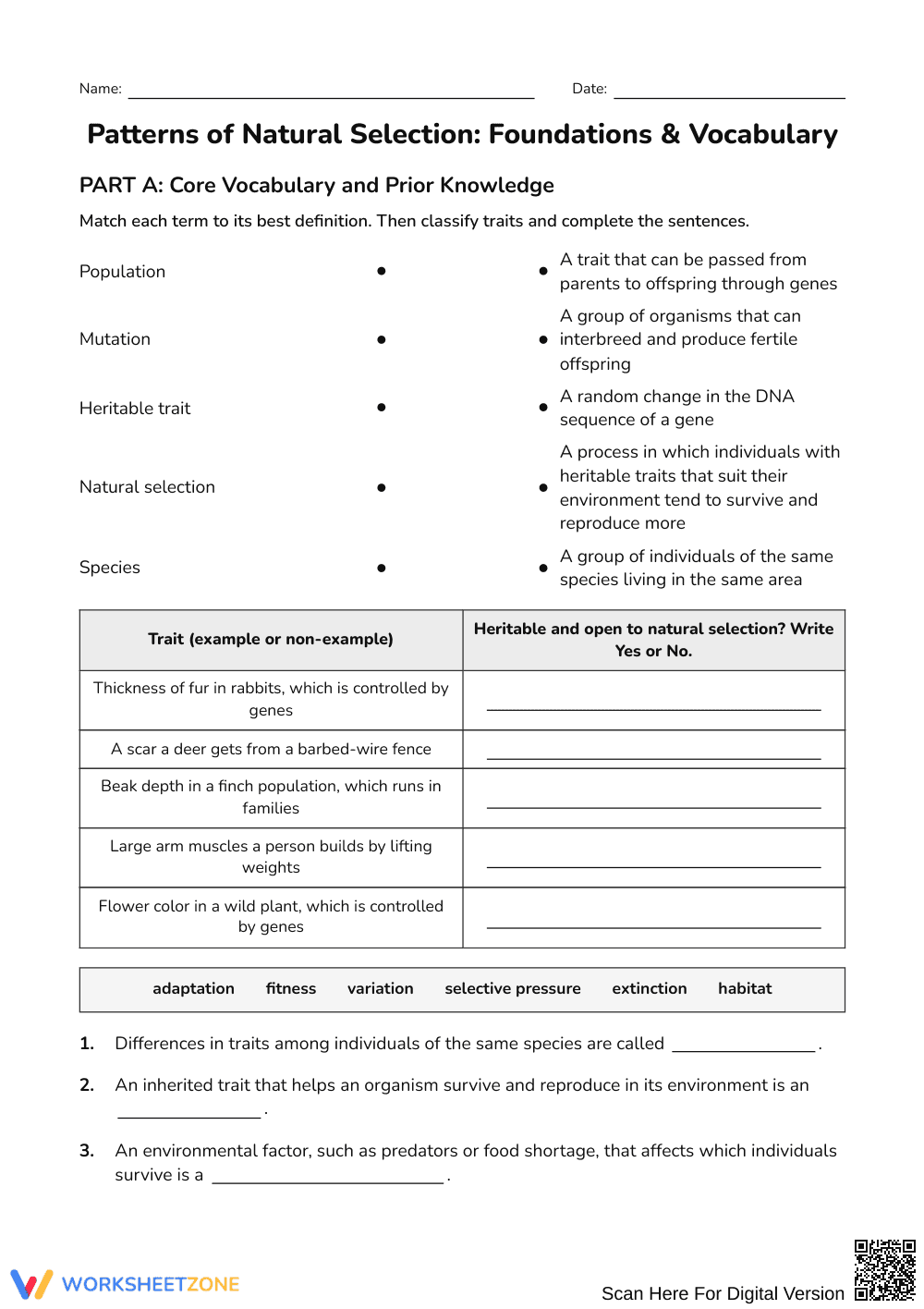
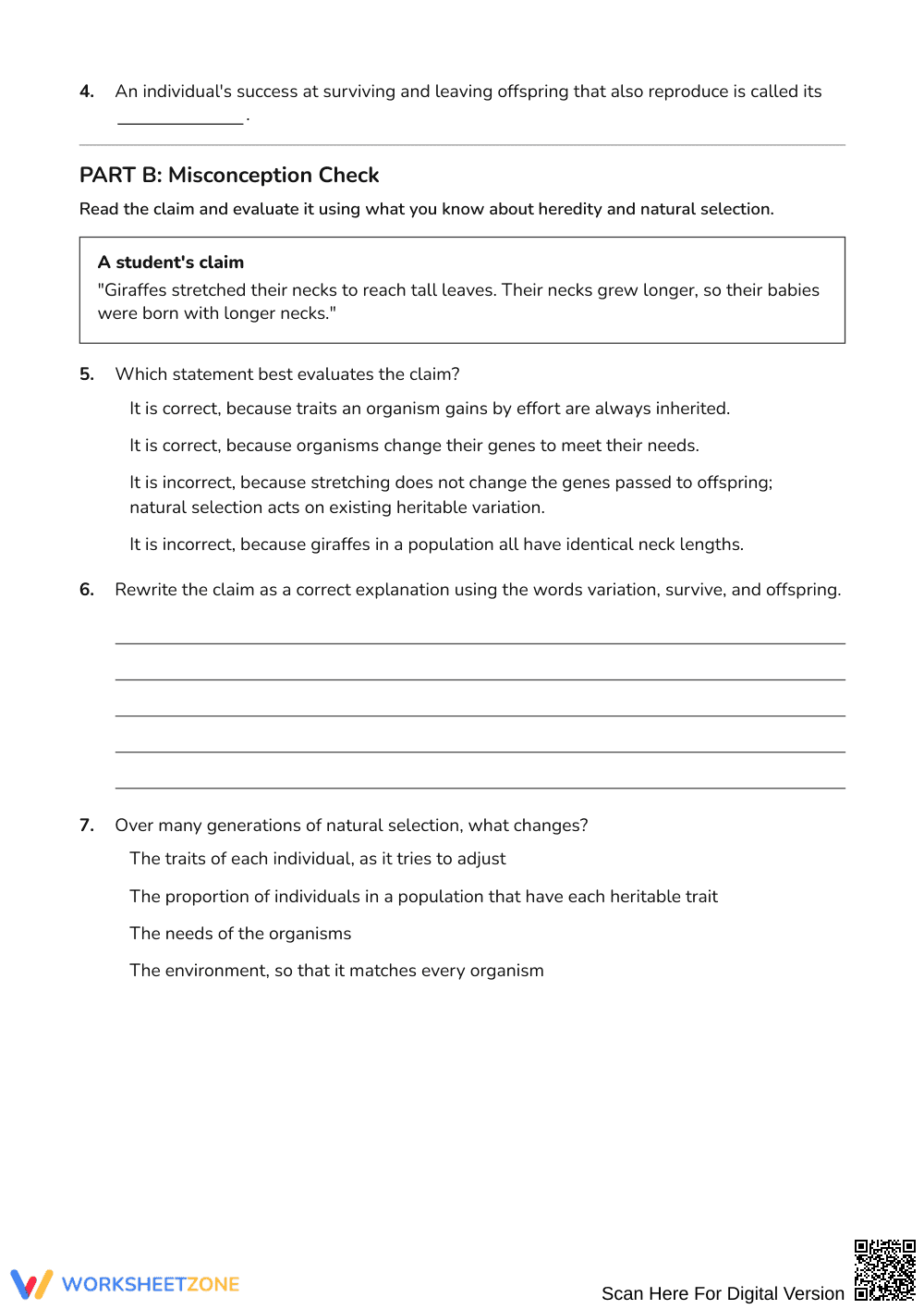
This worksheet gives eighth‑through‑twelfth‑grade science students a focused, vocabulary‑rich practice set on the foundations of natural selection, guiding them to identify key terms, correct misconceptions, and interpret data patterns.
At a Glance
- Grade: 8‑12 · Subject: Science
- Standard:
— Explain natural‑selection processes using correct terminology- Skill Focus: Patterns of Natural Selection: Foundations & Vocabulary
- Format: 4 pages · 25 problems · Answer key included · PDF
- Best For: Vocabulary review and misconception check
- Time: 30–45 minutes
The packet contains four pages of varied tasks: matching, true/false classification, multiple‑choice misconception checks, data‑interpretation questions, and a short‑answer cycle‑completion activity. A complete answer key occupies an additional four pages. Scaffolds include a word bank, worked‑example sentences, and clear sentence frames for the written explanation.
- Guided practice – 8 matching and classification items with a word bank to support initial term acquisition.
- Supported practice – 9 multiple‑choice and short‑answer items that require students to apply concepts while still receiving sentence frames.
- Independent practice – 8 data‑analysis and cycle‑completion problems where students work without prompts, demonstrating mastery.
This three‑stage progression follows the classic I Do, We Do, You Do release model, ensuring students move from teacher‑led exposure to autonomous application.
Standard Alignment: Students will explain how variation, differential survival, and reproductive success drive changes in trait frequencies within populations. This aligns with typical state science standards for high‑school biology that require learners to describe natural‑selection mechanisms and interpret related data. Both the conceptual description and the data‑analysis tasks can be copied directly into lesson plans, IEP goals, or district curriculum maps.
How to Use It:
• Before a unit on evolution, use the matching and definition section as a quick diagnostic to gauge prior knowledge; follow with a brief discussion of any misconceptions uncovered.
• After direct instruction, assign the data‑interpretation and cycle‑completion sections as formative assessment; observe student explanations to inform immediate reteaching.
Who It’s For: Ideal for high‑school biology classes, especially mixed‑ability groups. The built‑in word bank and sentence frames support struggling readers, while the data‑analysis items challenge advanced learners. Pair this worksheet with a short video on natural selection or an anchor chart of the selection cycle for a seamless lesson flow.
Research shows that explicit vocabulary instruction combined with structured data analysis significantly improves conceptual retention and scientific reasoning in secondary biology education (Fisher and Frey, 2014). When secondary learners actively connect domain-specific terminology to graphical representations and real-world selective pressures, they develop more durable cognitive models of evolutionary mechanisms. This worksheet operationalizes evidence-based pedagogy by embedding systematic scaffolding, including guided word banks, concrete sentence frames, and authentic scenario analysis. These targeted supports reduce cognitive load for emerging readers while simultaneously requiring higher-order evaluation from advanced students. By systematically moving learners from initial term identification to independent data interpretation, the resource reinforces critical connections between genetic variation, differential survival, and reproductive success over successive generations. Educators can confidently integrate these structured tasks into daily biology instruction, intervention sessions, or review routines to foster rigorous scientific communication, eliminate persistent misconceptions, and secure lasting conceptual mastery across diverse classroom environments.


