































Essential Monohybrid Cross Worksheet | Grades 8-12 Science

Paste this activity's link or code into your existing LMS (Google Classroom, Canvas, Teams, Schoology, Moodle, etc.).
Students can open and work on the activity right away, with no student login required.
You'll still be able to track student progress and results from your teacher account.
This comprehensive genetics resource provides targeted practice on monohybrid crosses, helping secondary students master foundational terminology, Punnett square mechanics, and inheritance probabilities. Students analyze allele combinations, differentiate genotypes from phenotypes, and resolve common misconceptions surrounding dominant and recessive traits to construct accurate biological explanations.
At a Glance
- Grade: Grades 8–12 · Subject: Science
- Standard: Inheritance of Traits — Predict genetic outcomes and distinguish genotype from phenotype in monohybrid crosses
- Skill Focus: Monohybrid cross vocabulary and Punnett square probability
- Format: 3 pages · 40 problems · Answer key included · PDF
- Best For: Genetics unit introduction and practice
- Time: 45–60 minutes
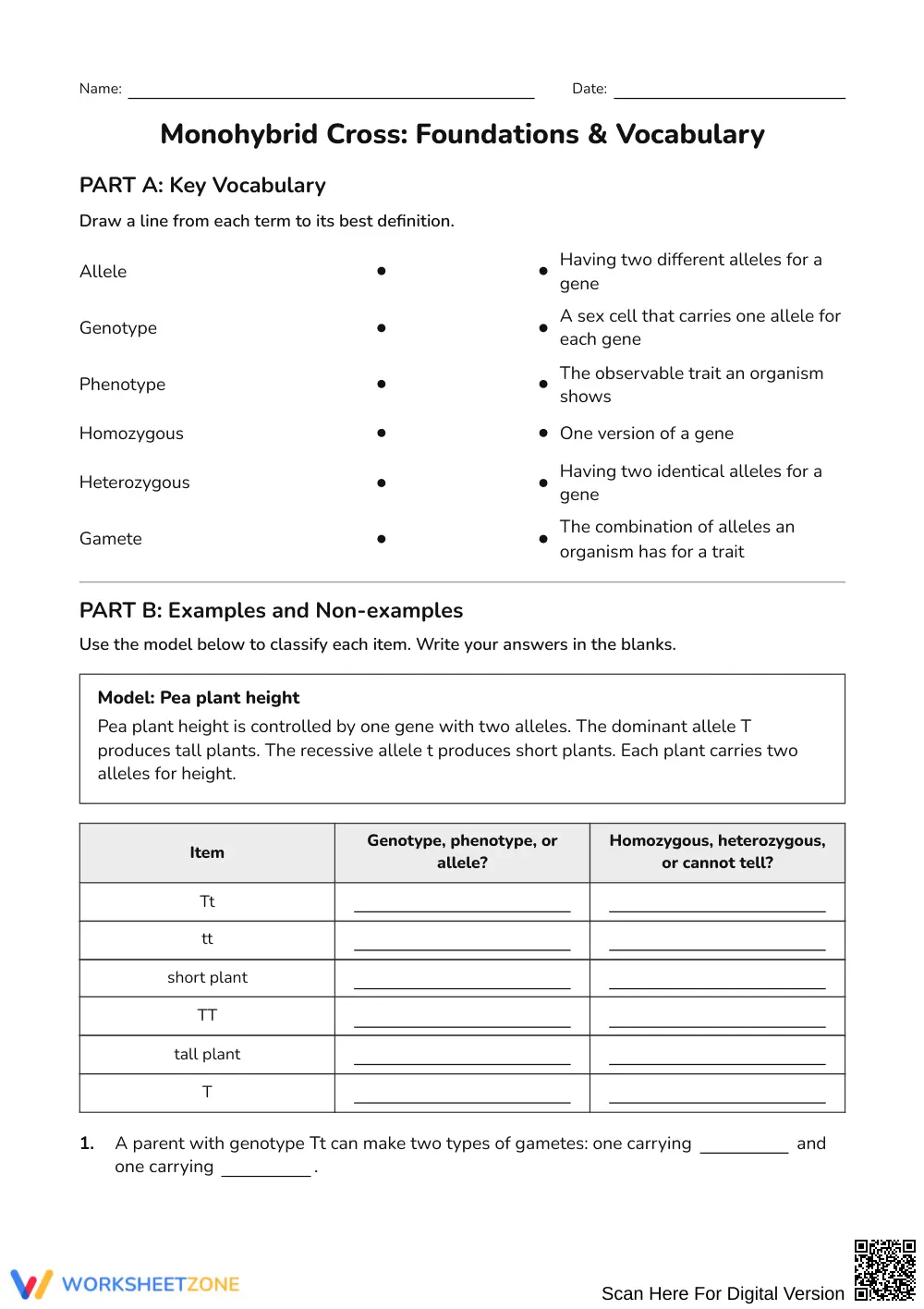
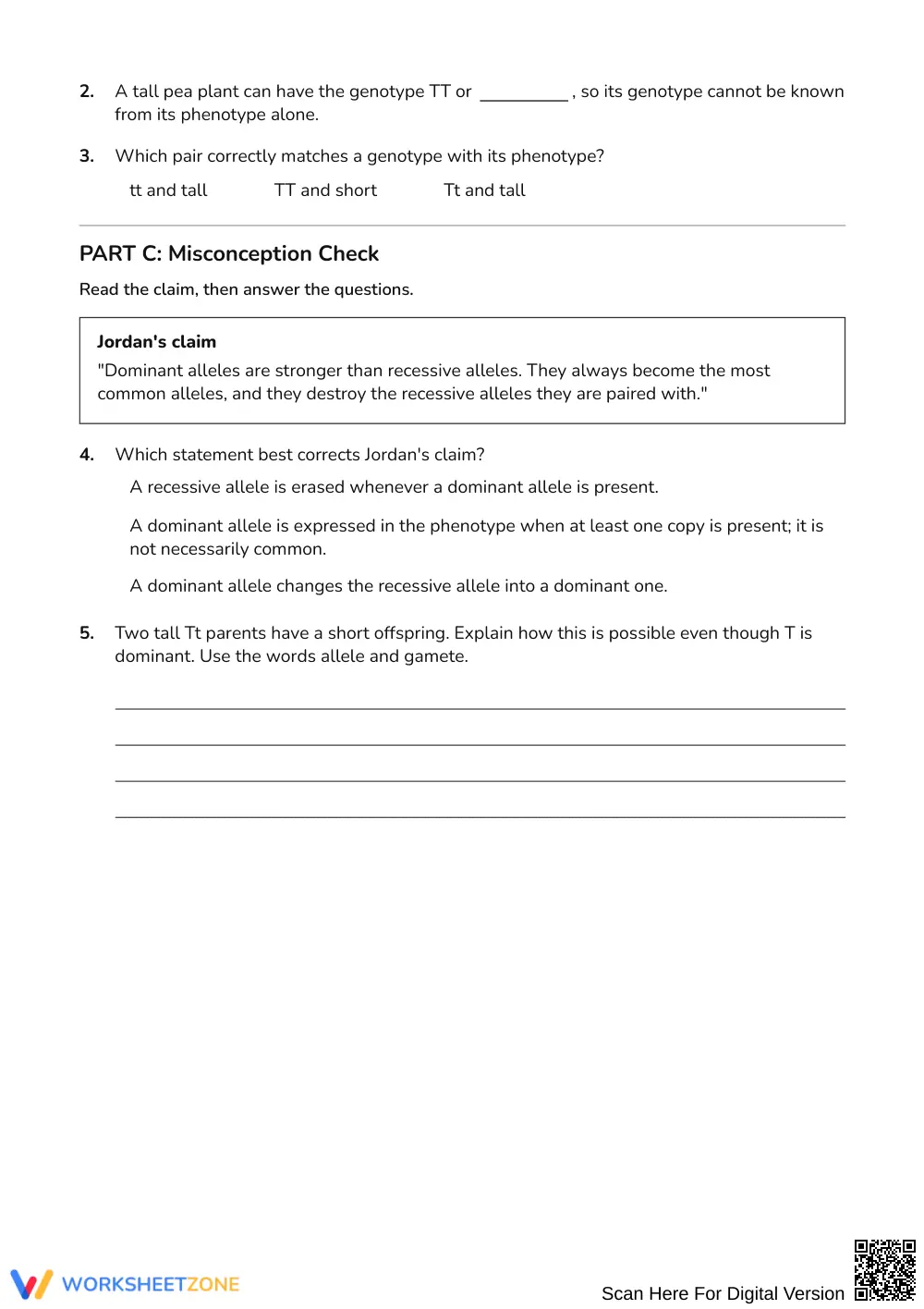
Across 3 pages, this resource presents 40 focused tasks. Part A provides matching for core vocabulary like alleles, homozygous states, and gametes. Part B prompts students to classify pea plant traits into genotypes and phenotypes. Part C analyzes misconceptions about dominant alleles, while Part D applies Punnett squares to calculate ratios and evaluate empirical data.
Skill Progression
- Guided practice (Tasks 1–12): Students match definitions and classify pea plant height alleles with direct model support.
- Supported practice (Tasks 13–26): Students distinguish genotypes from phenotypes and correct common misconceptions about dominant alleles using short analytical explanations.
- Independent practice (Tasks 27–40): Students complete Punnett squares, determine genotypic and phenotypic ratios, and deduce unknown parental genotypes from sample data.
This sequence implements a gradual-release model, progressing from basic terminology recall to independent probability analysis.
Standards Alignment
This resource aligns with secondary life science standards on inheritance and trait variation. Students model monohybrid crosses to demonstrate how sexual reproduction produces genetic variation through allele segregation. Both standard codes can be copied directly into lesson plans, IEP goals, or district curriculum mapping tools.
How to Use It
Assign this worksheet during direct instruction on Mendelian genetics to anchor key definitions before introducing complex crosses. It also functions well as a mid-unit formative check. During class, monitor student responses in Part C to ensure they recognize that recessive alleles are hidden rather than destroyed. Expected completion time is 45 to 60 minutes.
Who It's For
This worksheet serves general biology, introductory life science, and high school remedial courses. Scaffolding supports diverse learners, while extension questions challenge advanced students. Pair this activity with an introductory allele anchor chart or a guided Punnett square presentation.
Structured progression in genetics education ensures that secondary students build durable conceptual frameworks before tackling complex biological calculations. Research by Fisher & Frey (2014) on the gradual release of responsibility highlights that intentional scaffolding, moving systematically from foundational vocabulary acquisition to supported model analysis and independent problem solving, significantly improves student mastery of abstract scientific principles. This 40-problem monohybrid cross worksheet exemplifies that pedagogy by grounding high school life science learners in essential terms like allele, homozygous, and phenotype before demanding quantitative probability calculations. By addressing common misconceptions about allele dominance and requiring students to compare empirical class data with theoretical Punnett square ratios, the resource fosters rigorous analytical thinking. Teachers can deploy these structured exercises to evaluate student comprehension of trait inheritance, verify mechanistic understanding of gamete segregation, and prepare learners for advanced Mendelian problem sets across diverse instructional settings.


