




























Views
Downloads



Essential MLA Works-Cited Worksheet | Grade 11 English III

Paste this activity's link or code into your existing LMS (Google Classroom, Canvas, Teams, Schoology, Moodle, etc.).
Students can open and work on the activity right away, with no student login required.
You'll still be able to track student progress and results from your teacher account.
This Grade 11 research worksheet trains students to construct accurate MLA works-cited entries and integrate textual evidence from archival sources. High school scholars evaluate regional theater records, resolve missing metadata, and practice container formatting. Mastering these conventions helps students avoid plagiarism and build foundational skills for collegiate research writing.
At a Glance
- Grade: 11 · Subject: English III
- Standard:
W.11-12.8— Gather authoritative print and digital source information and follow a standard format for citation- Skill Focus: Constructing Works-Cited Entries and In-Text Citations
- Format: 6 pages · 12 problems · Answer key included · PDF
- Best For: Research paper citation and bibliography practice
- Time: 45–60 minutes
What's Inside
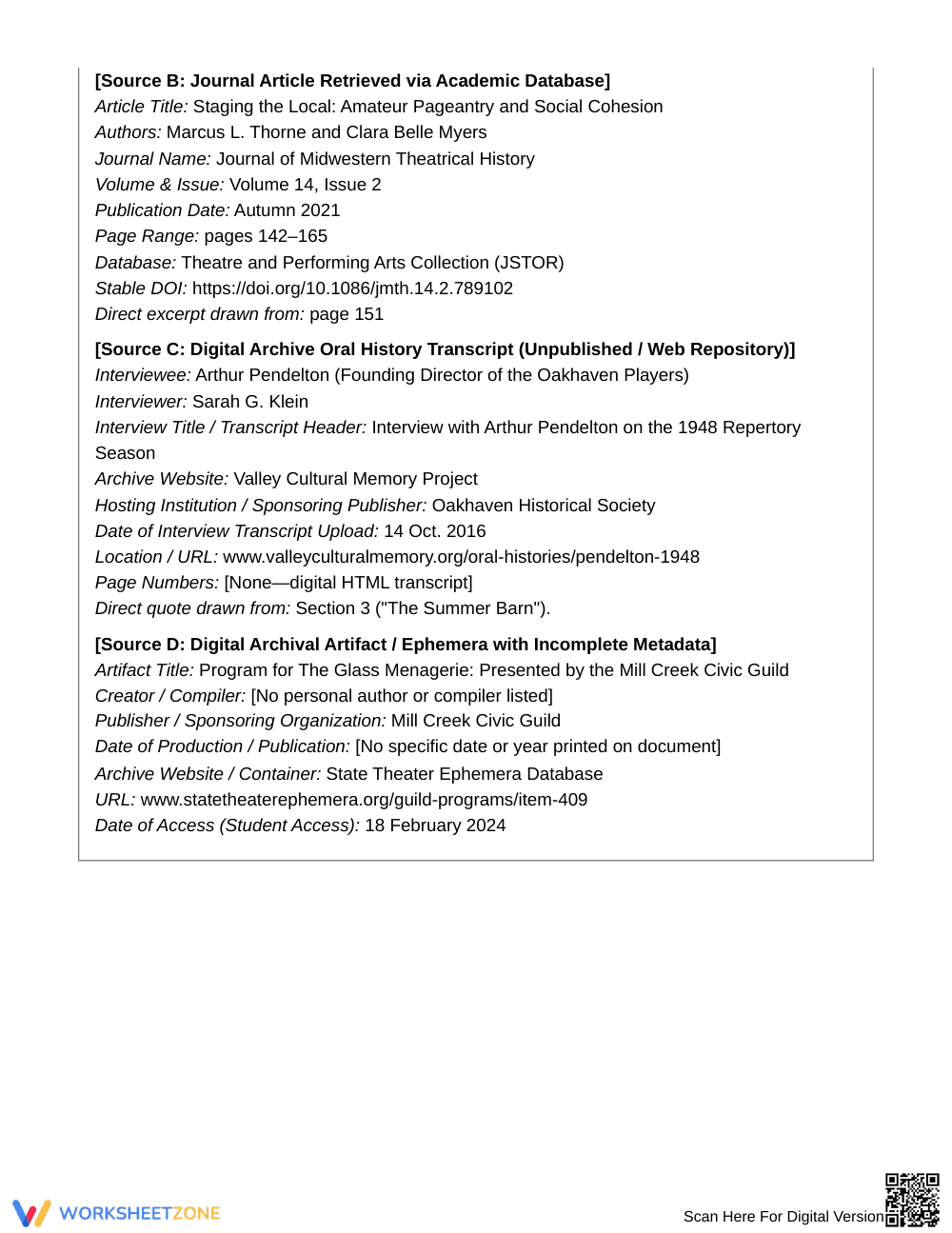
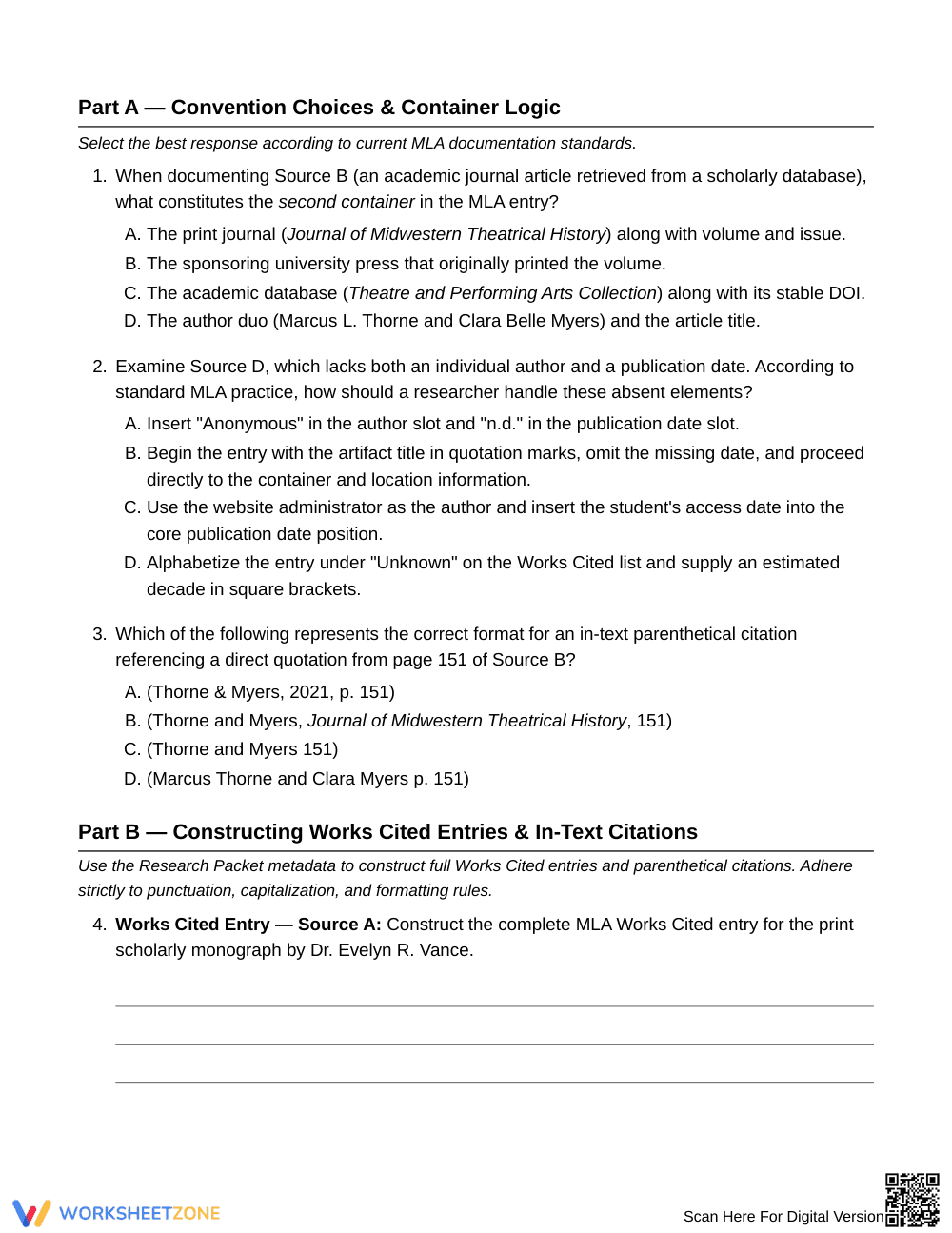
This 6-page printable resource includes a theater archive research packet with four varied source types, a 12-task activity sheet, and a 3-page answer key. Students reference an MLA 9th Edition core elements chart while analyzing monographs, JSTOR articles, digital oral histories, and undated ephemera.
Skill Progression
- Guided practice (Tasks 1–3): Students analyze multiple-choice items on container rules, missing metadata, and parenthetical conventions using an introductory reference guide.
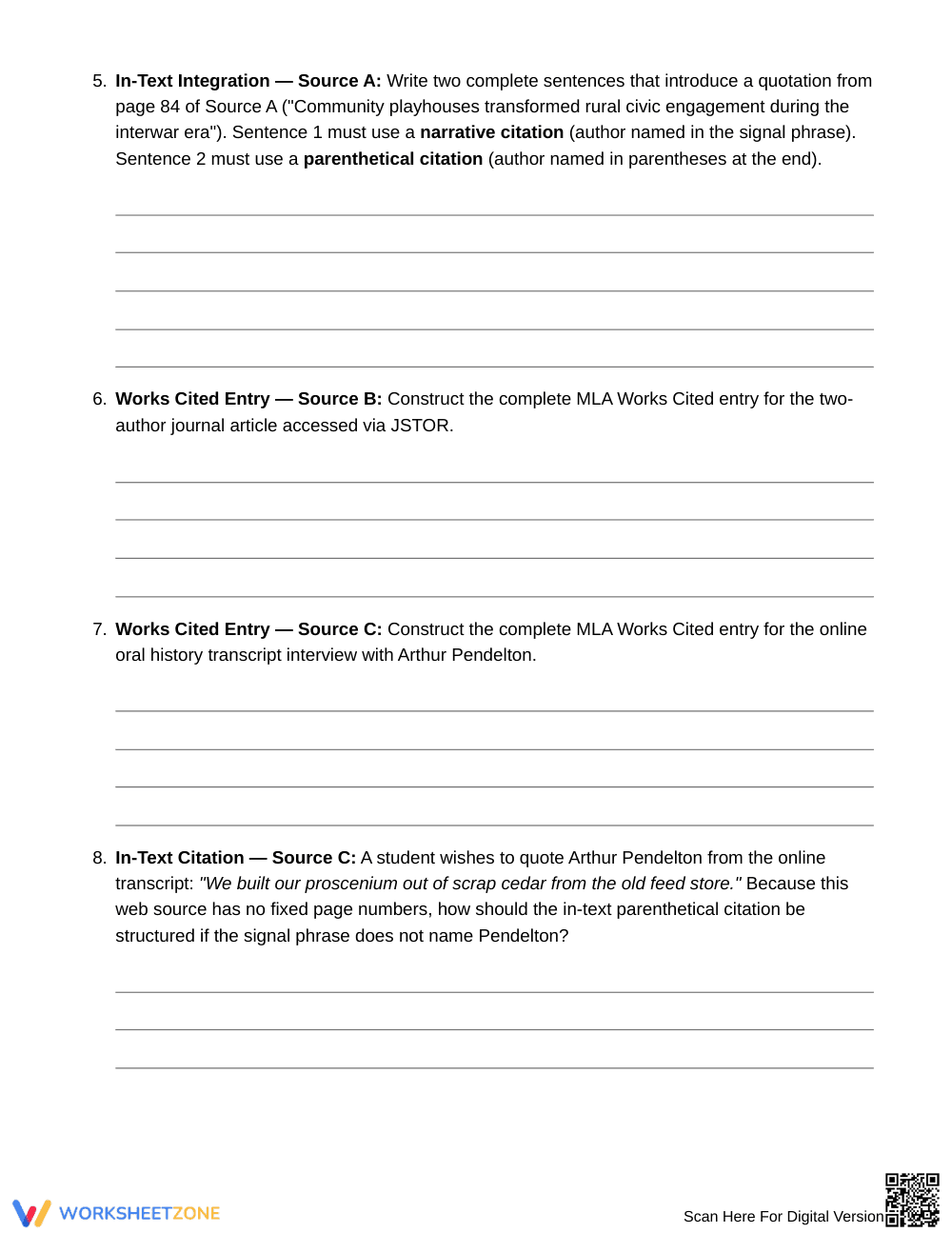
- Supported practice (Tasks 4–9): Learners construct full Works Cited entries and write narrative and parenthetical in-text citations for four distinct archival sources.
- Independent practice (Tasks 10–12): Students correct flawed student citations, format an anthology entry, and evaluate Works Cited page alphabetization rules.
This structure follows a gradual-release model, guiding students from fundamental container concepts to autonomous documentation.
Standards Alignment
This activity aligns with Common Core standard `W.11-12.8`: Gather relevant information from multiple authoritative print and digital sources, integrate information selectively into the text, and follow a standard format for citation. It also reinforces `RL.11-12.1` through textual citation integration. Both standard codes can be copied directly into lesson plans, IEP goals, or district curriculum mapping tools.
How to Use It
Use this worksheet after direct instruction on MLA 9th Edition containers during a research unit. Alternatively, assign Parts A and B for collaborative partner practice and Part C as an individual assessment. Formatively assess understanding by checking whether students omit missing dates rather than inventing placeholders. Students typically complete all 12 tasks in 45 to 60 minutes.
Who It's For
This worksheet serves Grade 11 English III and honors students mastering academic research papers. Built-in reference charts support developing writers, while complex database sources challenge advanced students. Pair this resource with an archival research project or an MLA style guide mini-lesson.
Academic writing proficiency in secondary English language arts hinges on standard documentation literacy and disciplined evidence attribution. Aligned to Common Core standard W.11-12.8, this instructional resource trains eleventh-grade students in the essential skill of constructing standardized MLA works-cited entries and integrating parenthetical text citations from archival materials. Educational research by Fisher & Frey (2014) highlights that structured gradual-release frameworks significantly accelerate complex procedural learning in secondary literacy, bridging the gap between guided modeling and autonomous application. By systematically walking learners through core container identification, multi-author formats, missing metadata conventions, and flawed citation evaluation, the six-page curriculum module cultivates deep bibliographic accuracy. Students move past surface-level citation generation tools to develop genuine procedural mastery, ensuring they can independently document digital archives, subscription databases, and print monographs. Consequently, high school scholars gain the critical academic integrity and research formatting stamina demanded across collegiate writing environments.


