


























Views
Downloads




Essential MLA Citation Worksheet | Grade 11 English III
Paste this activity's link or code into your existing LMS (Google Classroom, Canvas, Teams, Schoology, Moodle, etc.).
Students can open and work on the activity right away, with no student login required.
You'll still be able to track student progress and results from your teacher account.
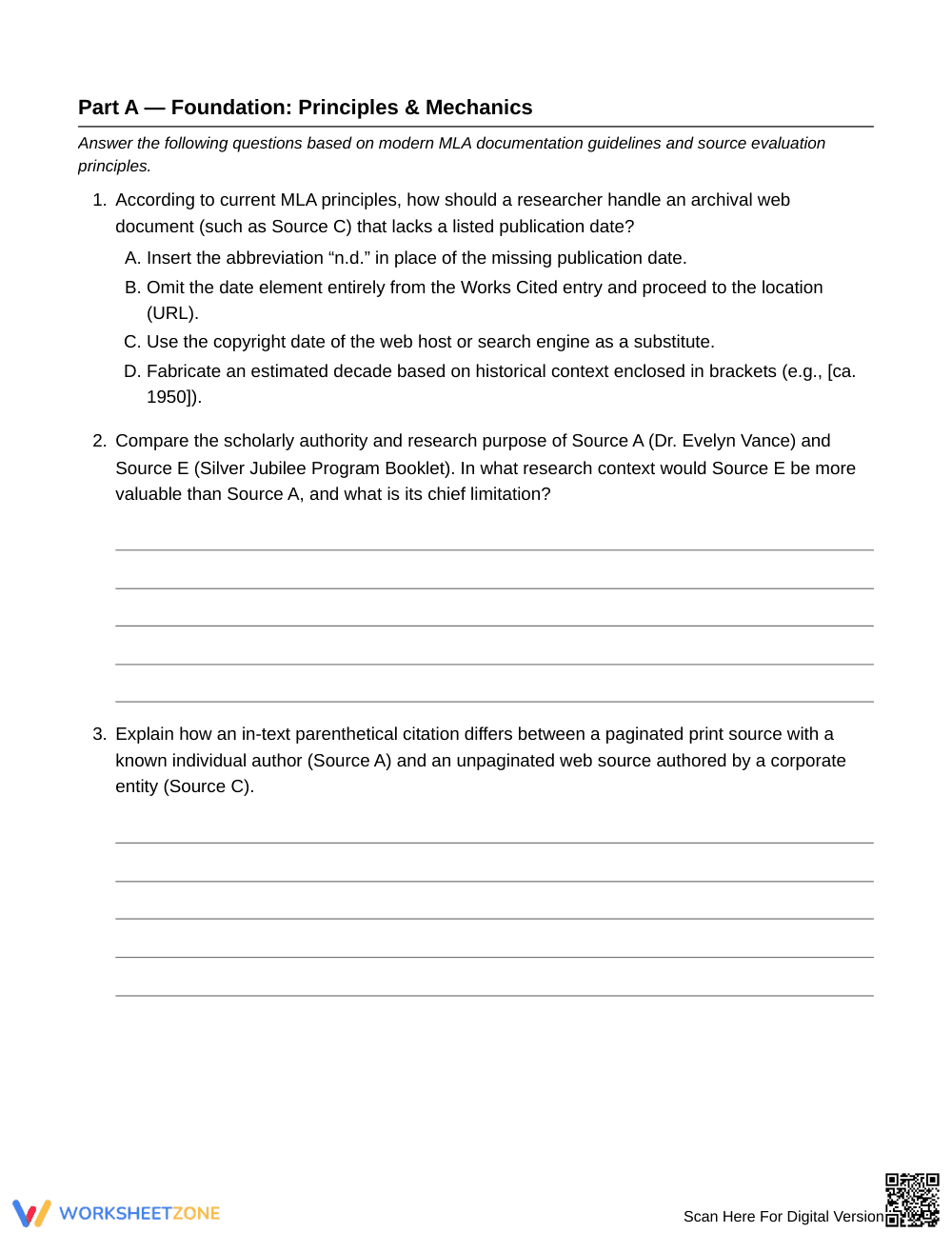
This Grade 11 English III worksheet equips students to master MLA 9 documentation and archival source synthesis. Students analyze five historical artifacts, construct complete Works Cited entries, integrate quotes and paraphrases, and resolve complex citation scenarios across 12 structured tasks.
At a Glance
- Grade: 11 · Subject: English III
- Standard:
W.11-12.8— Gather authoritative information, integrate research ethically, and follow MLA citation formatting- Skill Focus: MLA 9 Documentation & Archival Synthesis
- Format: 6 pages · 12 problems · Answer key included · PDF
- Best For: High school research paper preparation
- Time: 45–60 minutes
This 6-page printable resource includes an archival research packet containing five authentic historical artifacts and 12 multi-part exercises. It includes a 3-page answer key with complete model Works Cited entries, in-text citations, and analytical guides.
Skill Progression
- Guided practice (Tasks 1–3): Students evaluate MLA container rules, handle missing metadata, and evaluate monograph versus archival authority.
- Supported practice (Tasks 4–9): Learners construct Works Cited entries, fix formatting errors, and embed direct quotes and paraphrases.
- Independent practice (Tasks 10–12): Students resolve advanced citation cases, including indirect quotes and conflicting evidence synthesis.
This progression uses the gradual-release model to build independent documentation proficiency.
Standards Alignment
This resource aligns with `W.11-12.8`: Gather relevant information from multiple authoritative print and digital sources, assess strengths and limitations, integrate information selectively, and follow standard citation formats. Both standard codes can be copied directly into lesson plans, IEP goals, or district curriculum mapping tools.
How to Use It
Use this worksheet after direct instruction on MLA 9 as a mid-unit practice lab or pre-drafting research checkpoint. During work time, review Task 8 to formatively assess student accuracy with Works Cited punctuation. Expected completion time is 45 to 60 minutes.
Who It's For
Designed for Grade 11 English III students preparing for formal research synthesis. Explicit metadata prompts assist developing writers, while edge cases challenge advanced learners. Pair this resource with an MLA container framework anchor chart.
According to Fisher & Frey (2014), structured instructional frameworks that guide learners from foundational understanding to independent synthesis significantly enhance academic literacy outcomes. This Grade 11 English III worksheet operationalizes standard W.11-12.8 by immersing high school students in authentic archival documentation, teaching them to ethically gather, evaluate, and integrate multi-source evidence using modern MLA 9 conventions. By engaging directly with diverse historical artifacts—including published monographs, edited anthologies, digital institutional records, and unpaginated ephemera—students develop critical evaluation skills alongside citation accuracy. Rather than treating source citation as an isolated mechanical task, the 12 problems require writers to resolve missing metadata, format indirect quotations with signal phrases, and objectively synthesize contradictory historical claims. This deliberate pedagogical design ensures secondary students build robust, transferrable research documentation competencies that prepare them for advanced academic writing, college coursework, and informed information literacy.


