


























Views
Downloads



Essential Mitosis vs Meiosis Worksheet | Grade 10 Biology
Paste this activity's link or code into your existing LMS (Google Classroom, Canvas, Teams, Schoology, Moodle, etc.).
Students can open and work on the activity right away, with no student login required.
You'll still be able to track student progress and results from your teacher account.
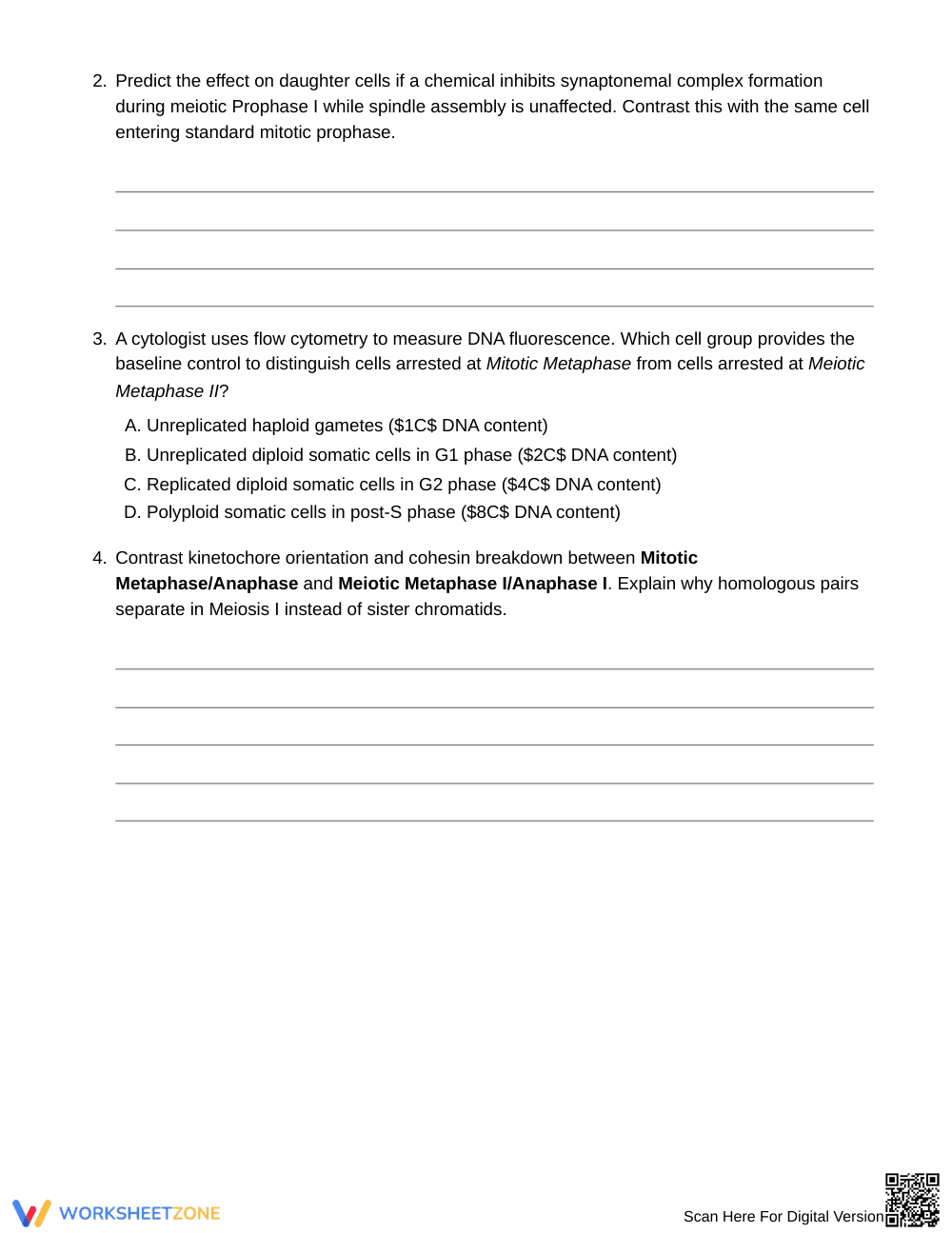
This Grade 10 biology worksheet guides students through a rigorous mechanistic comparison of mitosis and meiosis. Learners apply centromere counting rules, calculate DNA mass changes, analyze molecular perturbations, and evaluate competing scientific models of gametogenesis.
At a Glance
- Grade: 10 · Subject: Biology
- Standard: Model cellular division and chromosome segregation during growth and reproduction
- Skill Focus: Mechanistic Comparison of Mitosis and Meiosis
- Format: 5 pages · 10 problems · Answer key included · PDF
- Best For: Advanced biology practice and assessment
- Time: 45–60 minutes
Students solve 10 multi-part analytical problems across 5 pages, supported by a 3-page complete answer key. Key structural features include a "Core Mechanistic Rules" reference box on centromere counting and DNA C-values, quantitative ploidy tracking tables, flow cytometry baselines, and dual-model empirical evaluation datasets.
Skill Progression
- Guided practice (Problems 1–4): Students use reference rules to track centromeres, ploidy (2n vs. n), and DNA mass across division stages, predicting outcomes of synaptonemal inhibition and kinetochore orientation.
- Supported practice (Problems 5–8): Students evaluate molecular variables, analyzing Shugoshin mutants, calculating assortment combinations, and contrasting spindle checkpoint arrest from insect lineage data.
- Independent practice (Problems 9–10): Students evaluate two competing gametogenesis models against synthetic nematode data and fluorophore assays.
This gradual-release structure builds foundational chromosome rule fluency before demanding complex experimental analysis.
Standards Alignment
This resource reinforces core high school biology standards by modeling cellular division and differentiation across life cycles, emphasizing sources of genetic variation and chromosome segregation. These learning targets can be copied directly into lesson plans, IEP goals, or district curriculum mapping tools.
How to Use It
Assign this worksheet after direct instruction on cell division. Use it as a collaborative analysis activity or a summative review. Formative tip: verify that students do not confuse chromatid separation with centromere segregation when calculating ploidy. Completion takes 45 to 60 minutes.
Who It's For
Ideal for Grade 10 general, honors, and pre-AP biology students studying cellular reproduction. For differentiation, direct struggling learners back to the core rules box. Pair this practice with hands-on chromosome bead models or karyotype analysis lessons.
According to research by Fisher & Frey (2014), structured instructional progressions that move from foundational schema application to evidence-based scientific argumentation significantly increase conceptual retention in complex biological domains. Mechanistically comparing mitosis and meiosis requires high school students to differentiate between homologous chromosome segregation, sister chromatid disjunction, ploidy states, and DNA mass variations across division stages. By embedding quantitative data tables, molecular perturbation scenarios like cohesin degradation, and empirical model evaluation tasks into cell biology curricula, educators provide the cognitive scaffolding necessary for secondary learners to master cellular division mechanisms. Research from EdReports 2024 confirms that multi-part, evidence-centered biology tasks promote durable scientific reasoning and deeper mastery of chromosome inheritance dynamics compared to rote vocabulary memorization. This comprehensive 5-page worksheet delivers the structured problem sets necessary for Grade 10 biology students to achieve verifiable mastery in cellular division mechanics.


