


























Views
Downloads




Essential Missing Metadata Worksheet | Grade 11 English III
Paste this activity's link or code into your existing LMS (Google Classroom, Canvas, Teams, Schoology, Moodle, etc.).
Students can open and work on the activity right away, with no student login required.
You'll still be able to track student progress and results from your teacher account.
This Grade 11 English III worksheet teaches high school researchers to apply MLA 9th edition citation conventions when documenting archival and digital sources with missing metadata. Students examine authentic primary records, identify omitted bibliographic elements, apply container rules, and construct ethical Works Cited entries without inventing speculative details.
At a Glance
- Grade: 11 · Subject: English III
- Standard:
W.11-12.8— Gather authoritative information and follow standard citation formats- Skill Focus: Documenting Sources with Missing Nonessential Metadata
- Format: 6 pages · 8 problems · Answer key included · PDF
- Best For: Research citation mastery
- Time: 45–60 minutes
What's Inside
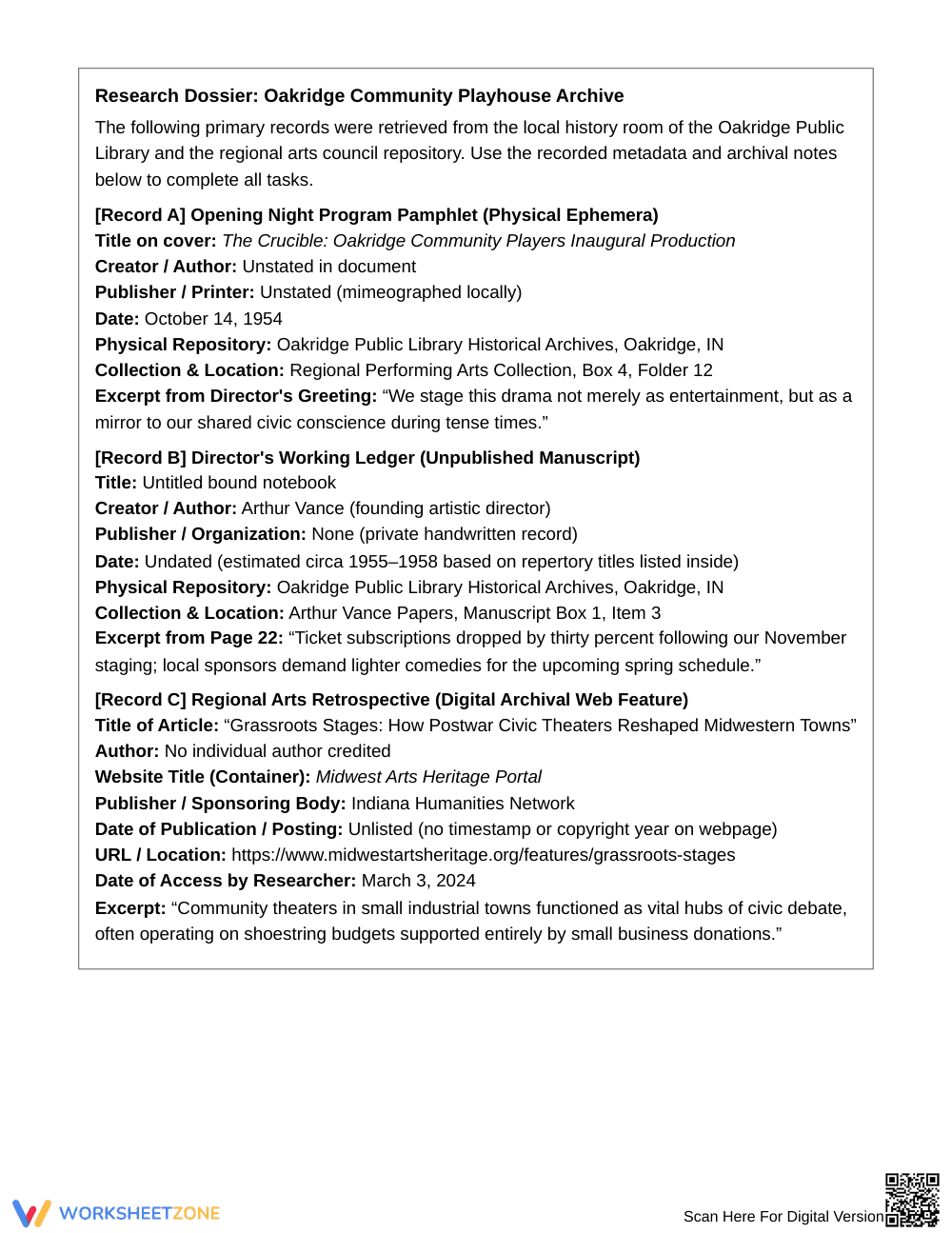
Across 6 pages, students analyze an archival dossier containing three historical records: an ephemera program, an unpublished manuscript ledger, and a digital feature. The worksheet provides core MLA 9 principle summaries, 8 targeted documentation tasks, and a 3-page answer key modeling complete Works Cited entries and parenthetical citations.
Skill Progression
- Guided practice (Tasks 1–2): Students analyze physical and digital records to identify missing metadata and explain MLA 9 rules prohibiting placeholder abbreviations.
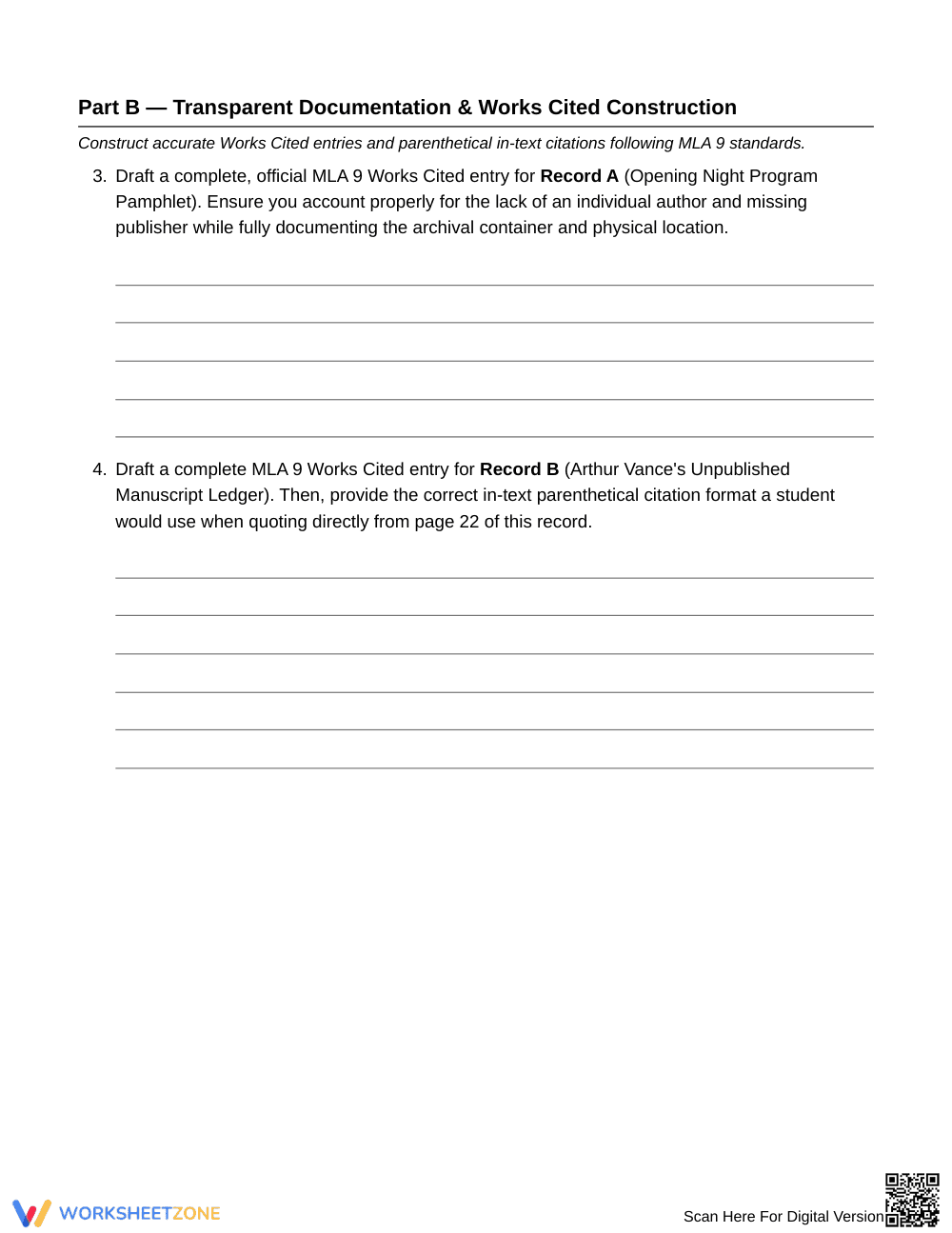
- Supported practice (Tasks 3–6): Learners construct Works Cited entries for unauthored and unpublished records, correct faulty citations, and write citation-supported synthesis sentences.
- Independent practice (Tasks 7–8): Students evaluate source limitations and research ethics when working with undated artifacts, proposing valid cross-referencing strategies.
This sequence follows a gradual-release model from metadata analysis to ethical scholarship.
Standards Alignment
This worksheet aligns with primary standard W.11-12.8: Gather relevant information from multiple authoritative print and digital sources, assess source strengths and limitations, and follow a standard format for citation. Supporting standard RI.11-12.1 reinforces citing strong textual evidence. Both standard codes can be copied directly into lesson plans, IEP goals, or district curriculum mapping tools.
How to Use It
Use this resource during a research unit after introducing MLA containers. Assign Part A for guided partner practice auditing source records. Assign Parts B and C as formative assessment on Works Cited mechanics and ethics. Check whether students avoid obsolete abbreviations like "n.d." Expected completion time is 45 to 60 minutes.
Who It's For
This worksheet serves Grade 11 English III students and AP Seminar researchers evaluating incomplete primary sources. Provide the included MLA container principle box for differentiated scaffolding. Pair this activity with a direct instruction lesson on synthesis writing and historical research methods.
Mastering standard W.11-12.8 requires secondary students to accurately document diverse print and digital sources using standard academic formats, specifically resolving incomplete bibliographic records without fabricating missing details. Educational research by Fisher & Frey (2014) demonstrates that structured gradual-release instructional sequences significantly improve student independence in complex disciplinary literacy tasks, such as scholarly documentation, evidence evaluation, and source synthesis. When high school researchers encounter archival ephemera, private manuscripts, or digital articles lacking publication dates or personal authors, systematic container frameworks prevent widespread citation errors and discourage unethical metadata extrapolation. This 6-page instructional resource engages Grade 11 learners in authentic source analysis across 8 structured tasks, establishing transparent Works Cited construction and rigorous parenthetical citation habits. By bridging core metadata identification with critical source limitation analysis, students develop transferable academic research competencies essential for postsecondary analytical writing success.


