


























Views
Downloads

Essential Meiosis I and II Worksheet | Grade 10 Biology
Paste this activity's link or code into your existing LMS (Google Classroom, Canvas, Teams, Schoology, Moodle, etc.).
Students can open and work on the activity right away, with no student login required.
You'll still be able to track student progress and results from your teacher account.
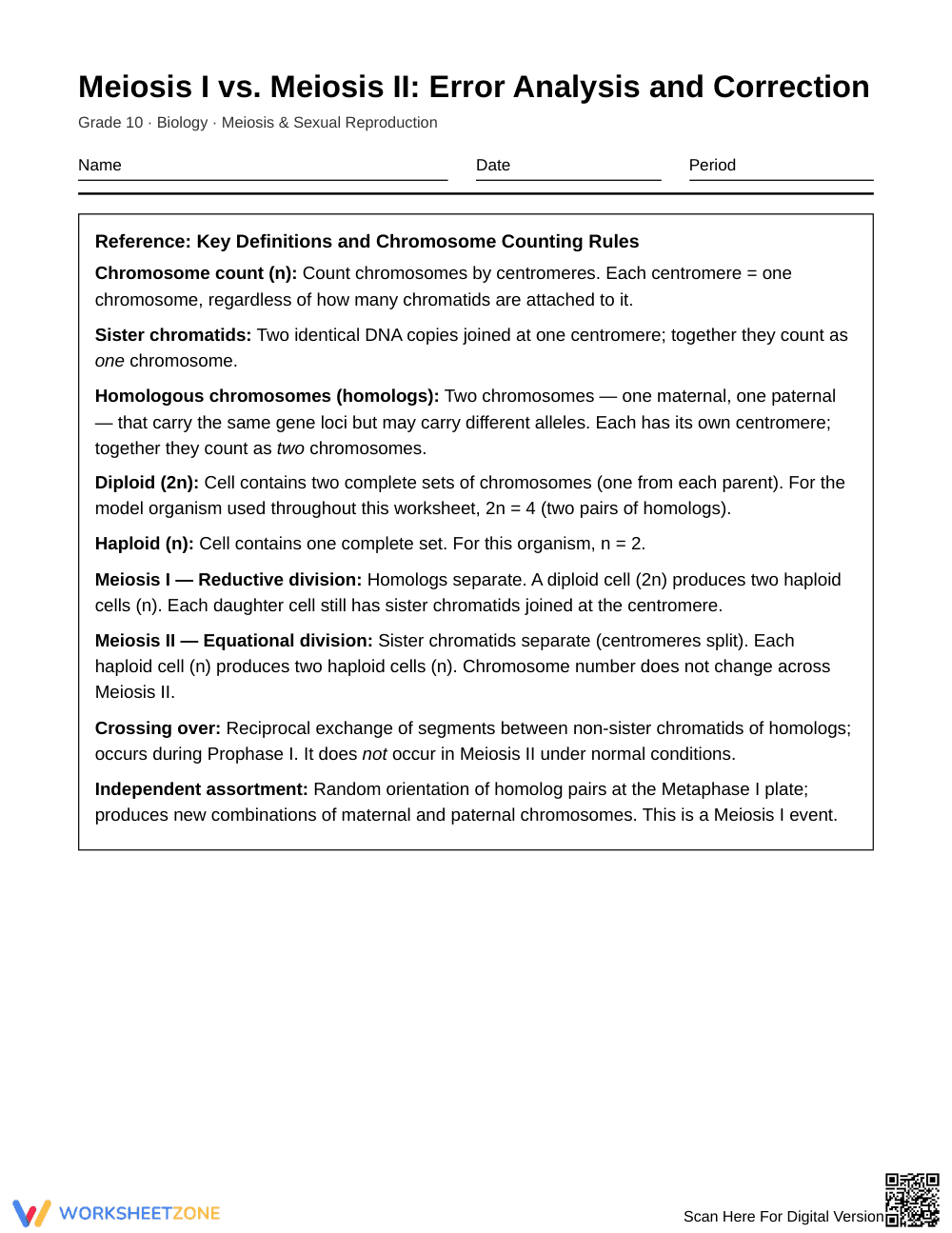
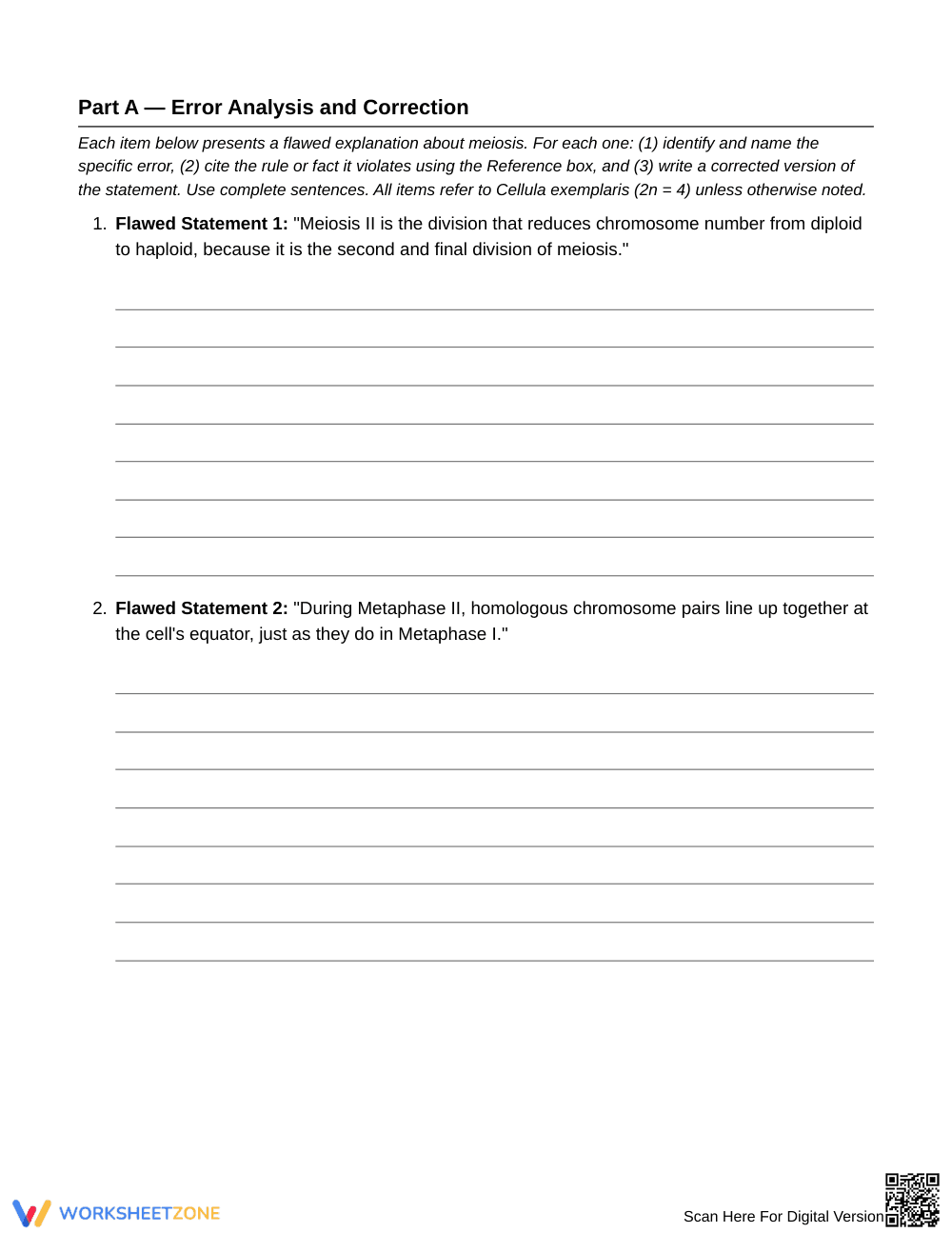
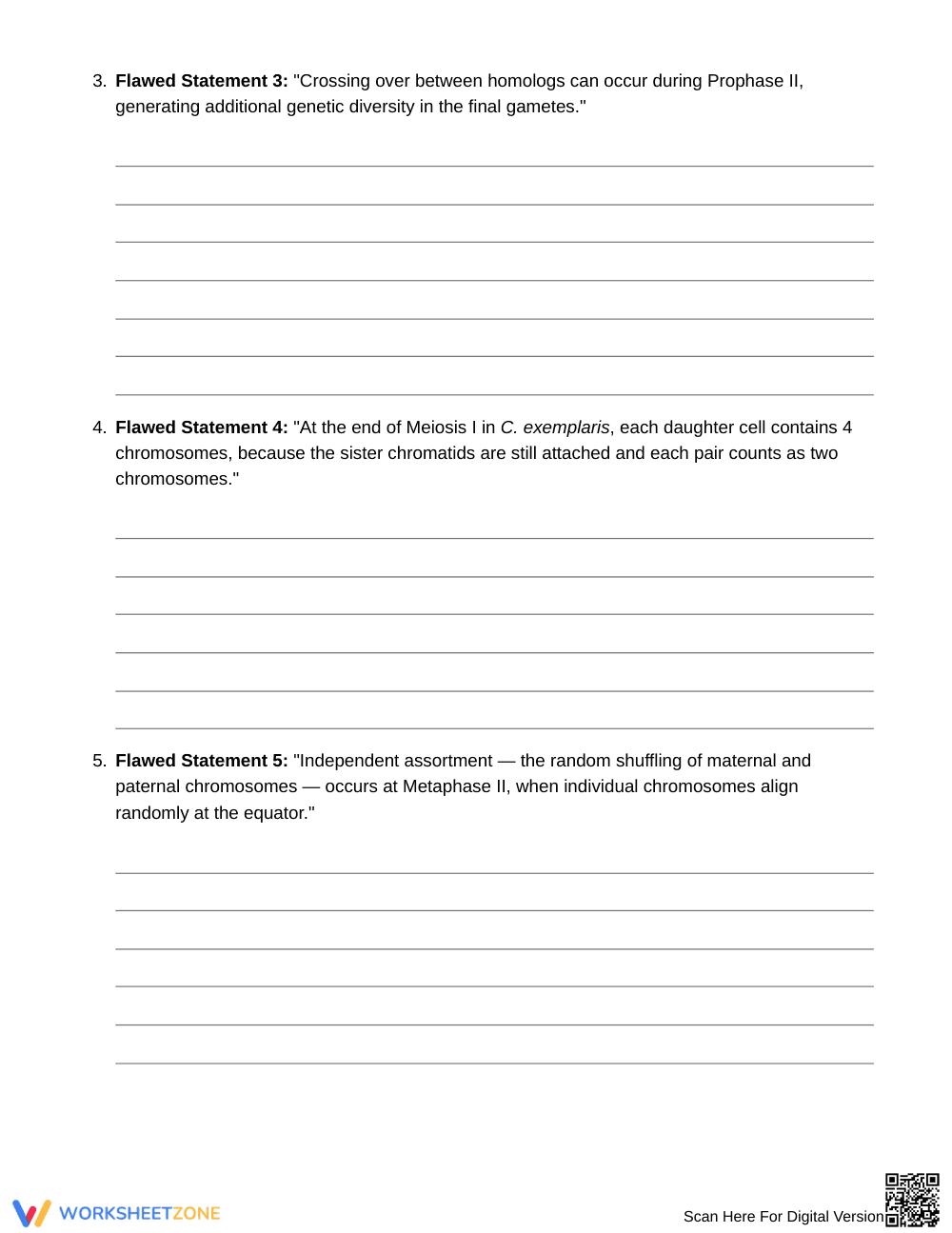
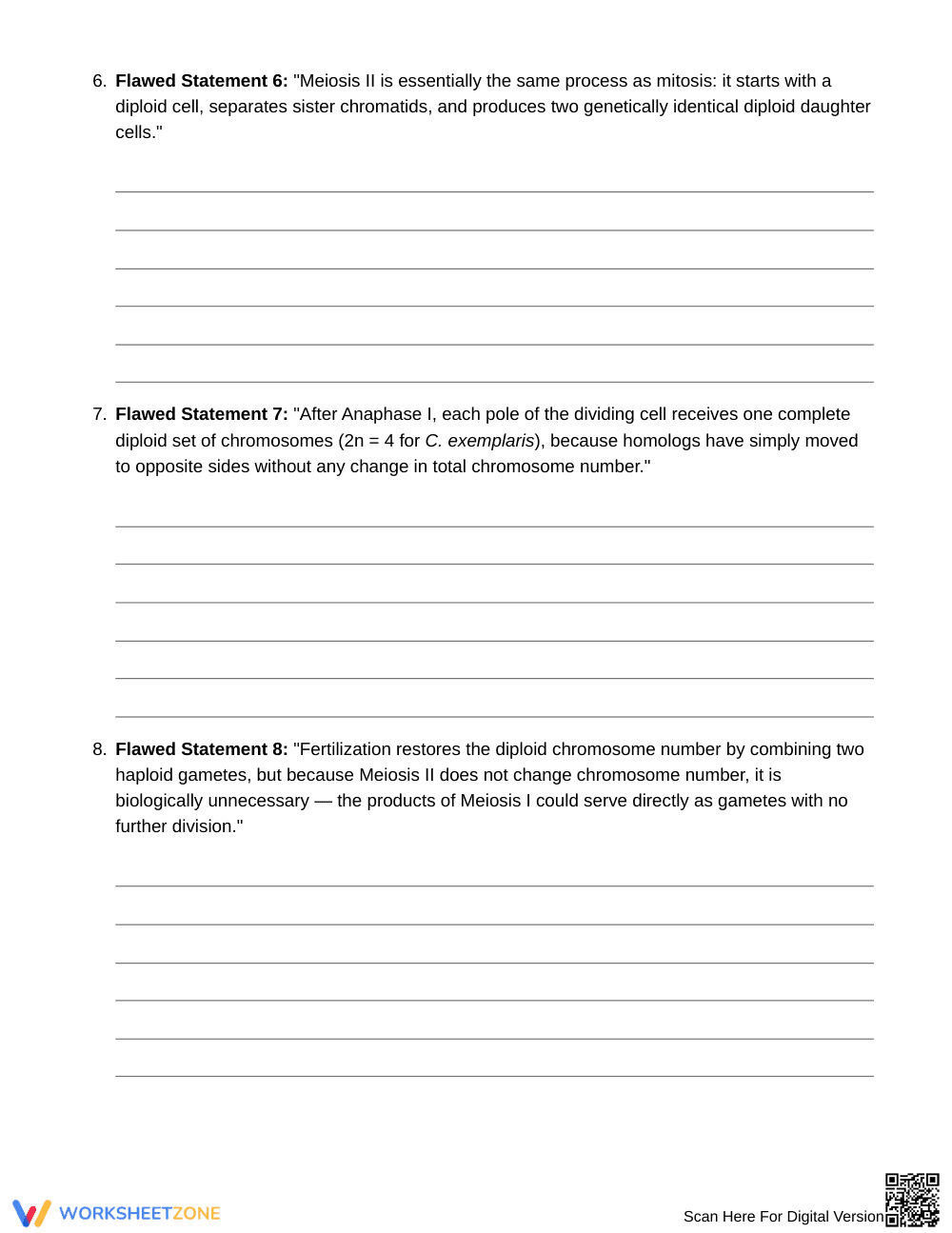
This high school biology worksheet eliminates persistent student confusion between Meiosis I and Meiosis II through rigorous error analysis. Students evaluate eight flawed biological claims, diagnose conceptual mistakes regarding ploidy and chromatid separation, and compose scientifically accurate revisions using formal chromosome counting rules.
At a Glance
- Grade: 10 · Subject: Biology
- Standard: Cellular Division — Distinguish between chromosome separation events in reductive and equational divisions
- Skill Focus: Correct Meiosis-I and Meiosis-II Confusion
- Format: 5 pages · 8 problems · Answer key included · PDF
- Best For: Post-instruction practice and misconception remediation
- Time: 40–50 minutes
What's Inside
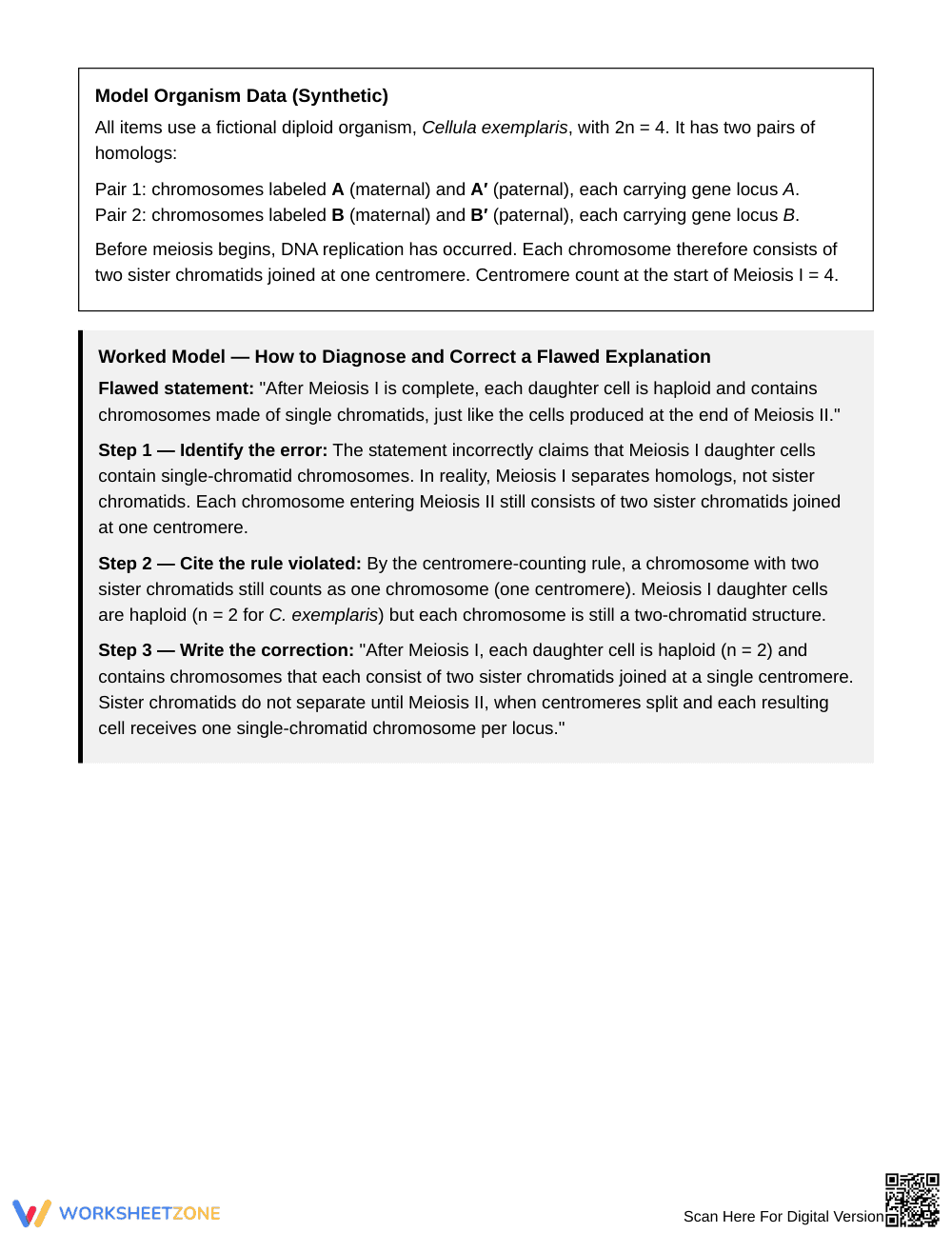
This 5-page printable resource opens with an essential reference guide outlining chromosome counting conventions, ploidy definitions, and synthetic data for the model organism Cellula exemplaris (2n = 4). A step-by-step worked model illustrates how to spot an error, cite the violated biological principle, and write a complete correction. Students complete eight targeted error-analysis tasks accompanied by a comprehensive five-page teacher answer key.
Skill Progression
- Guided practice (Worked Model): Explicit teacher-modeled prompt showing the three-step diagnostic sequence to identify false chromatid claims and write rigorous scientific corrections.
- Supported practice (Tasks 1–4): High-scaffold prompts focusing on foundational errors regarding reductive division, homolog alignment during metaphase, crossing over timing, and centromere counting rules.
- Independent practice (Tasks 5–8): Rigorous, open-ended evaluations targeting advanced misunderstandings of independent assortment, mitotic comparisons, anaphase poles, and the evolutionary necessity of equational division.
This progression embodies the gradual-release framework, guiding learners from teacher-modeled reasoning directly to self-directed scientific argumentation.
Standards Alignment
This resource aligns with high school Life Science standards addressing the cellular mechanisms of heredity. Students explain how meiosis results in genetically diverse haploid gametes through homolog pairing and chromatid segregation. Supporting standards include scientific literacy benchmarks that require evaluating and revising contradictory explanations. Both standard codes can be copied directly into lesson plans, IEP goals, or district curriculum mapping tools.
How to Use It
Deploy this worksheet after direct instruction on sexual reproduction. Use it as an independent practice activity where students actively verify chromosome behavior against the reference box, or assign it during collaborative review stations. During work time, monitor whether students count centromeres rather than individual chromatids when determining chromosome numbers. Expected completion time is 40 to 50 minutes.
Who It's For
This assignment serves tenth-grade general biology and honors biology students tackling genetics. Built-in reference definitions and worked steps support struggling learners and English language learners, while the demanding prose requirements challenge advanced thinkers. Pair this document with a chromosome bead-modeling lab or a meiosis stages anchor chart for maximum instructional impact.
According to Fisher & Frey (2014), systematic error correction reinforces metacognitive monitoring and prevents misconceptions from solidifying during independent practice. By requiring tenth-grade biology students to evaluate flawed claims regarding reductive versus equational division, this targeted resource addresses chronic confusion surrounding homologous pairs and sister chromatids. Learners apply explicit centromere-counting rules across eight structured analysis tasks, articulating accurate biological mechanisms in formal writing. The built-in worked model operationalizes deliberate corrective feedback, ensuring students distinguish between Meiosis I and Meiosis II with precision before summative assessments.


