




























Essential Limiting Resources Worksheet | Grade 9 Biology
Paste this activity's link or code into your existing LMS (Google Classroom, Canvas, Teams, Schoology, Moodle, etc.).
Students can open and work on the activity right away, with no student login required.
You'll still be able to track student progress and results from your teacher account.
This biology worksheet helps high school students master population dynamics by evaluating how limiting factors and resource availability determine carrying capacity. Through conceptual distinctions, dataset analysis, and demographic scenario modeling, students build scientific reasoning skills to explain population stability and ecological feedback mechanisms.
At a Glance
- Grade: 9 · Subject: Biology
- Standard: Ecosystem Dynamics — Analyze how resource availability and environmental factors regulate population stability
- Skill Focus: Population Size and Limiting Resources
- Format: 5 pages · 12 problems · Answer key included · PDF
- Best For: Quantitative ecology practice and data analysis
- Time: 45–60 minutes
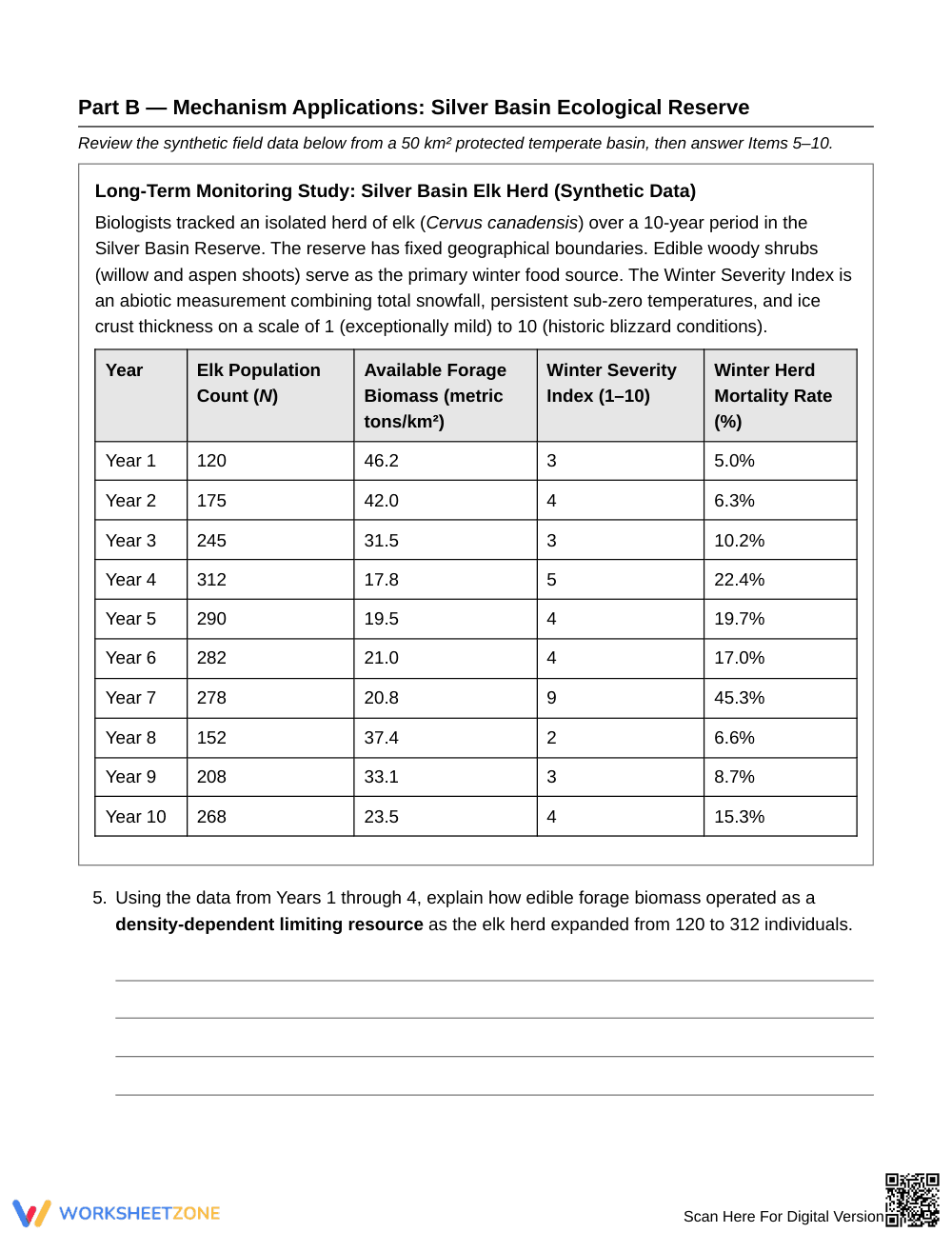
What's Inside: The 5-page worksheet opens with a core ecological foundations reference box defining limiting factors, carrying capacity, and density-dependent factors. Students complete 12 analytical items across three sections, featuring a 10-year synthetic field study dataset of an isolated elk herd with forage biomass, winter severity indexes, and mortality rates. A 4-page answer key provides complete demographic explanations.
Skill Progression
- Guided Practice (Part A, Items 1–4): Structured conceptual prompts establish baseline distinctions between instantaneous population size, carrying capacity, and negative feedback loops.
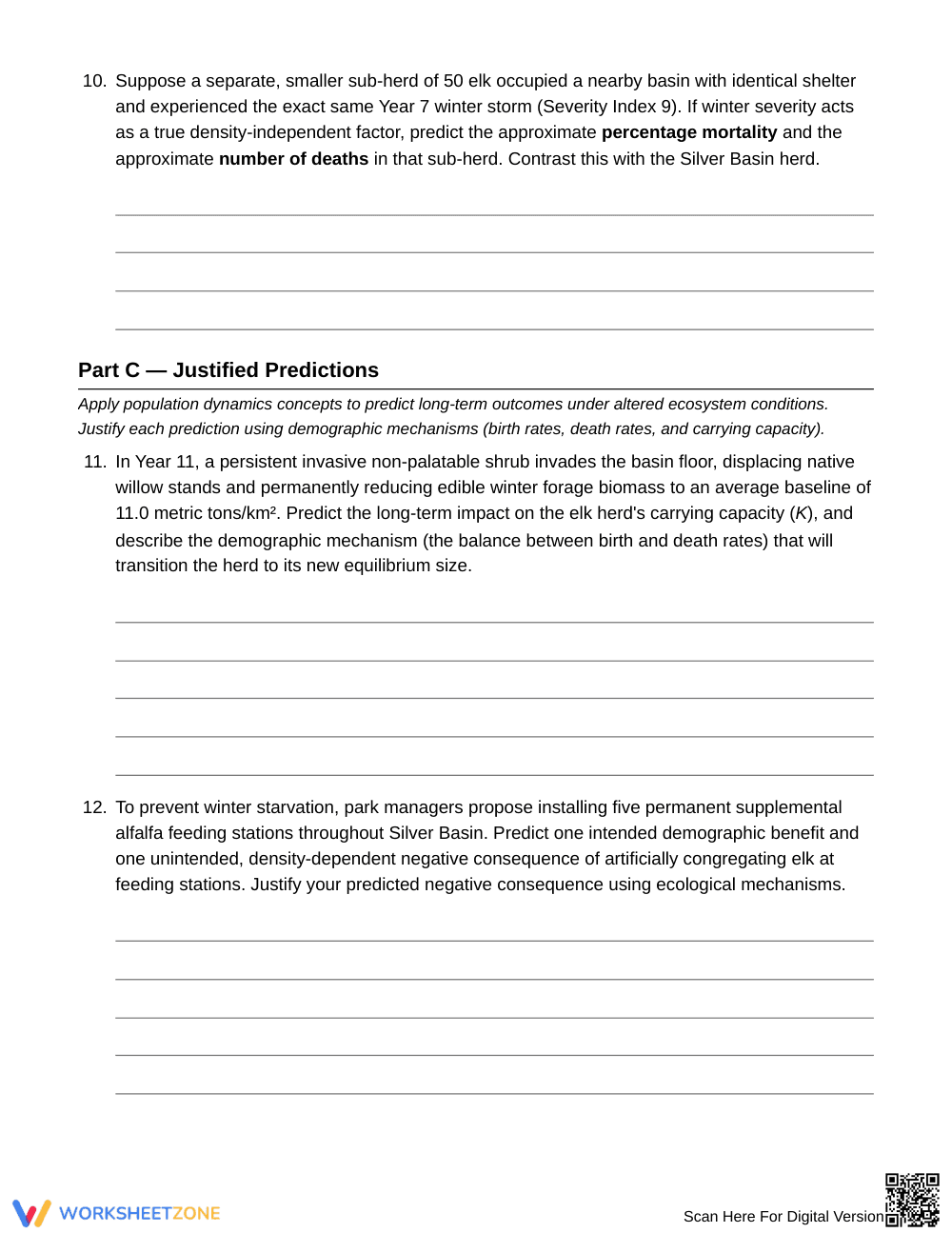
- Supported Practice (Part B, Items 5–10): Data-driven mechanism tasks require students to interpret a 10-year longitudinal reserve dataset, construct causal chains connecting forage depletion to winter mortality, and calculate carrying capacity.
- Independent Practice (Part C, Items 11–12): Scenario prompts require students to predict demographic shifts resulting from invasive plant displacement and evaluate supplemental feeding stations.
This gradual-release sequence moves students from foundational concepts to authentic ecological data analysis.
Standards Alignment
This resource aligns with high school life science standards on ecosystem dynamics and population limits. Students evaluate mathematical and biological relationships that govern species numbers. Both standard descriptions and learning objectives can be copied directly into lesson plans, IEP goals, or district curriculum mapping tools.
How to Use It
Assign this worksheet after introducing population growth models as a 45–60 minute classroom investigation. Alternatively, use Part B for paired data analysis before students complete Part C independently. Formatively assess whether students distinguish weather as a density-independent factor rather than confusing storm mortality with density-dependent starvation.
Who It's For
This resource is designed for Grade 9 Biology students practicing quantitative ecology and scientific explanations. Clear reference boxes support developing readers, while Part C extension items challenge advanced students. Pair this activity with a population graphing lab or an ecological succession study.
According to research by Fisher & Frey (2014) on purposeful instructional design, structured progression from conceptual grounding to authentic data analysis significantly enhances scientific reasoning and retention. This high school biology resource operationalizes that evidence-based pedagogy by guiding Grade 9 students through population size regulation, carrying capacity dynamics, and density-dependent versus density-independent limiting factors. By analyzing a longitudinal 10-year wildlife reserve dataset comprising elk population counts, edible forage biomass, winter severity metrics, and mortality percentages, learners evaluate complex ecological feedback loops rather than relying on rote memorization. The multi-step problem progression directly targets core life science competencies, training students to construct multi-step biological causal chains and justify demographic equilibrium predictions. Educational practitioners can readily integrate these 12 structured tasks to measure student mastery of ecological interactions, carrying capacity thresholds, and evidence-based environmental analysis in secondary science classrooms.


