

































Essential Limited vs Omniscient Worksheet | Grade 6 ELA

Paste this activity's link or code into your existing LMS (Google Classroom, Canvas, Teams, Schoology, Moodle, etc.).
Students can open and work on the activity right away, with no student login required.
You'll still be able to track student progress and results from your teacher account.
This Grade 6 point of view worksheet trains students to distinguish between third-person limited and third-person omniscient narration by analyzing internal access to character consciousness. Students move beyond simple pronoun hunting to examine how authors control character thoughts, physical sensations, and dramatic irony across paired narrative texts.
At a Glance
- Grade: 6 · Subject: ELA
- Standard:
RL.6.6— Explain how an author develops the point of view of the narrator or speaker- Skill Focus: Third-Person Limited vs. Omniscient Point of View
- Format: 5 pages · 10 problems · Answer key included · PDF
- Best For: Narrative point of view analysis and text evidence practice
- Time: 30–45 minutes
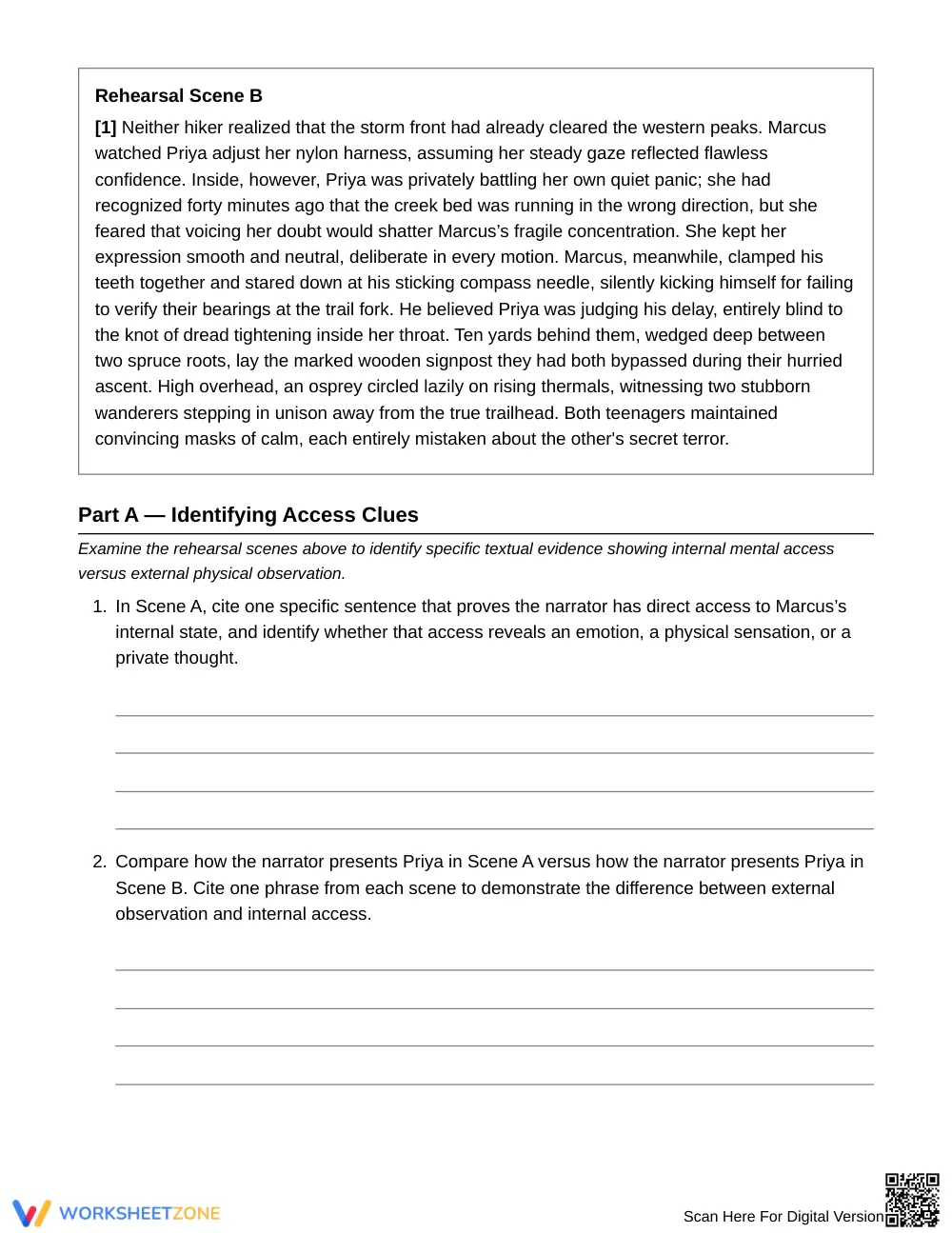
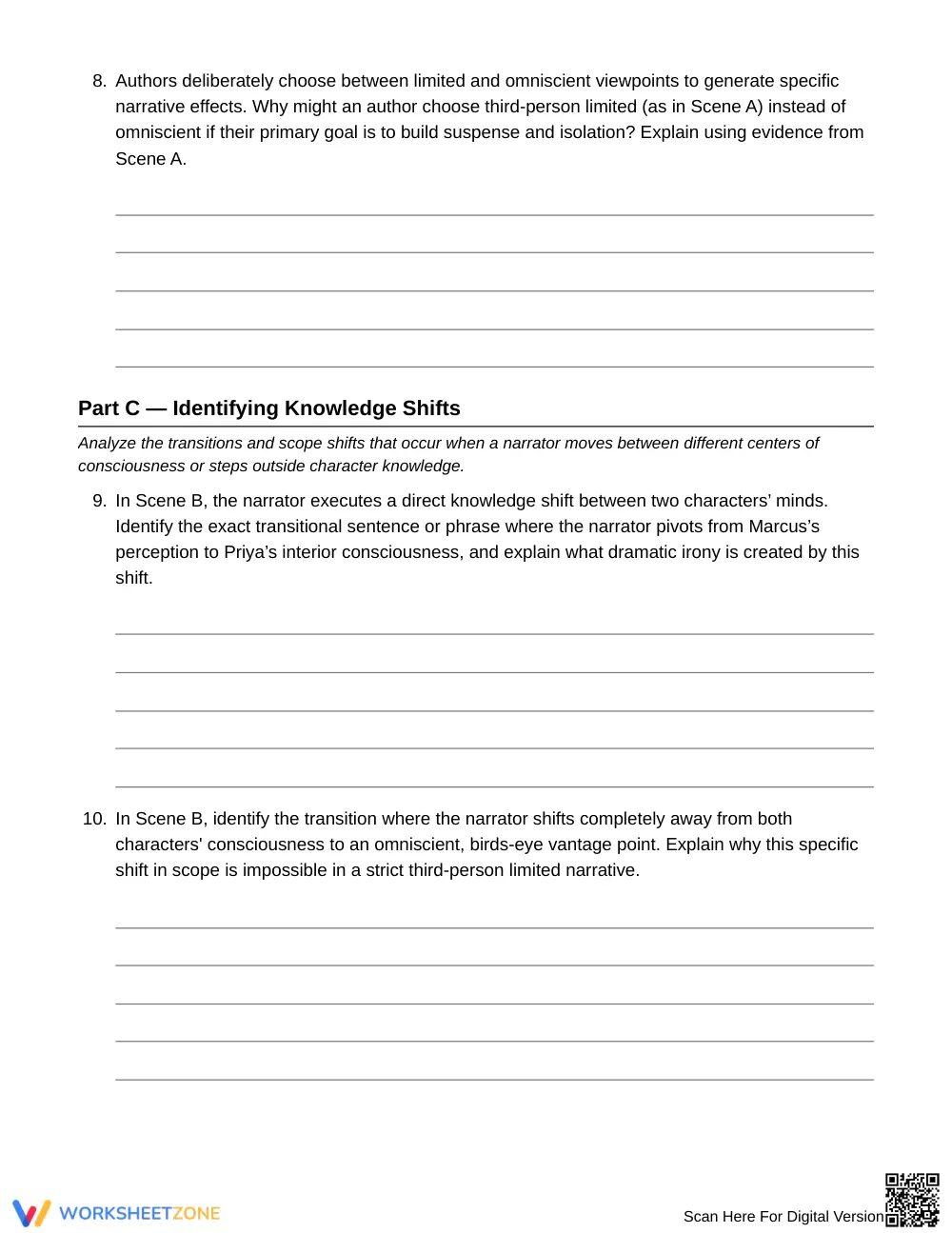
What's inside: This 5-page student activity includes two parallel narrative passages featuring the same characters under different points of view, a concise core concept rule box defining consciousness access, 10 text-dependent analytical tasks, and a detailed 3-page teacher answer key with complete rationale explanations.
Skill Progression
- Guided practice (Tasks 1–3): Students analyze paired anchor scenes to identify specific textual evidence of internal mental access versus external physical observation across characters.
- Supported practice (Tasks 4–8): Students classify narrative stance, justify classifications across fresh micro-excerpts, and explain why authors select specific vantage points to build suspense.
- Independent practice (Tasks 9–10): Students identify narrative pivot points where consciousness shifts occur and evaluate why omniscient vantage points create dramatic irony.
This structured sequence follows a gradual-release framework, moving learners from text-based identification to high-level analysis of authorial intent.
Standards Alignment
This resource aligns directly with `RL.6.6`: Explain how an author develops the point of view of the narrator or speaker in a text. Both standard codes can be copied directly into lesson plans, IEP goals, or district curriculum mapping tools.
How to Use It
Implement this worksheet during or immediately after direct instruction on narrative perspective. In small-group intervention, direct students to highlight internal thoughts in one color and external dialogue in another before answering Part A. For whole-class instruction, assign the rehearsal scenes for paired discussion followed by independent completion of Parts B and C. Plan for 30 to 45 minutes of total instructional time.
Who It's For
This resource is designed for general education Grade 6 ELA classrooms, reading intervention groups, and upper elementary students needing accelerated perspective practice. Pair this printable with a short story anchor text or narrative writing unit to reinforce how perspective shapes reader knowledge.
According to Fisher and Frey (2014), close reading routines that require learners to locate text-based evidence of authorial choices significantly strengthen reading comprehension and metacognitive awareness. When Grade 6 readers evaluate narrator stance through standard RL.6.6, they shift from passive plot tracking to active analysis of how narrator consciousness influences tone, characterization, and suspense. Mastering the boundary between limited and omniscient perspective equips middle school students to decode complex narrative structures across classic literature and standardized reading assessments. Furthermore, explicit examination of narrator vantage points trains students to identify intentional bias, reliable reporting, and dramatic irony within challenging literary works. By systematically contrasting restricted internal access with all-knowing perspectives, young scholars build foundational critical thinking habits that directly enhance their own narrative writing craft, descriptive maturity, and analytical independence across diverse academic tasks and future grade levels.


