



























Essential Lifecycle Emissions Worksheet | Grade 12 Science
Paste this activity's link or code into your existing LMS (Google Classroom, Canvas, Teams, Schoology, Moodle, etc.).
Students can open and work on the activity right away, with no student login required.
You'll still be able to track student progress and results from your teacher account.
This Grade 12 environmental science worksheet equips students to critically evaluate lifecycle greenhouse gas emissions and dismantle misleading zero-emissions claims. Working from empirical lifecycle assessment data, learners diagnose boundary truncation errors, calculate system-wide carbon impacts, and write precise scientific refutations across eight analytical prompts, developing essential data literacy for advanced energy studies.
At a Glance
- Grade: 12 · Subject: Environmental Science
- Standard: Analyze lifecycle emissions data to evaluate and correct false clean energy claims
- Skill Focus: Correct Zero-Emissions Lifecycle Claims in Energy Systems
- Format: 5 pages · 8 problems · Full answer key included · PDF
- Best For: Energy resource analysis, critical thinking, and claim refutation
- Time: 45–60 minutes
What's Inside
This 5-page packet features an authentic Lifecycle Assessment framework, synthetic greenhouse gas benchmark data for eight 500 MW energy pathways, a worked error-repair model, and eight student diagnostic tasks. A full two-page answer key provides complete flaw analyses and sample refutations.
Skill Progression
The worksheet structures student reasoning through a methodical learning progression:
- Guided practice: A modeled exemplar demonstrates diagnosing truncation errors and writing refutations with LCA benchmark data.
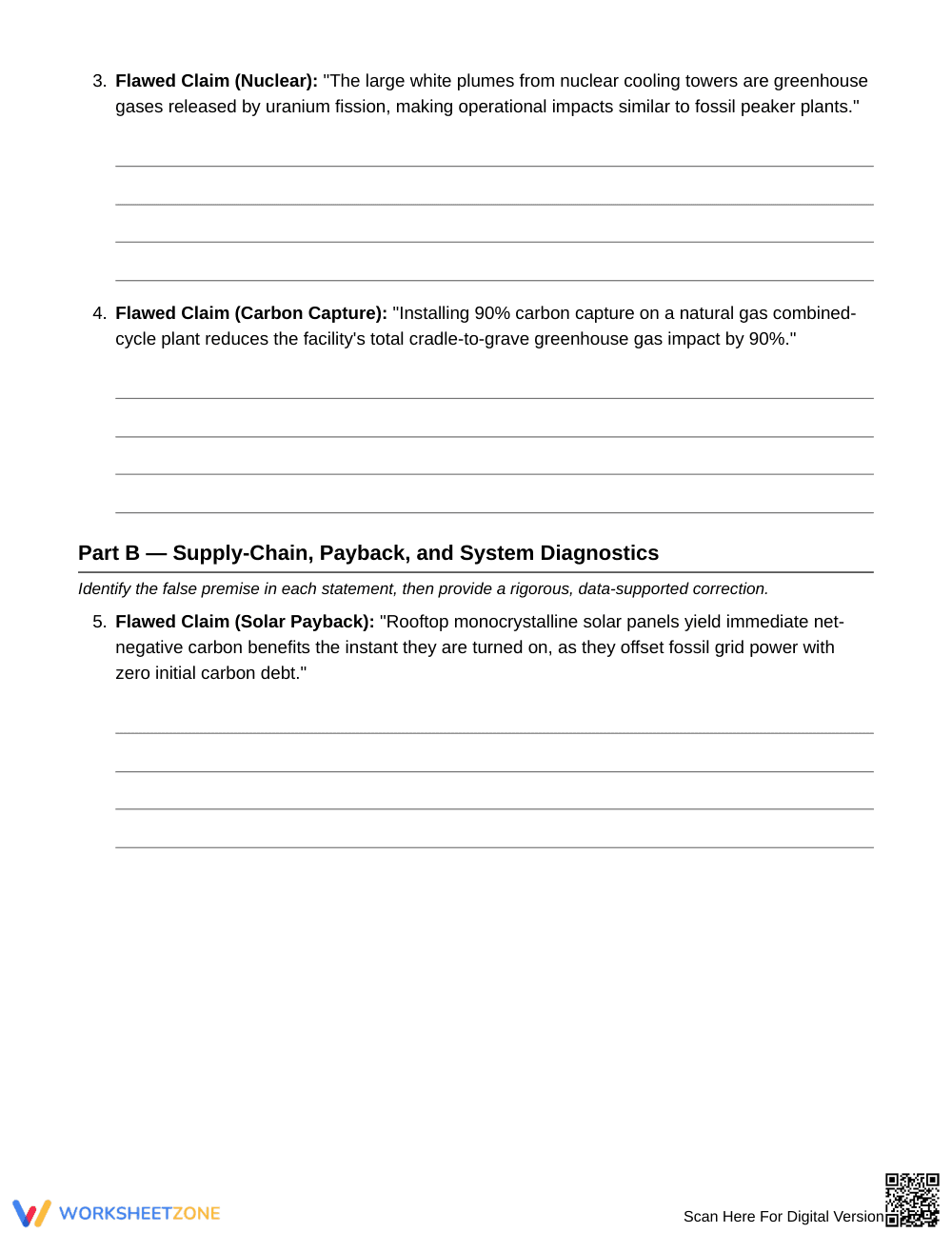
- Supported practice: Part A features 4 boundary diagnostics evaluating wind, biomass, nuclear, and carbon-capture claims against upstream and operational metrics.
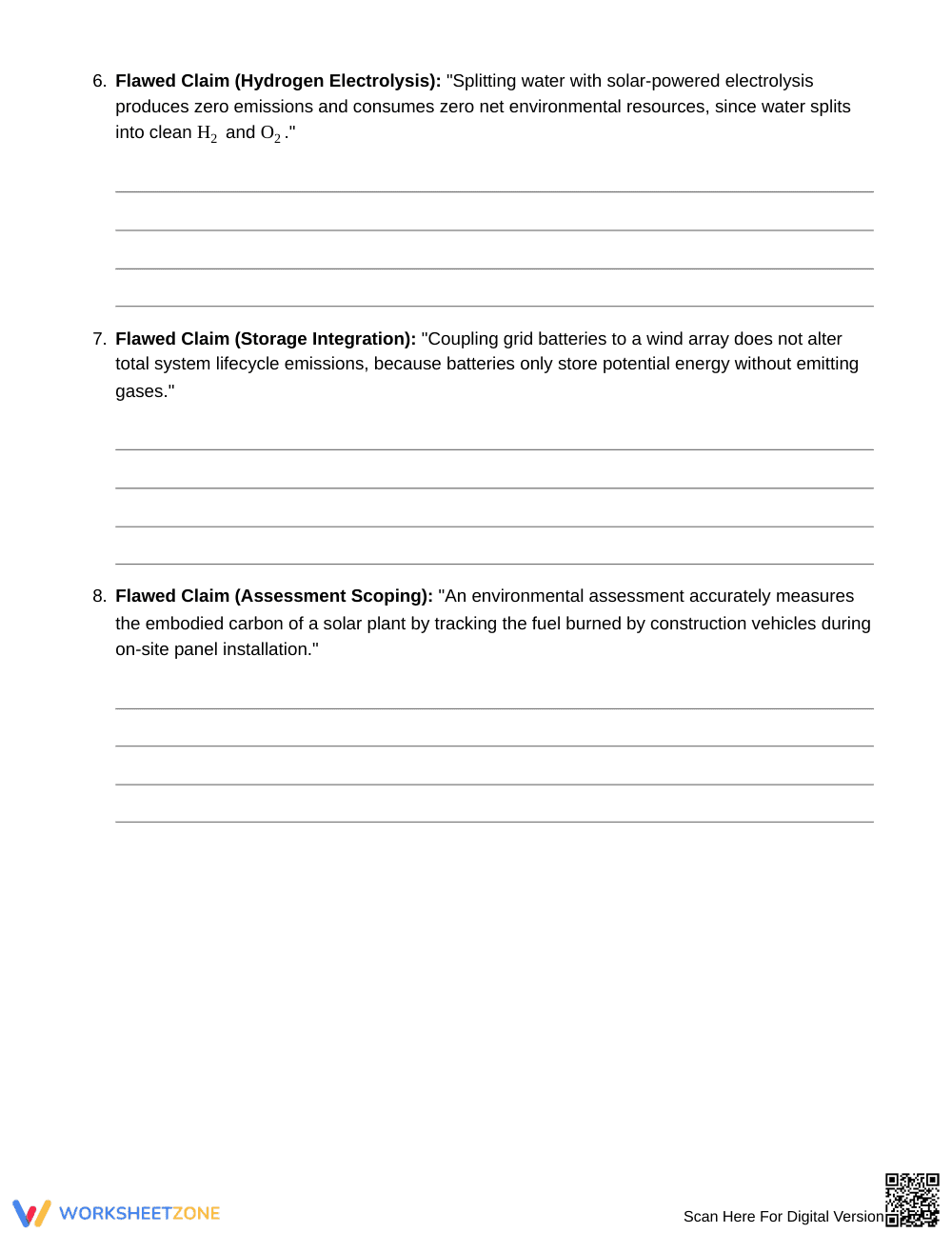
- Independent practice: Part B challenges students with 4 system diagnostics addressing solar payback, electrolysis, battery storage, and scoping boundaries.
This structure follows gradual release of responsibility, moving students from guided analysis to independent argumentation.
Standards Alignment
This resource aligns with high school Environmental Science standards targeting the evaluation of design solutions and resource utilization through lifecycle analysis. Students synthesize quantitative carbon intensity metrics, evaluate competing technological trade-offs, and construct evidence-based scientific arguments. Both standard codes can be copied directly into lesson plans, IEP goals, or district curriculum mapping tools.
How to Use It
Implement this worksheet after direct instruction on lifecycle carbon accounting or as an analytical capstone for renewable energy units. During class, monitor student responses in Part A to ensure learners distinguish between direct operational emissions and embodied upstream manufacturing footprints. Expect students to complete the 8 diagnostic items in 45 to 60 minutes, followed by a collaborative review where peers compare data justifications.
Who It's For
Designed for Grade 12 Environmental Science and advanced Earth science courses, this activity serves students ready for quantitative data evaluation. For extra support, pair the reference table with sentence frames; for extensions, have learners calculate total lifecycle emissions for local power grids. It pairs naturally with energy technology units and resource management lessons.
Research shows that systematic error diagnosis and data-driven refutation significantly enhance scientific literacy. According to Fisher & Frey (2014), structured cognitive scaffolding—moving from modeled demonstrations to collaborative analysis and independent evaluation—substantially improves students' ability to critique flawed arguments and synthesize complex evidence. In secondary energy education, students frequently conflate zero tailpipe or stack emissions with true lifecycle carbon neutrality due to widespread public misconceptions. This Grade 12 resource directly targets those misunderstandings by guiding learners to correct zero-emissions lifecycle claims using empirical greenhouse gas data across mining, combustion, and decommissioning phases. By identifying false premises and constructing rigorous, evidence-based corrections across 8 authentic diagnostic tasks, students cultivate the critical reasoning competencies prioritized in contemporary secondary science frameworks. The included multi-phase reference table and comprehensive answer key ensure teachers can verify students' analytical precision and deepen scientific discourse.


