
































Essential Intended Audience Worksheet | Grade 7 ELA

Paste this activity's link or code into your existing LMS (Google Classroom, Canvas, Teams, Schoology, Moodle, etc.).
Students can open and work on the activity right away, with no student login required.
You'll still be able to track student progress and results from your teacher account.
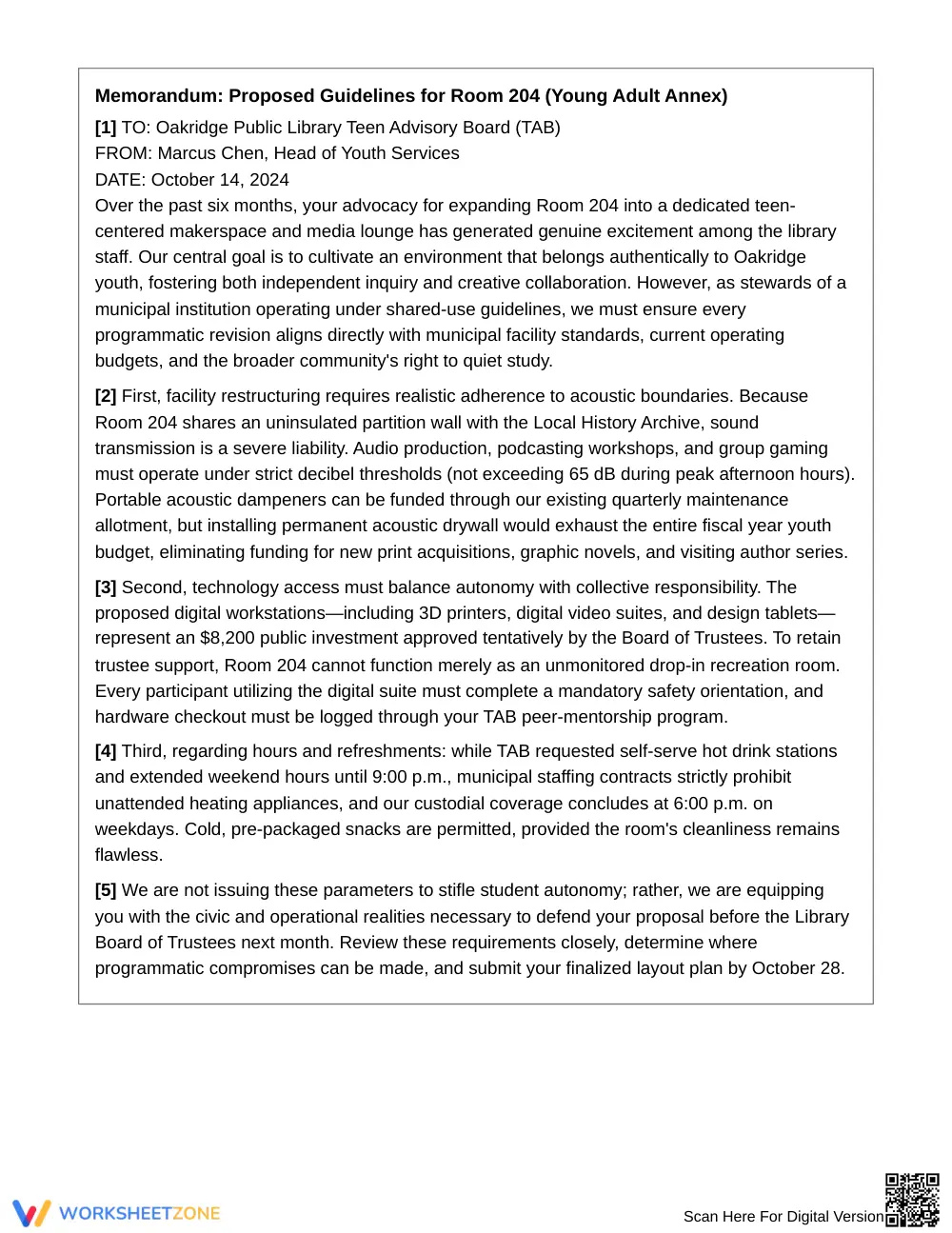
This Grade 7 informational text worksheet equips students to evaluate how an author tailors a formal message to an intended audience. Through a realistic municipal memorandum regarding a youth makerspace, learners analyze administrative constraints, detect underlying motives, and draft a text-grounded compromise proposal, strengthening critical reading and civic reasoning skills.
At a Glance
- Grade: 7 · Subject: ELA
- Standard:
RI.6.6— Determine an author's point of view or purpose and explain how it is conveyed- Skill Focus: Evaluate a Message for Its Intended Audience
- Format: 5 pages · 10 problems · Answer key included · PDF
- Best For: Informational text analysis and close reading
- Time: 45–60 minutes
What's Inside
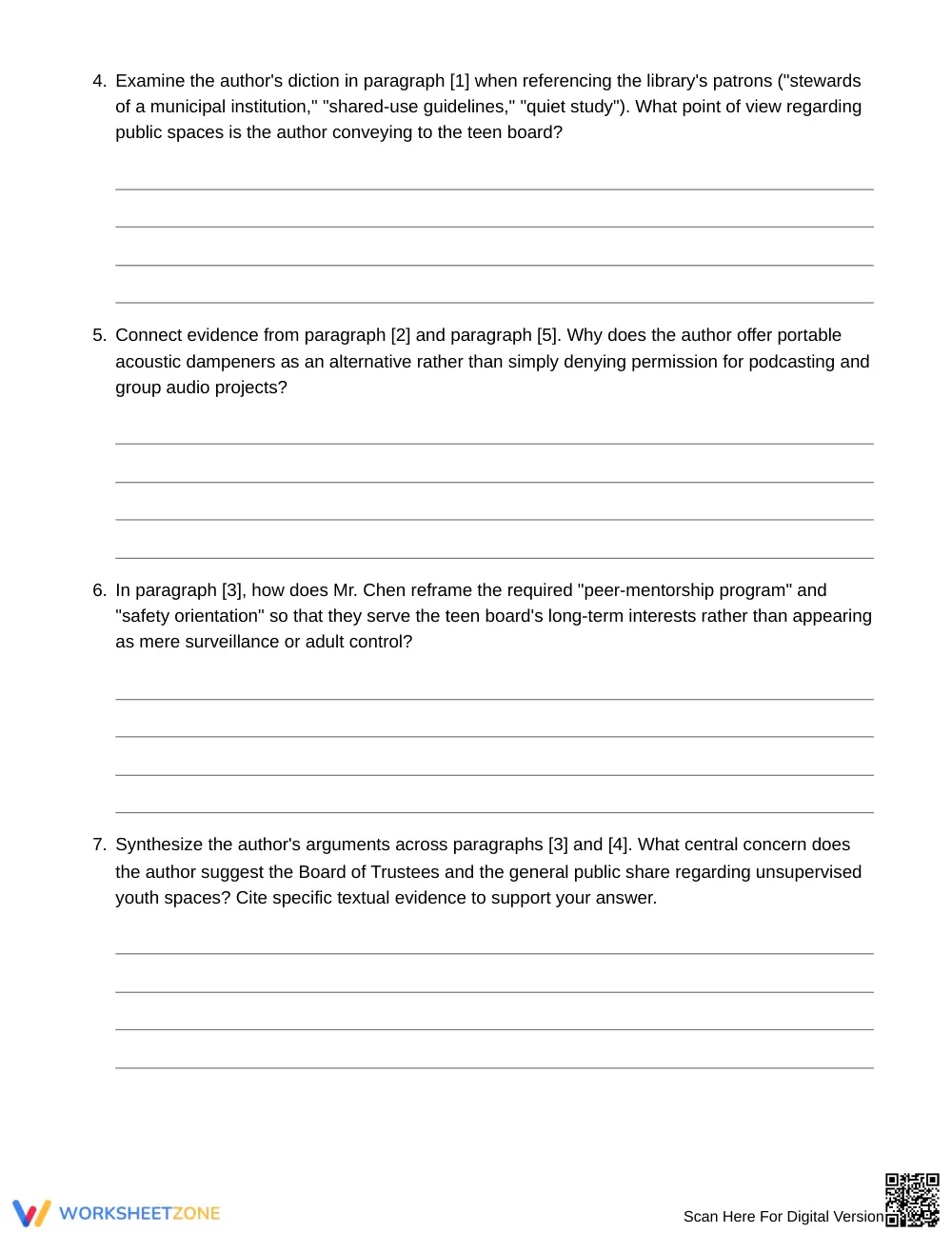
The 5-page resource centers on an administrative memo from a Youth Services director to a Teen Advisory Board. Across 10 analytical prompts, students tackle evidence retrieval, diction analysis, and an authentic synthesis task. The packet includes a core concept overview and a detailed 3-page answer key with model responses.
Skill Progression
- Guided practice (Tasks 1–2): Low-scaffold retrieval identifying literal budget caps and municipal facility constraints in paragraphs 2 through 4.
- Supported practice (Tasks 3–8): Moderate-scaffold analysis evaluating rhetorical transitions, diction, and audience framing across paragraphs 1 through 5.
- Independent practice (Tasks 9–10): High-scaffold synthesis requiring students to justify policy compromises and draft a formal administrative rebuttal using textual evidence.
This sequence implements the gradual release model, moving learners systematically from text retrieval to rhetorical critique.
Standards Alignment
This resource aligns with `RI.6.6`: Determine an author's point of view or purpose in a text and explain how it is conveyed in the text. It also reinforces `RI.7.6` by prompting students to analyze how the author addresses diverse patron perspectives. Both standard codes can be copied directly into lesson plans, IEP goals, or district curriculum mapping tools.
How to Use It
Use this worksheet after direct instruction on author's purpose, or assign it during an informational text unit. For formative assessment, observe student responses to Task 4 to evaluate how well they interpret administrative diction. The complete 10-problem sequence takes approximately 45 to 60 minutes to complete.
Who It's For
Designed for Grade 7 ELA classes, this worksheet also supports Grade 8 intervention groups and advanced Grade 6 readers. Scaffold the assignment by providing highlighters for institutional limits, or extend it by having students debate the policy revisions. Pair this worksheet with an anchor chart on author's perspective.
Explicit instruction in analyzing authorial intent and audience awareness directly enhances adolescent comprehension of complex informational texts. According to foundational research on structured literacy and disciplinary reading by Fisher & Frey (2014), guiding middle school students through sequenced, text-dependent questions fosters critical evaluative thinking, bridging basic literal comprehension with sophisticated rhetorical analysis. Aligned with standard `RI.6.6`, this instructional resource targets the essential skill of determining an author's point of view or purpose and explaining how it is systematically conveyed through deliberate organizational choices and nuanced word selection. By examining a realistic municipal memorandum, seventh-grade students dissect how communicative tone, municipal policy boundaries, and administrative rhetoric interact to shape audience perception. Ultimately, students translate analytical observations into an evidence-based written compromise, actively strengthening their ability to evaluate complex functional texts across academic, workplace, and civic environments.


