


























Views
Downloads



Essential Human Homeostasis Worksheet | Grade 10 Biology
Paste this activity's link or code into your existing LMS (Google Classroom, Canvas, Teams, Schoology, Moodle, etc.).
Students can open and work on the activity right away, with no student login required.
You'll still be able to track student progress and results from your teacher account.
This high school biology worksheet builds student mastery of human feedback mechanisms, thermoregulation, and blood glucose regulation. Tenth-grade learners analyze dynamic equilibrium, trace endocrine signaling pathways, and interpret physiological data to explain how negative feedback maintains internal stability.
At a Glance
- Grade: 10 · Subject: Biology
- Standard: High School Life Sciences — Evaluate evidence that feedback mechanisms maintain homeostasis
- Skill Focus: Human Homeostasis & Feedback Systems
- Format: 4 pages · 12 problems · Answer key included · PDF
- Best For: Feedback loop review & data analysis
- Time: 40–50 minutes
What's Inside: Across 4 pages, this 12-task worksheet features multiple-choice conceptual items, reflex arc tables, and quantitative data interpretation. Students evaluate cycling thermoregulation tables and post-exercise glucose tolerance curves. A complete 2-page answer key provides model physiological explanations and pathway breakdowns.
Skill Progression
- Guided Practice (Part A, 3 problems): Reviews core concepts by contrasting negative and positive feedback, completing a thermoregulatory reflex arc, and identifying pancreatic islet secretions.
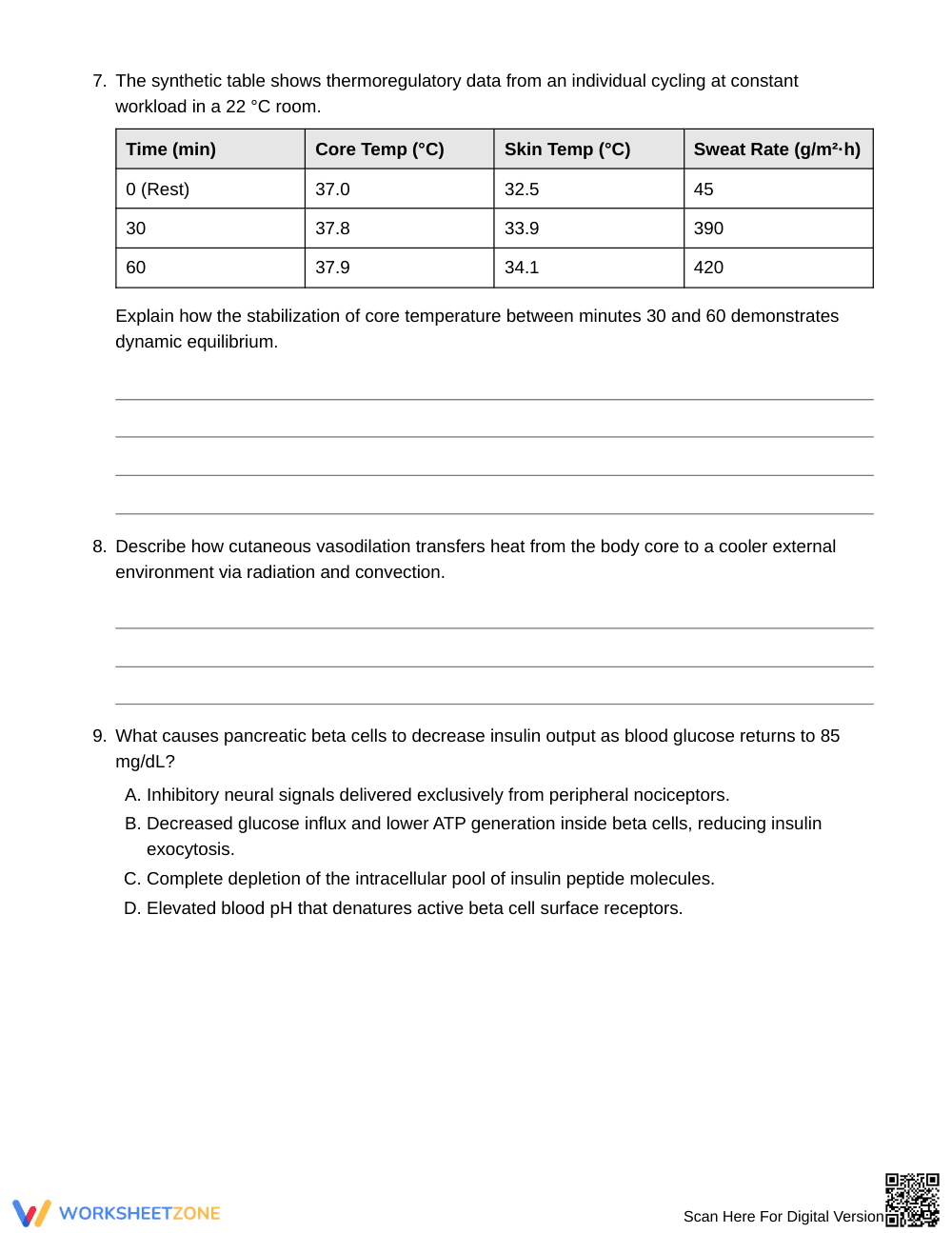
- Supported Practice (Part B, 6 problems): Deepens mechanistic analysis through response sequencing, glucose counter-regulation tracing, dynamic equilibrium data evaluation, and cutaneous heat transfer physics.
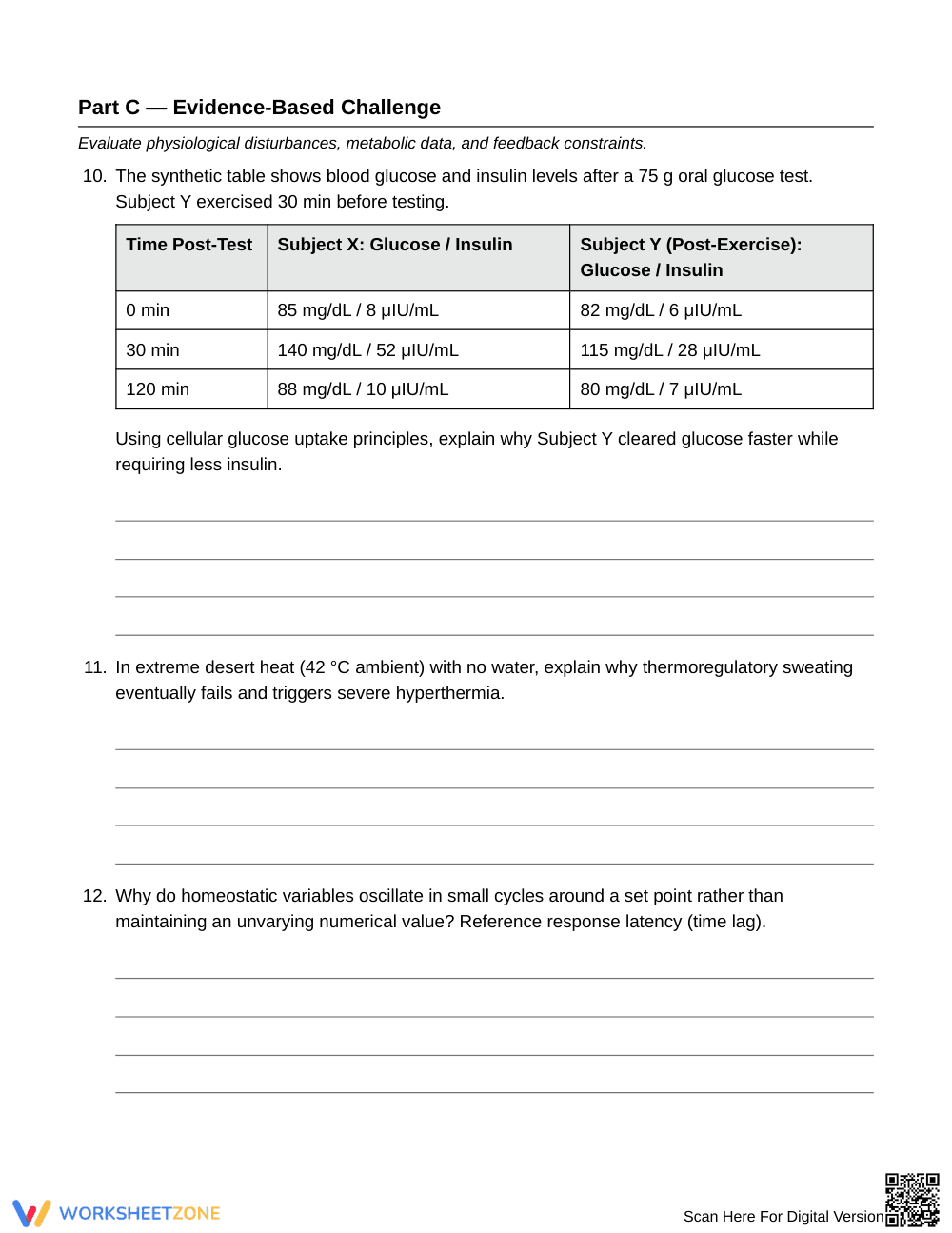
- Independent Practice (Part C, 3 problems): Challenges students to evaluate metabolic data curves, explain dehydration thermoregulatory failure, and analyze response latency oscillations around set points.
This structured progression follows a gradual-release model, moving learners from conceptual recall to complex physiological reasoning.
Standards Alignment
This resource aligns with high school life science standards requiring students to illustrate how feedback mechanisms maintain dynamic equilibrium in living systems. Learners explain how negative feedback actively stabilizes body temperature and glucose levels during physiological stress. Both standard codes can be copied directly into lesson plans, IEP goals, or district curriculum mapping tools.
How to Use It
Use this worksheet after direct instruction on human endocrine and nervous regulation. Have students complete Parts A and B in pairs over 25 minutes to check understanding of glucagon and insulin pathways. Assign Part C as an independent exit ticket over 15 minutes. Expected completion time is 40 to 50 minutes.
Who It's For
Designed for Grade 10 biology students studying human body systems. Scaffolded tables support emerging learners, while data interpretation challenges advanced students. Pair this activity with a negative feedback diagram or an interactive homeostasis lab.
According to Fisher & Frey (2014), structured practice that progresses from foundational concepts to multi-variable data interpretation significantly improves conceptual retention and scientific reasoning in secondary science classrooms. This Grade 10 homeostasis worksheet provides 12 rigorous analytical tasks focused on negative feedback mechanisms, thermoregulation, and endocrine signaling. By analyzing synthetic experimental datasets—including continuous core temperature measurements and oral glucose tolerance curves—students actively reconstruct the physiological principles governing dynamic equilibrium rather than relying on rote memorization. The intentional sequence moves from basic reflex arc components to complex physiological explanations of response latency and environmental thermal stress. This clear progression ensures learners build transferrable analytical competencies across life science domains. Teachers can effectively measure student mastery of homeostatic set points and regulatory loops using the included formative prompts and detailed model answer keys.


