































Essential Greek Myths Word Search | Grade 6 ELA

Paste this activity's link or code into your existing LMS (Google Classroom, Canvas, Teams, Schoology, Moodle, etc.).
Students can open and work on the activity right away, with no student login required.
You'll still be able to track student progress and results from your teacher account.
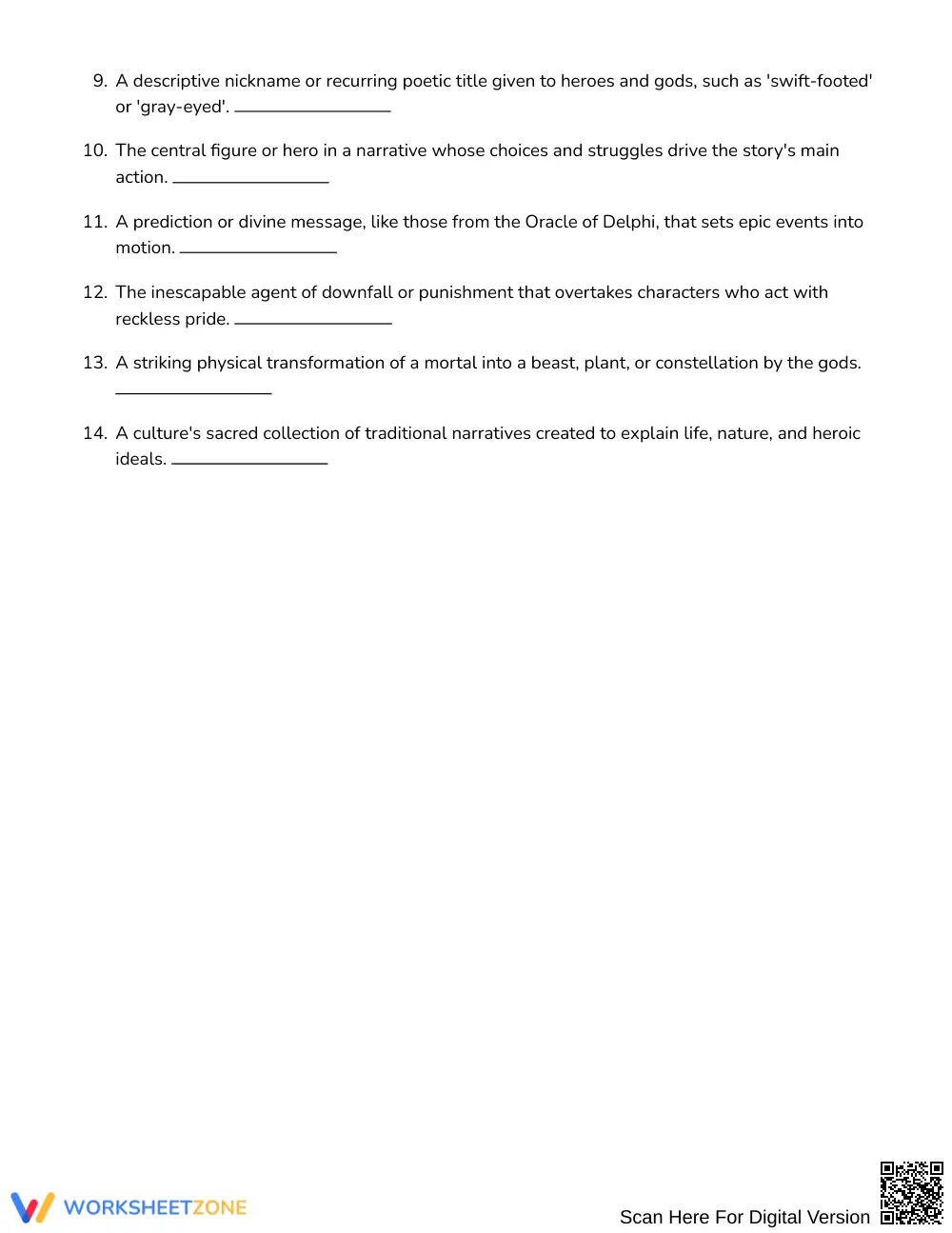
This Grade 6 Greek mythology word search reinforces essential literary terms and legendary figures through clue-based puzzle solving. Students analyze definitions to identify 14 core academic vocabulary terms before locating each hidden word within the puzzle grid, building key background knowledge for classical literature units.
At a Glance
- Grade: Grade 6 · Subject: ELA
- Standard: Not standards-assessed — vocabulary enrichment
- Skill Focus: Greek myths as literature
- Format: 3 pages · 14 words · Answer key included · PDF
- Best For: Myth unit review or warm-up
- Time: 15–25 minutes
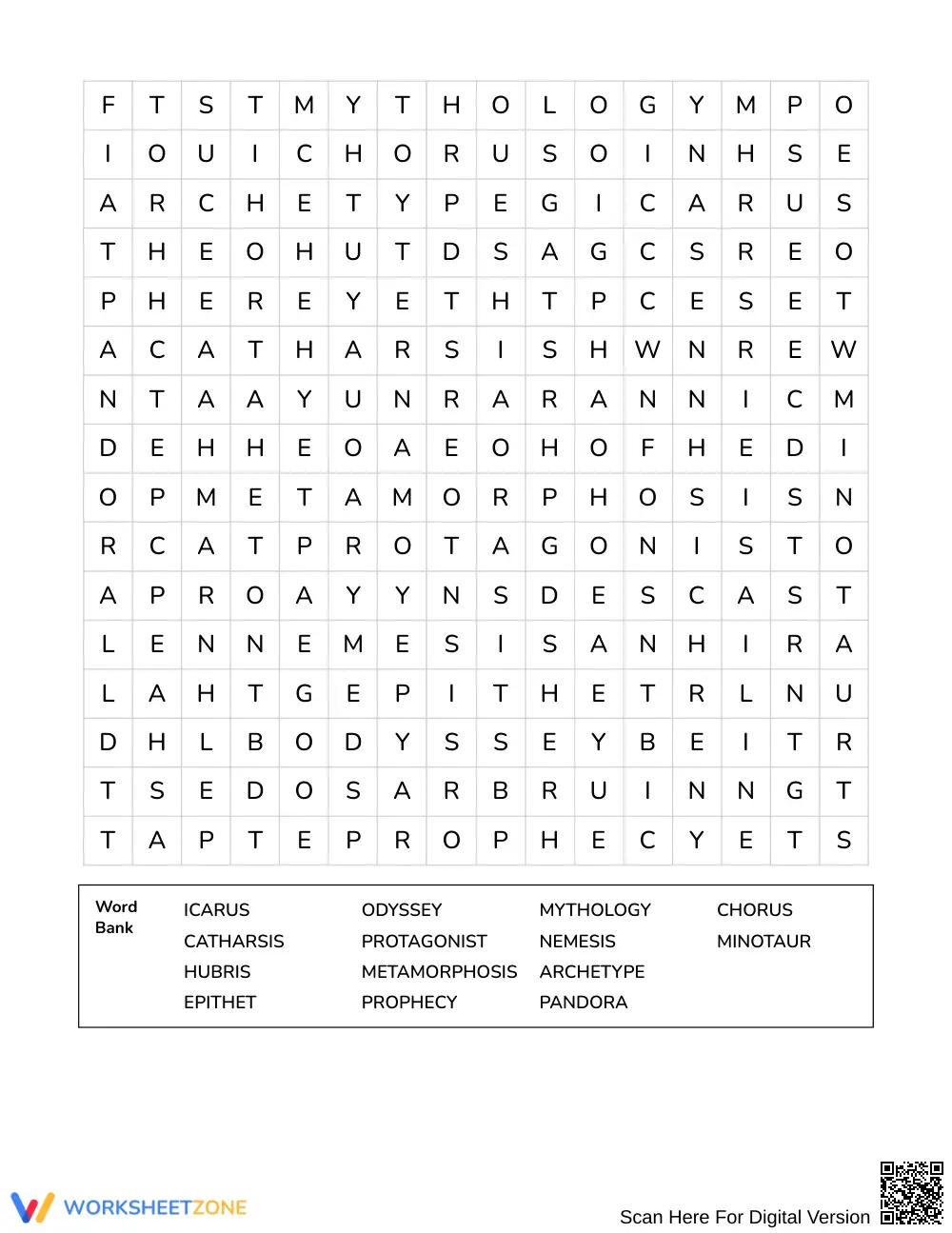
What's Inside: A 3-page printable activity featuring 14 critical literary terms from classical mythology, including words like hubris, archetype, catharsis, and epithet. Each item pairs a rigorous narrative clue with a hidden term, supported by a full 3-page answer key showing exact letter coordinates for quick checking.
Zero-Prep Workflow
- Step 1 (Print — 30 seconds): Send the puzzle pages directly to your printer with no formatting or scaling adjustments required.
- Step 2 (Distribute — 30 seconds): Hand out the clue detective activity as an immediate bellringer, literacy center, or emergency substitute plan.
- Step 3 (Review — 1 minute): Use the matching answer key overlays to verify student discoveries or facilitate a rapid class check. Total teacher prep time remains under 2 minutes.
Puzzle Mechanics & Design
This puzzle presents a challenging 16 x 16 letter grid designed to hone visual tracking and spelling accuracy. Words are placed across four distinct orientations: northeast, east, southeast, and south. Rather than relying on a passive word bank, students read descriptive definitions to deduce target vocabulary before locating each term across the grid.
Standards Alignment
This resource serves as targeted vocabulary enrichment and is not aligned to a specific grade-level standard. It provides supplementary academic language support to enrich classical literature studies, mythology units, and cross-curricular ancient history investigations.
How to Use It
Deploy this puzzle immediately after introducing literary elements in ancient Greek texts to solidify conceptual definitions, or assign it as an independent fast-finisher task. During seatwork, circulate to ensure students use the narrative clues rather than guessing letter strings. Students typically complete the 14 vocabulary words within 15 to 25 minutes.
Who It's For
Designed for Grade 6 English Language Arts classrooms, this resource supports general education students, gifted learners exploring classical motifs, and middle school readers needing structured contextual clues. Pair this activity directly with an introductory reading of Homer's Odyssey or a classroom anchor chart detailing common mythic archetypes.
Vocabulary acquisition requires deliberate exposure to domain-specific terminology across varied textual formats, a principle emphasized in RAND AIRS 2024 literacy research. By requiring students to interpret analytical definitions of literary concepts like nemesis and metamorphosis prior to locating letter strings, this 14-word puzzle strengthens orthographic mapping alongside thematic comprehension. Educational evaluations underscore that active retrieval practice using contextual clues produces deeper semantic retention than isolated rote repetition. Integrating classical literary terminology into structured word-finding tasks gives Grade 6 learners repeated, engaging interactions with complex academic terms that recur across middle school narrative analysis. The resulting familiarity lowers cognitive barrier during subsequent direct reading of challenging historical texts, providing educators with a practical, research-aligned tool for reinforcing essential humanities vocabulary during independent or transitional classroom intervals.


