

































Essential Framing of the Same Facts Worksheet | Grade 8 ELA

Paste this activity's link or code into your existing LMS (Google Classroom, Canvas, Teams, Schoology, Moodle, etc.).
Students can open and work on the activity right away, with no student login required.
You'll still be able to track student progress and results from your teacher account.
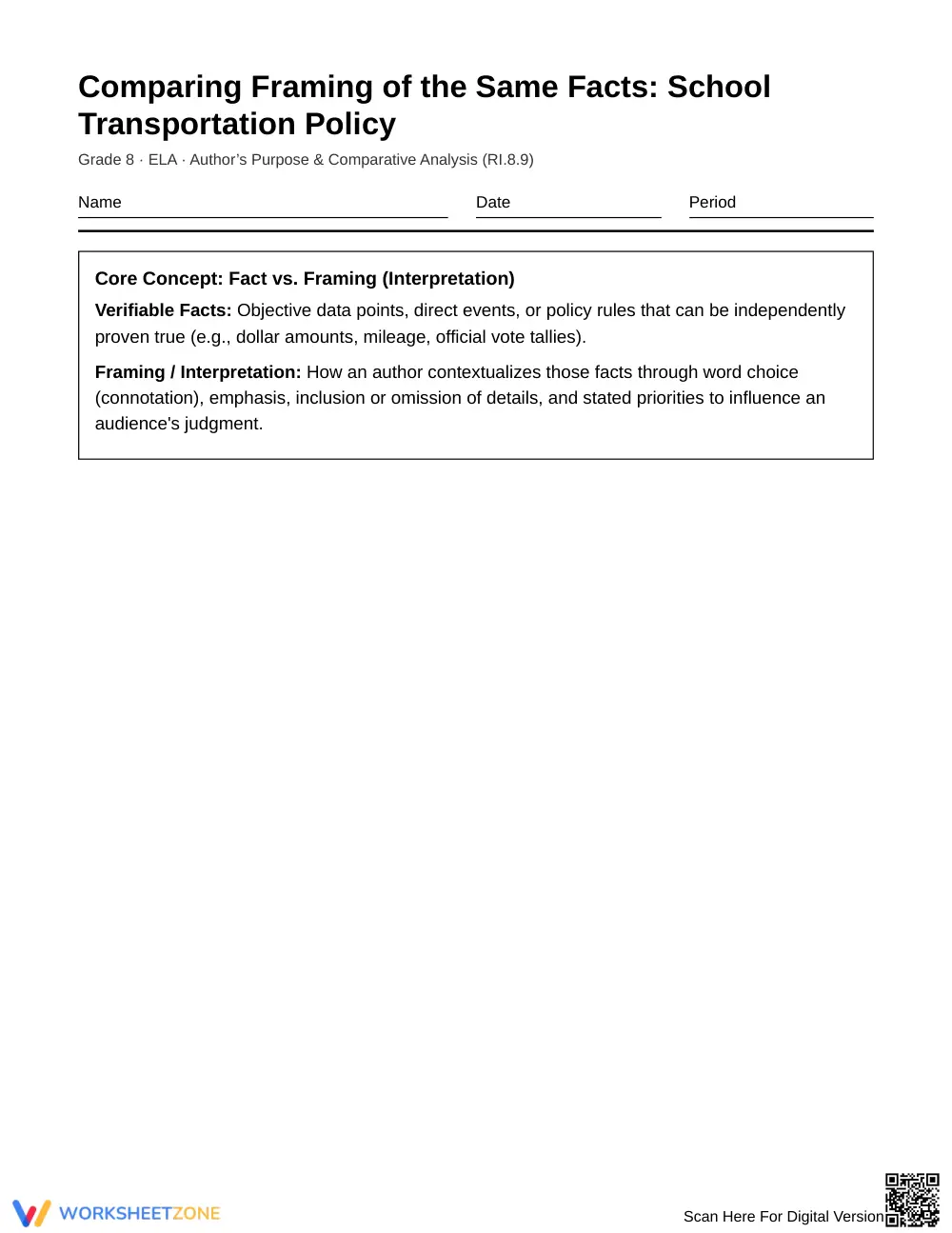
This Grade 8 informational text worksheet teaches students to analyze how two authors present identical facts using contrasting framing, tone, and word choice. Through 10 analytical problems, learners evaluate a news report and an editorial, discovering how authors shape public perception without altering baseline data.
At a Glance
- Grade: 8 · Subject: ELA
- Standard:
RI.8.9— Analyze how two texts present the same topic with contrasting framing- Skill Focus: Compare Framing of the Same Facts
- Format: 5 pages · 10 problems · Answer key included · PDF
- Best For: Paired text analysis and rhetoric lessons
- Time: 45–60 minutes
What's Inside
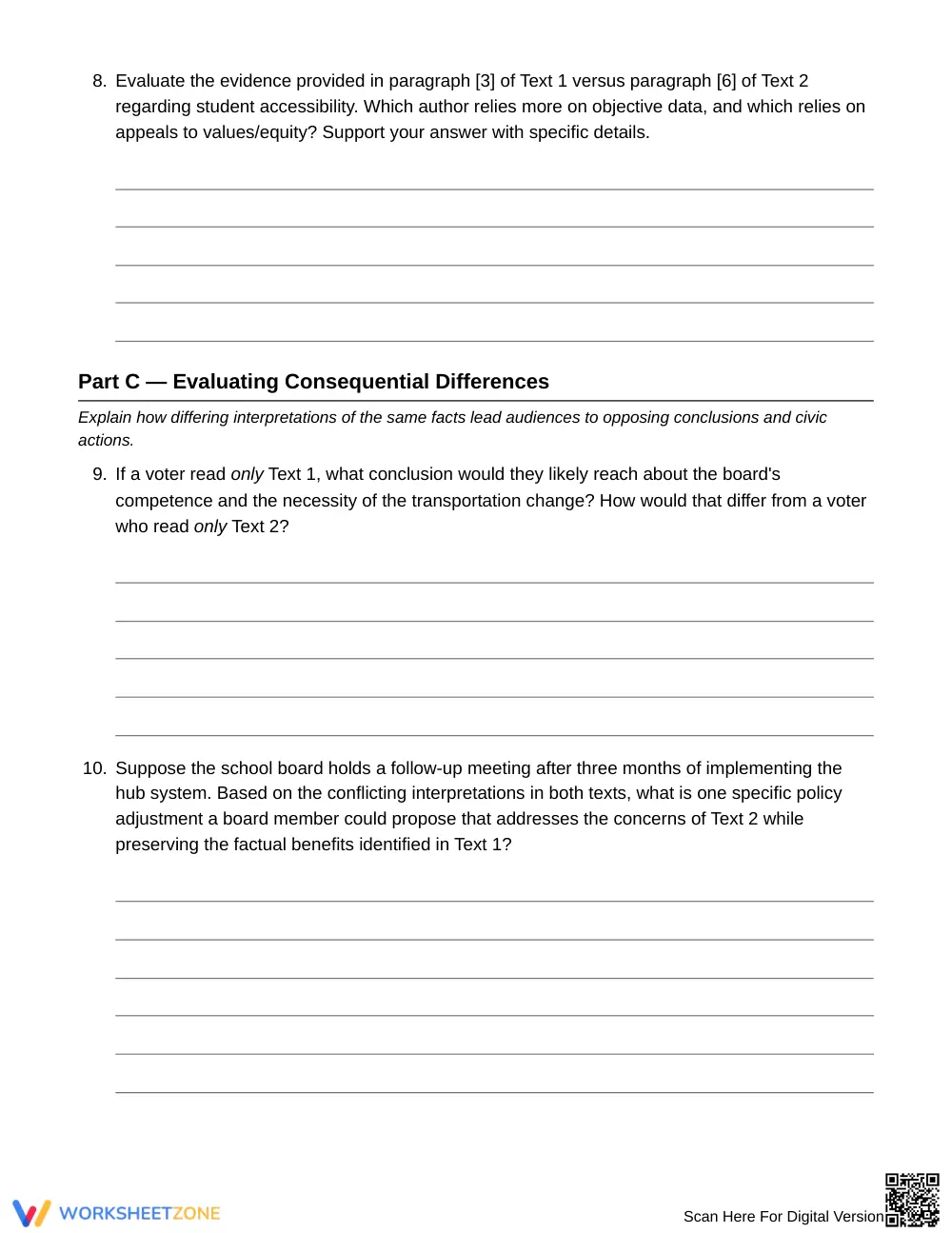
This 5-page resource features paired informational passages about school bus policy, a core concept definition box, and 10 analytical questions. It combines multiple-choice analysis with text-dependent written responses, supported by a 3-page comprehensive answer key complete with sample student explanations.
Skill Progression
- Guided Practice (Part A, 2 tasks): Students identify shared verifiable facts and analyze how purpose shapes framing.
- Supported Practice (Part B, 6 tasks): Learners evaluate conflicting connotations, data presentation, and omitted details.
- Independent Practice (Part C, 2 tasks): Students assess audience impact and synthesize balanced policy adjustments.
This gradual release sequence moves students from basic fact identification to rigorous rhetorical critique.
Standards Alignment
This worksheet aligns directly to RI.8.9: Analyze a case in which two or more texts provide conflicting information on the same topic and identify where the texts disagree on matters of fact or interpretation. It also supports RI.8.6 on author point of view. Both standard codes can be copied directly into lesson plans, IEP goals, or district curriculum mapping tools.
How to Use It
Assign this activity during a non-fiction unit after introducing author perspective. Use Part A as a formative check to ensure students distinguish data from spin before moving to paired partner analysis in Part B. Completion typically takes 45 to 60 minutes.
Who It's For
This resource serves Grade 8 ELA classes, reading intervention groups, and pre-AP English students tackling comparative analysis. Differentiate by having students highlight facts in yellow and author framing in blue. Pair this worksheet with direct instruction on rhetorical word choice.
Comparative analysis of conflicting informational texts is a critical component of middle school literacy under standard RI.8.9, which requires students to analyze how authors frame identical facts to support opposing interpretations. Research by Fisher & Frey (2014) confirms that structured close reading routines using paired texts with contrasting perspectives significantly strengthen students' analytical writing and evaluative comprehension. By examining how connotation, selective detail omission, and authorial purpose influence policy reporting, learners build vital discernment skills needed for academic assessments and civic engagement. This 5-page worksheet provides 10 scaffolded, text-dependent tasks that teach students to separate objective evidence from subjective framing. The structured progression ensures Grade 8 readers develop the evaluative habits necessary to critique complex arguments, identify media bias, and synthesize conflicting perspectives with intellectual clarity and deep academic rigor across all informational reading domains.


