


























Views
Downloads

Essential Founder Populations Worksheet | Grade 10 Biology
Paste this activity's link or code into your existing LMS (Google Classroom, Canvas, Teams, Schoology, Moodle, etc.).
Students can open and work on the activity right away, with no student login required.
You'll still be able to track student progress and results from your teacher account.
This comprehensive biology worksheet guides high school students through the complex interactions of genetic drift, natural selection, and gene flow. Working with quantitative synthetic datasets across multi-generational founder events, students analyze allele frequency shifts, evaluate adaptive versus non-adaptive evolutionary mechanisms, and practice interpreting biological evidence to draw rigorous, data-supported scientific conclusions.
At a Glance
- Grade: 10 · Subject: Biology
- Standard: Population Genetics — Analyze how founder events, genetic drift, and natural selection alter allele frequencies over time
- Skill Focus: Evaluate a Founder-Population Scenario
- Format: 5 pages · 10 problems · Answer key included · PDF
- Best For: Population genetics analysis and formative assessment
- Time: 45–60 minutes
What's Inside
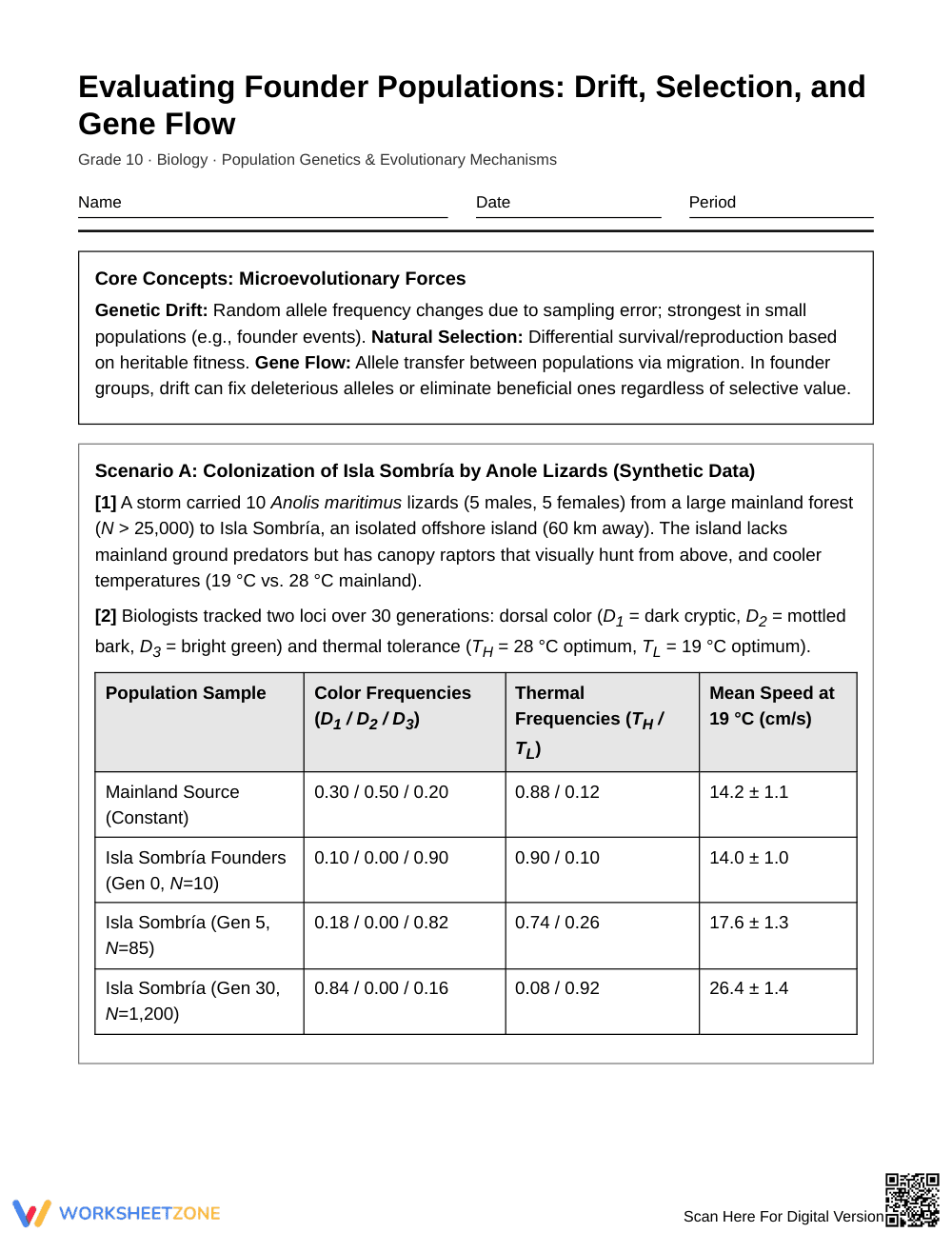
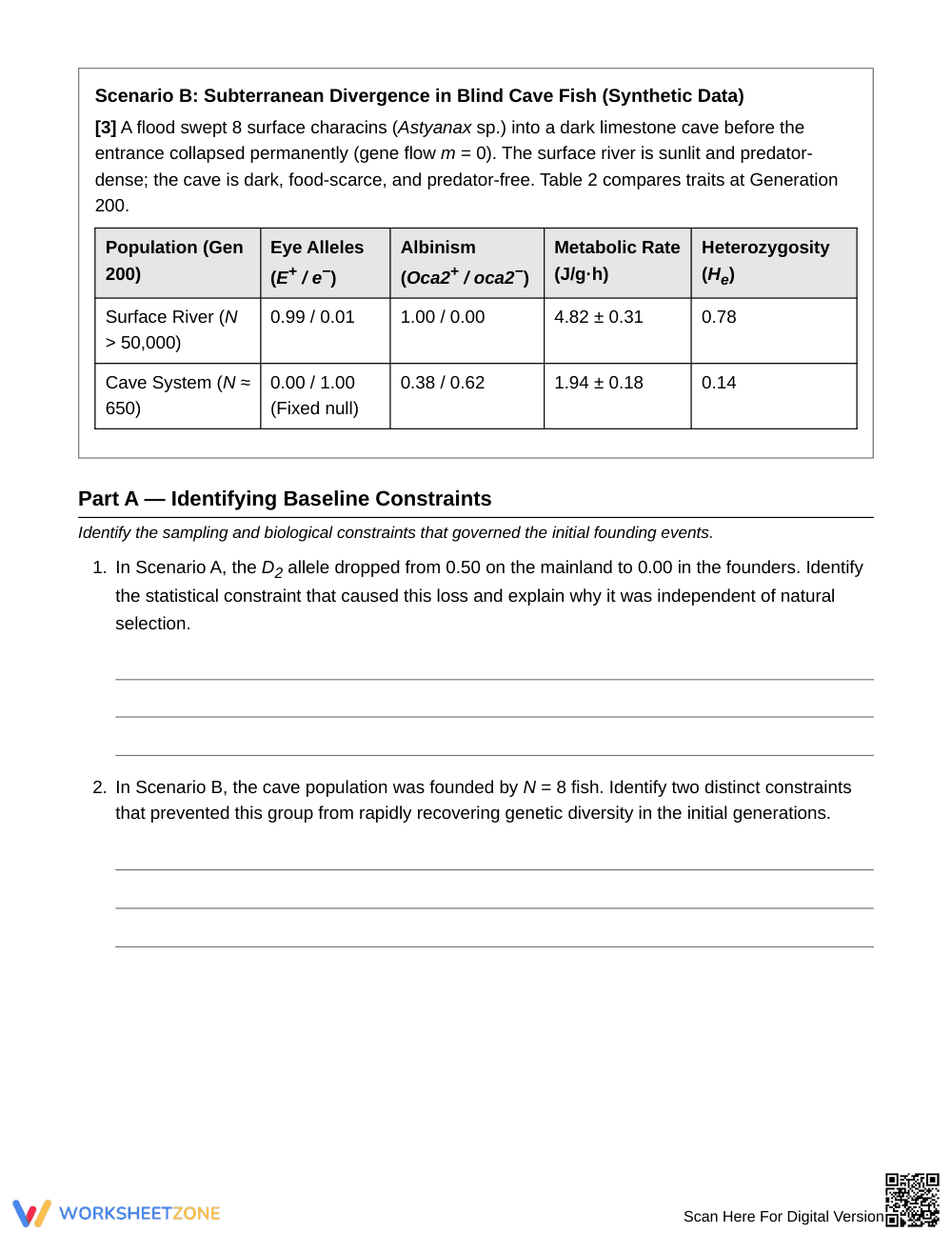
The resource contains 2 rich, synthetic scenario datasets across 5 pages, paired with a detailed 3-page teacher answer key. Students analyze colonization tracking data for island anoles across 30 generations and cave-dwelling fish across 200 generations. Question formats include constraint identification, quantitative multiple-choice items, data interpretation prompts, and claim evaluation tasks.
Skill Progression
- Guided practice (Part A, 2 tasks): Students identify initial sampling error and baseline constraints that limit genetic diversity following extreme bottleneck events.
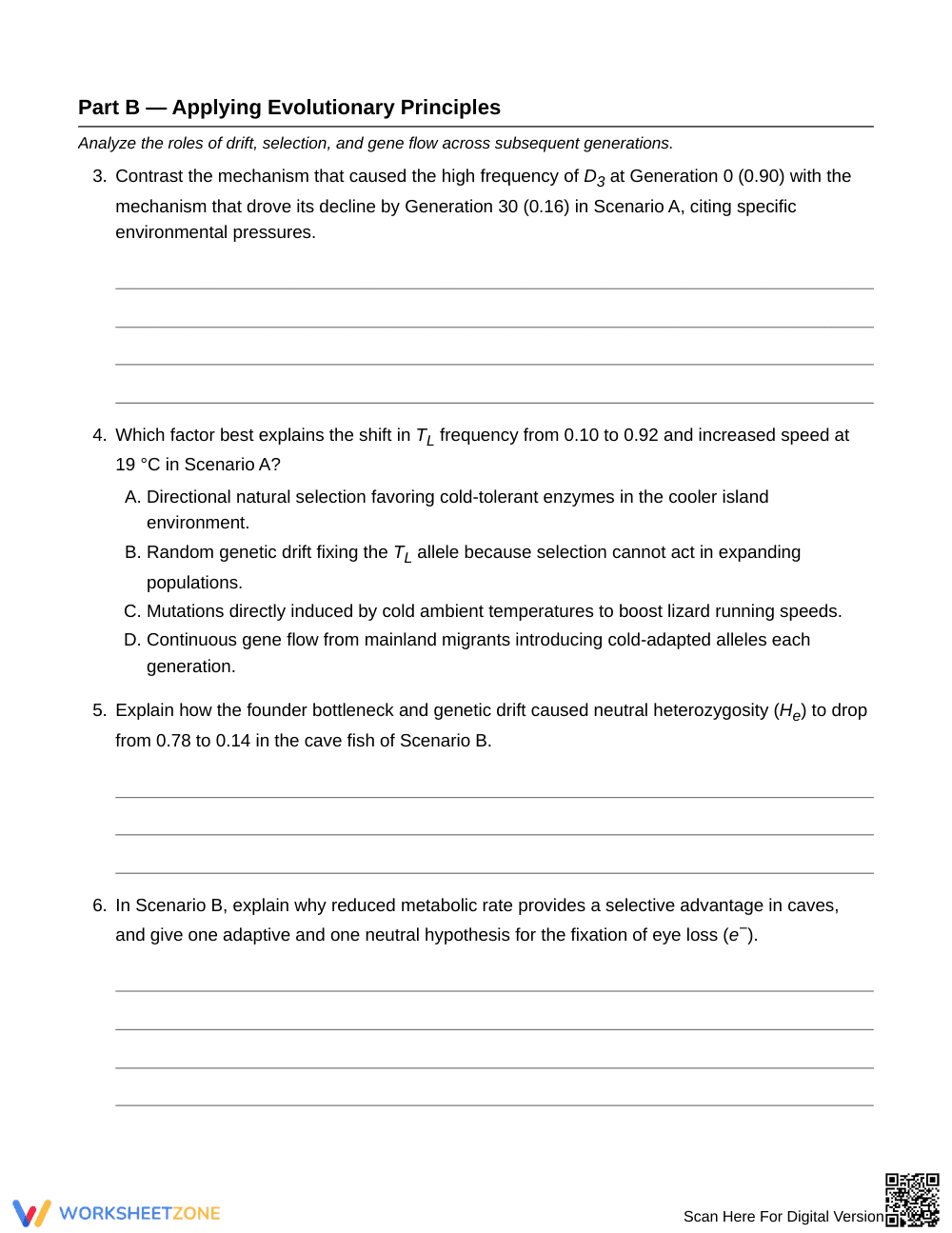
- Supported practice (Part B, 6 tasks): Learners apply microevolutionary mechanisms across generations, contrasting random genetic drift with directional selection using frequency data and heterozygosity metrics.
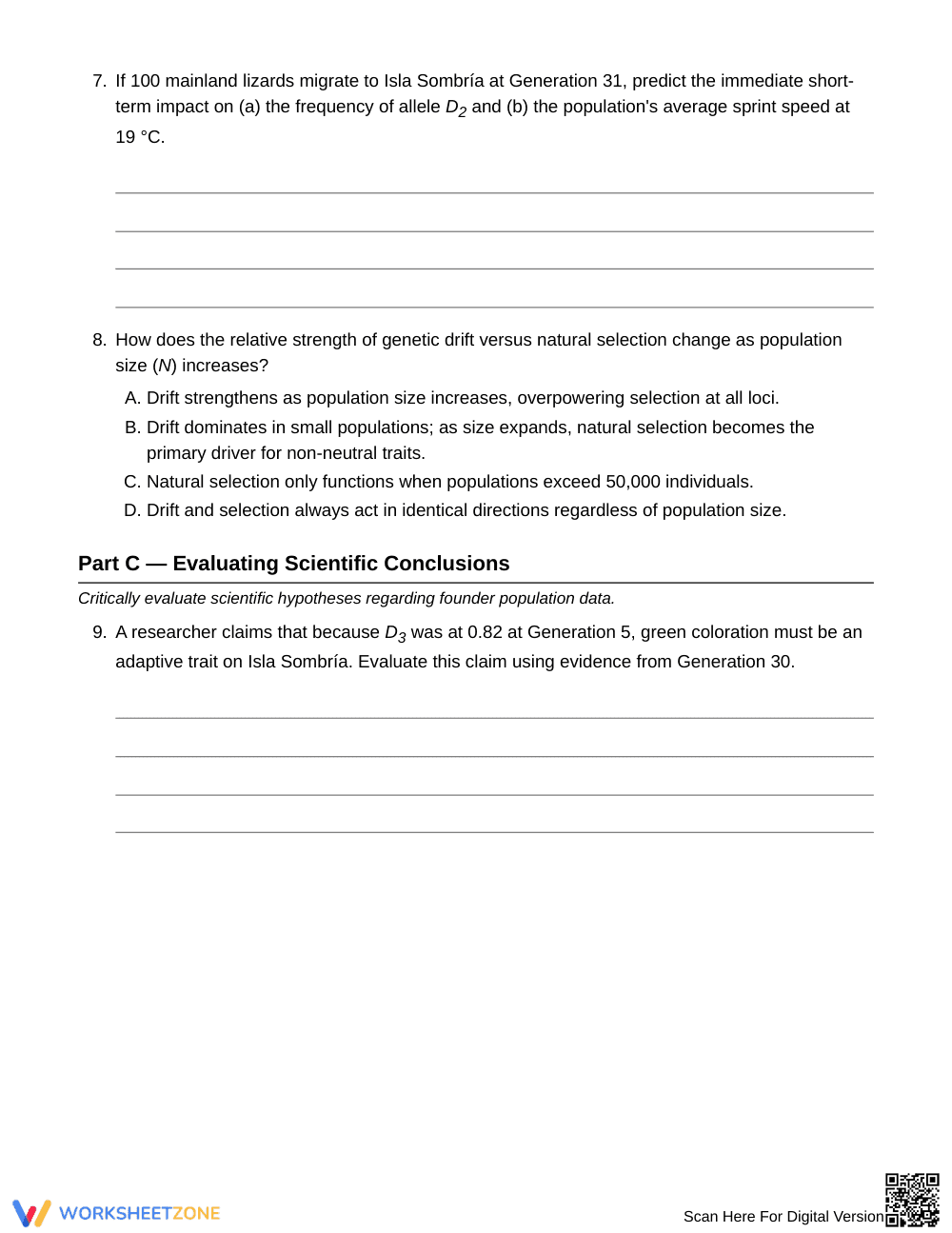
- Independent practice (Part C, 2 tasks): Students critically evaluate conflicting scientific hypotheses, distinguishing neutral drift artifacts from adaptive selective advantages.
This structured progression follows the gradual-release instructional model, moving students from foundational constraint analysis to nuanced hypothesis evaluation.
Standards Alignment
This resource aligns with high school life science standards focusing on natural selection and adaptation, where students apply concepts of statistics and probability to explain variation and distribution of expressed traits. It also supports expectations for evaluating mathematical models of allele changes in gene pools. Both standard codes can be copied directly into lesson plans, IEP goals, or district curriculum mapping tools.
How to Use It
Use this activity immediately after direct instruction on the Hardy-Weinberg equilibrium and microevolutionary mechanisms. In a collaborative workshop setting, students work in pairs to interpret the tabular data before completing individual evaluations. For formative assessment, examine student responses to Part B's heterozygosity question to identify common misconceptions regarding intentional adaptation versus random sampling error. Expected completion time is 45 to 60 minutes.
Who It's For
This worksheet serves Grade 10 general biology and honors life science students, as well as introductory AP Biology classes exploring population genetics. It pairs naturally with an evolutionary biology anchor chart on drift versus selection or a simulated allele-frequency lab.
According to Fisher & Frey (2014), structured data analysis tasks that follow a gradual-release architecture significantly strengthen secondary students' capacity to evaluate complex biological models. This 10-problem Grade 10 Biology worksheet targets the evaluation of founder-population scenarios, enabling learners to track quantitative shifts in allele frequencies, neutral heterozygosity, and physiological traits across successive generations. By evaluating synthetic data from isolated lizard and cave fish populations, students build empirical reasoning skills aligned with high school life science standards for population genetics. The integrated progression from identifying sampling constraints to critiquing competing scientific claims ensures students develop robust conceptual boundaries between stochastic genetic drift and adaptive natural selection. Teachers can utilize the 3-page comprehensive key to support rigorous classroom discourse and provide immediate, targeted feedback on student mechanistic explanations.


