


























Views
Downloads




Essential Flow Disruption Worksheet | Grade 8 Science
Paste this activity's link or code into your existing LMS (Google Classroom, Canvas, Teams, Schoology, Moodle, etc.).
Students can open and work on the activity right away, with no student login required.
You'll still be able to track student progress and results from your teacher account.
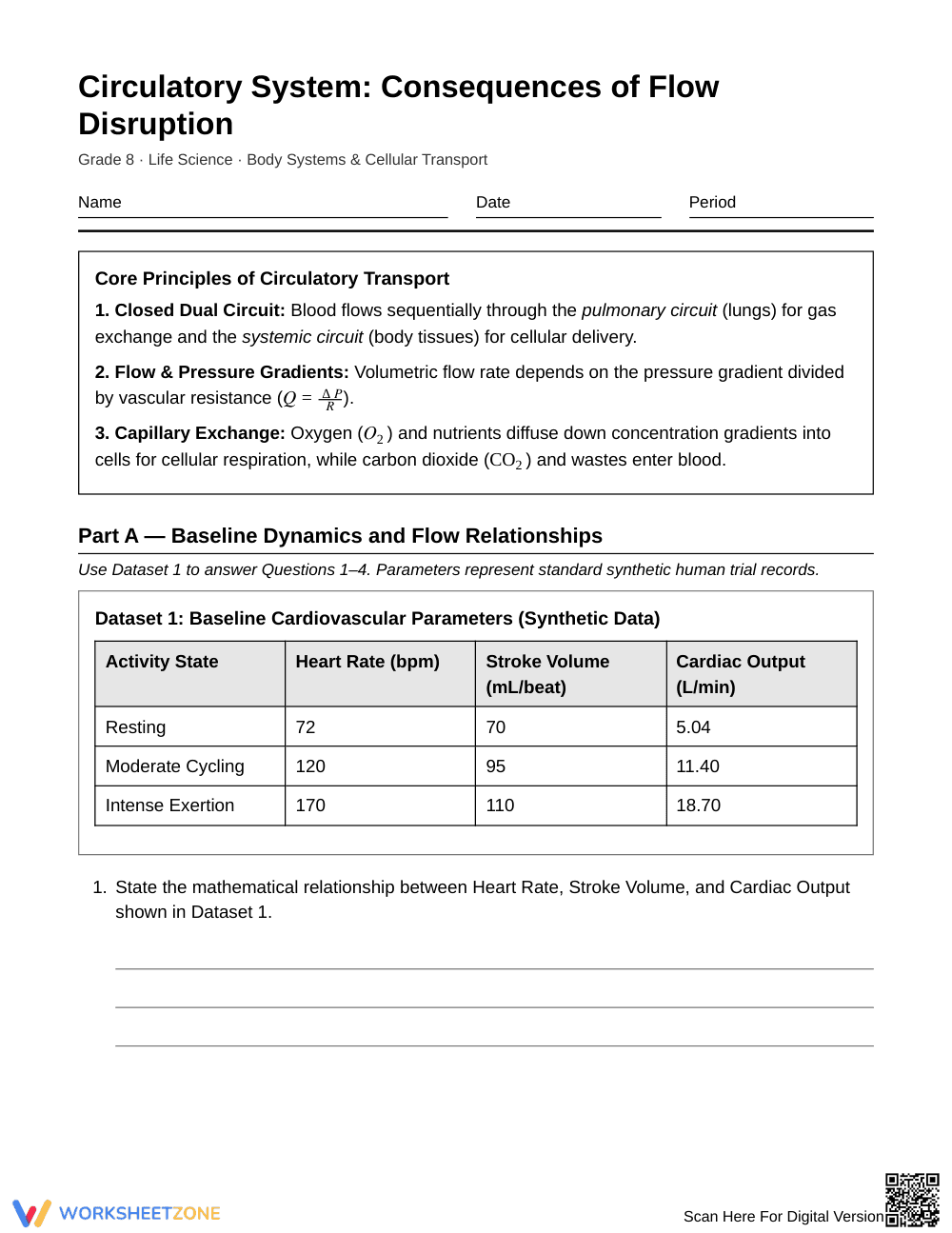
This Grade 8 science worksheet equips students to evaluate how circulatory disruptions impair blood transport and cellular respiration. Through data-driven analysis and quantitative modeling, learners trace changes in cardiac output, fluid filtration, and tissue oxygenation caused by arterial constrictions, valve failures, and capillary occlusions.
At a Glance
- Grade: 8 · Subject: Science
- Standard: Life Science — Model circulatory transport and analyze how flow disruptions impair cellular respiration
- Skill Focus: Explain Consequences of a Specified Flow Disruption
- Format: 5 pages · 14 problems · Answer key included · PDF
- Best For: Guided practice, data analysis, and unit review
- Time: 45–60 minutes
What's Inside
This 5-page printable resource includes 14 structured science problems and a 2-page complete answer key. A foundational Core Principles reference box defines dual-circuit transport, pressure gradients ($Q=\Delta P/R$), and capillary exchange. Students analyze two synthetic cardiovascular datasets, answering calculations, diagnostic multiple-choice items, competing model evaluations, and written analytical prompts connecting vascular mechanics to cellular stress.
Skill Progression
- Guided practice (Problems 1–4): Students use baseline cardiovascular data and core transport equations to establish flow relationships and predict pressure responses with direct data table support.
- Supported practice (Problems 5–8): Scaffolding decreases as students analyze localized disruptions, determining how venous valve failures, arteriolar constriction, and capillary clots affect downstream tissues.
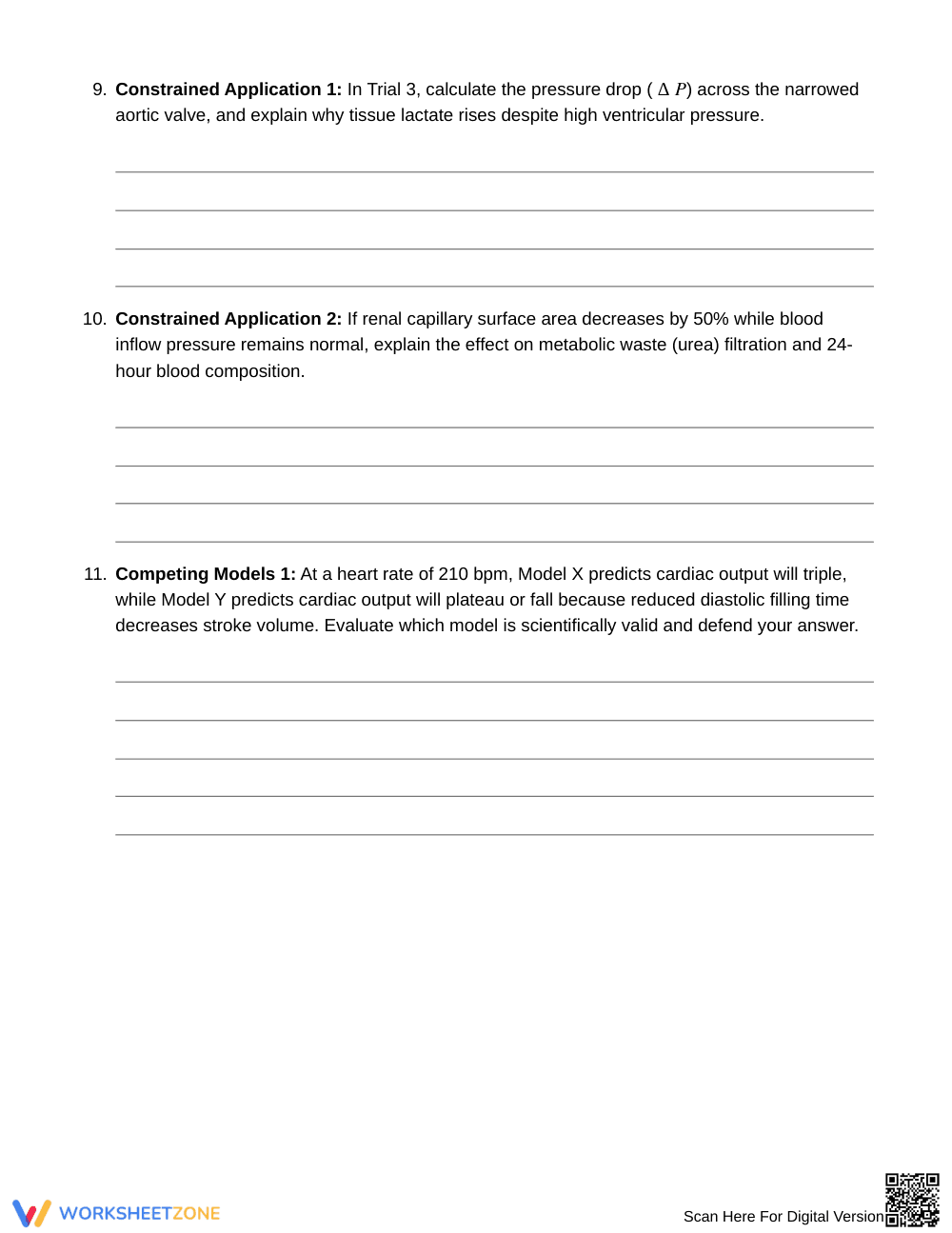
- Independent practice (Problems 9–14): Students autonomously evaluate regional trial datasets, resolve competing physiological models, perform inverse diagnostic reasoning, and defend complex synthesis chains.
This sequence implements the gradual release of responsibility model, moving students from guided calculation to independent physiological synthesis.
Standards Alignment
This worksheet aligns with middle school life science standards requiring students to develop models showing how interacting organ systems transport nutrients and oxygen to cells. Supporting benchmarks address cellular respiration and homeostatic regulation. Both standard codes can be copied directly into lesson plans, IEP goals, or district curriculum mapping tools.
How to Use It
Use this activity after direct instruction on the circulatory system during a 45–60 minute block. Assign Part A for guided partner practice, then have students complete Parts B and C independently. For formative assessment, examine Question 13 to verify whether students recognize oxygen shunting versus occlusion before administering summative assessments.
Who It's For
This worksheet serves Grade 8 science students and introductory biology classes studying body systems. Provide a dual-circuit anatomical diagram for emerging bilingual learners needing visual support. Pair this resource with a hands-on heart rate investigation or a direct instruction lesson on cellular respiration.
Middle school life science students develop robust physiological comprehension when instructional materials require them to explain consequences of a specified flow disruption across interacting body systems. Grounded in the instructional scaffolding frameworks documented by Fisher & Frey (2014), this five-page instructional resource guides learners from baseline cardiovascular mechanics through complex multi-vessel hemodynamic disruptions. By analyzing dual-circuit blood pathways, pressure gradients, and capillary diffusion rates, students investigate how localized blockages produce cellular hypoxia and systemic metabolic shifts. The fourteen data-driven problems require eighth-grade pupils to interpret synthetic clinical metrics, evaluate competing physiological models, and synthesize feedback loops governing cellular respiration. Structured gradual release scaffolds support learners in moving from explicit formulaic calculations to nuanced diagnostic reasoning, equipping students to articulate the critical dependency between cardiovascular transport dynamics, organ health, and cellular homeostasis across diverse physiological conditions.


