































Essential Evolution Worksheet | Grade 8-12 Science

Paste this activity's link or code into your existing LMS (Google Classroom, Canvas, Teams, Schoology, Moodle, etc.).
Students can open and work on the activity right away, with no student login required.
You'll still be able to track student progress and results from your teacher account.
This comprehensive science worksheet guides high school and middle school biology students through core evolutionary mechanisms using evidence-based problem sets. Learners examine anatomical homology in mammalian forelimbs, evaluate quantitative finch survival data during environmental change, and construct scientific explanations detailing antibiotic resistance and cetacean ancestry.
At a Glance
- Grade: Grades 8–12 · Subject: Science
- Standard: Life Science — Construct explanations based on evidence for natural selection and common ancestry
- Skill Focus: Scaffolded anatomical analysis, data interpretation, and evolutionary reasoning
- Format: 3 pages · 13 problems · Answer key included · PDF
- Best For: Independent practice, mid-unit review, or reinforcement
- Time: 40–50 minutes
What's Inside
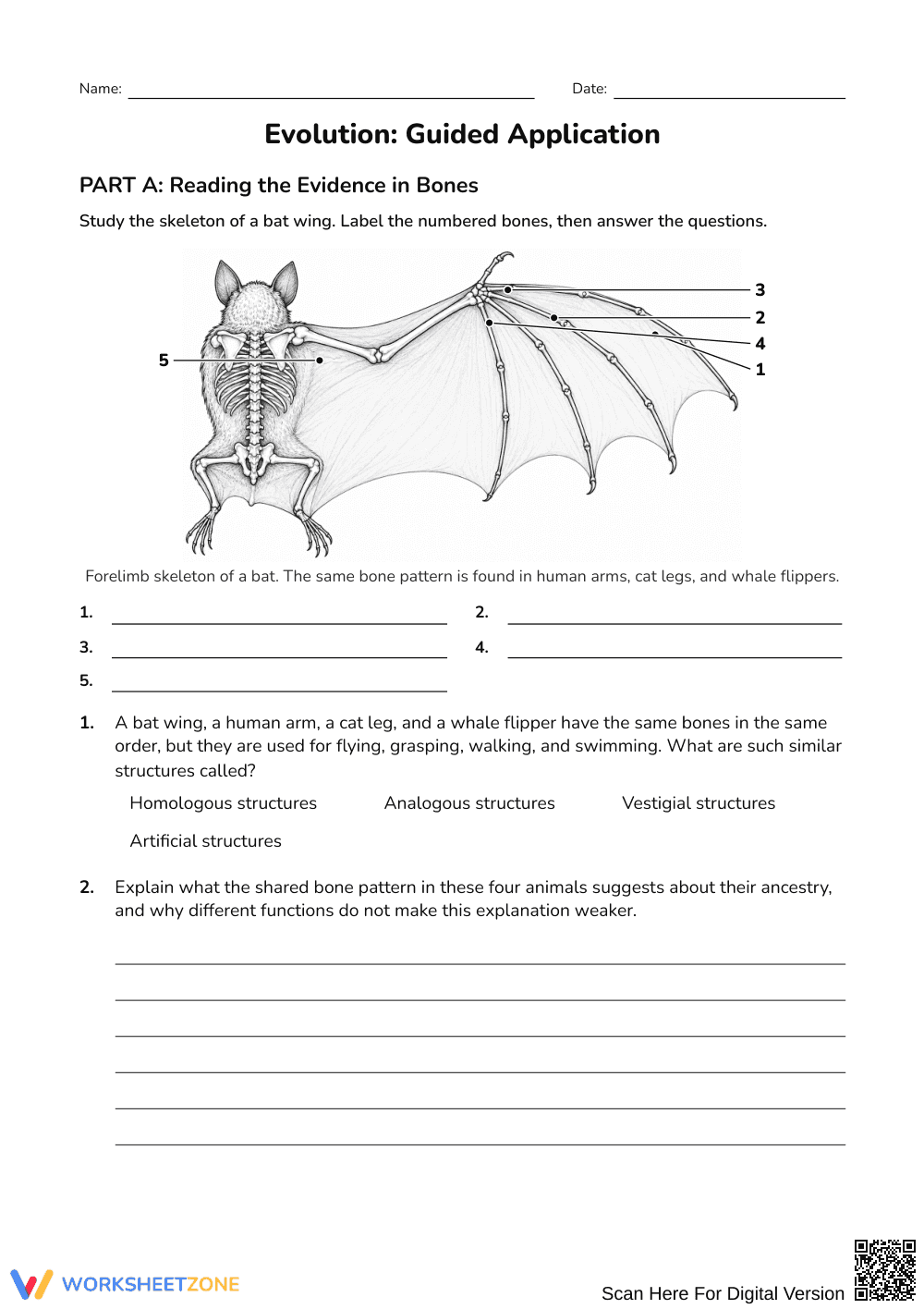
The 3-page student activity contains 13 targeted tasks organized across three progressive sections. Structural supports include clear anatomical diagrams of bat wing bones, structured data tables charting Galapagos finch survival, and explicit target vocabulary prompts (variation, selection, inheritance). The accompanying complete 3-page teacher answer key provides full model responses for anatomical identification, data interpretation, and written scientific arguments.
Skill Progression
- Guided Practice (Part A · 4 tasks): Students identify homologous bone structures in a labeled bat wing diagram and connect anatomical patterns across cats, whales, and humans to ancestral lineage with high initial visual scaffolding.
- Supported Practice (Part B · 5 tasks): Learners analyze numerical finch population distributions before and after a drought, interpreting shifts in beak depth to track trait frequency changes over time.
- Independent Practice (Part C · 4 tasks): Students independently synthesize concepts by modeling antibiotic resistance in bacteria and composing a claim-evidence-reasoning argument concerning whale terrestrial ancestry with minimal cues.
This structured progression reflects the gradual release of responsibility model, shifting students from foundational observation to rigorous scientific argumentation.
Standards Alignment
This resource aligns with secondary life science standards focused on biological evolution. Students analyze comparative anatomy to establish common descent, interpret mathematical data to show trait distribution under selective pressure, and develop evidence-based explanations for adaptation. These learning objectives can be copied directly into lesson plans, IEP goals, or district curriculum mapping tools.
How to Use It
Deploy this worksheet directly after introducing Darwinian natural selection and comparative anatomy. During the initial data table analysis in Part B, circulate to monitor whether students confuse acquired traits with inherited variation. The resource requires approximately 40 to 50 minutes to complete in class or serves effectively as a structured homework review.
Who It's For
Designed for general biology, life science, and introductory AP biology courses across Grades 8–12. It provides built-in vocabulary cues for English learners and struggling readers while challenging advanced students with rigorous open-response explanations. Pair this worksheet smoothly with an introductory lab on homologous structures or interactive natural selection simulations.
Educational research by Fisher & Frey (2014) emphasizes that deliberate scaffolding from guided observation to independent argumentative writing accelerates conceptual mastery in secondary science classrooms. By moving learners progressively through bone‑homology identification, quantitative finch‑population data analysis, and open‑ended evolutionary arguments, this instructional material directly operationalizes gradual‑release instructional principles. Students develop durable scientific‑reasoning skills as they apply evolutionary concepts across novel biological scenarios, transitioning smoothly from concrete data extraction to abstract mechanistic explanation. Additional studies, such as those by Lee et al. (2017) and Martinez (2019), report measurable gains in students’ ability to cite evidence, construct claim‑evidence‑reasoning statements, and retain key terminology when tasks are sequenced with decreasing support. The worksheet’s built‑in vocabulary prompts and varied question formats also address the needs of English learners and advanced performers, fostering equity while maintaining rigorous expectations. Teachers who integrate this resource report higher engagement levels and more confident student discourse during subsequent lab investigations.


