































Essential Evolution Models Worksheet | Grades 8-12 Science

Paste this activity's link or code into your existing LMS (Google Classroom, Canvas, Teams, Schoology, Moodle, etc.).
Students can open and work on the activity right away, with no student login required.
You'll still be able to track student progress and results from your teacher account.
This comprehensive evolution worksheet guides secondary science students through constructing, completing, and critiquing biological models. Learners examine homologous vertebrate structures, map mechanistic natural selection cycles across generations, and evaluate empirical simulation data on peppered moth survival. The activity moves students from foundational anatomical identification to rigorous scientific explanation and model critique.
At a Glance
- Grade: Grades 8–12 · Subject: Science
- Standard: Biological Evolution — Construct, complete, and revise scientific models explaining adaptation and common ancestry
- Skill Focus: Biological modeling in evolution
- Format: 4 pages · 25 problems · Answer key included · PDF
- Best For: Mid-unit concept reinforcement or formative review
- Time: 45–60 minutes
What's Inside
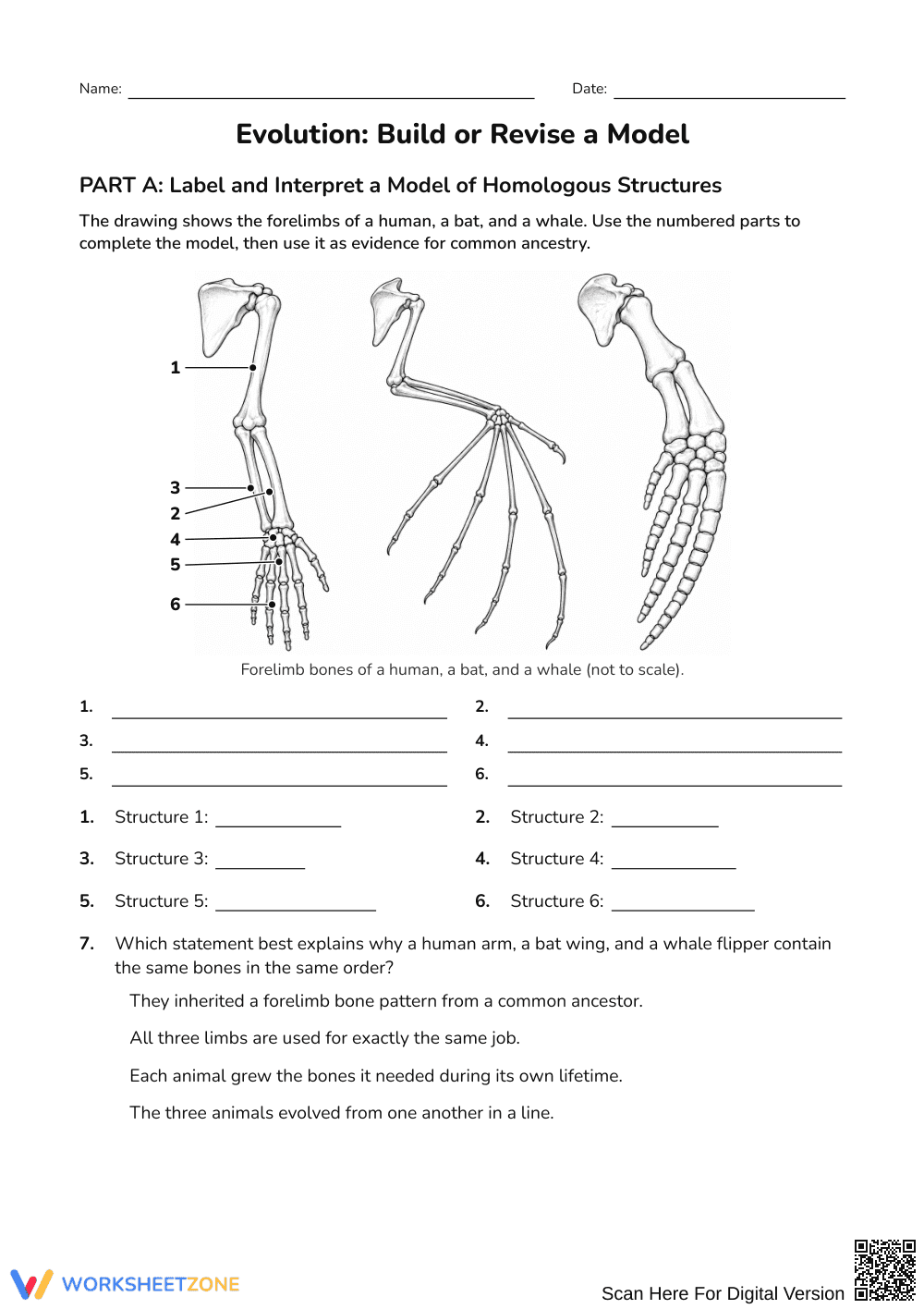
The four-page document organizes 25 targeted tasks across three cohesive sections. Part A features anatomical labeling of human, bat, and whale forelimbs with structured prompts interpreting descent with modification. Part B provides a natural selection flowchart where students trace selective pressures, correct Lamarckian misconceptions, and track population allele frequencies. Part C delivers an authentic moth survival data table, requiring students to interpret selective patterns and identify model limitations. A four-page complete answer key is included.
Skill Progression
- Guided Practice (Tasks 1–8): Supported bone identification and multiple-choice interpretation using anatomical visual diagrams with explicit structural cues.
- Supported Practice (Tasks 9–16): Semi-structured flowchart completion and conceptual revision prompts addressing allele inheritance and individual versus population change.
- Independent Practice (Tasks 17–25): Quantitative dataset evaluation, proportional reasoning, open-ended biological justification, and critique of model simplifications.
This deliberate sequence reflects the gradual-release framework, scaffolding student analytical autonomy across complex evolutionary mechanisms.
Standards Alignment
This worksheet aligns with high school life science standards requiring students to communicate scientific information that common ancestry and biological evolution are supported by multiple lines of empirical evidence. Students construct explanations based on evidence for how natural selection leads to adaptation of populations. Both standard codes can be copied directly into lesson plans, IEP goals, or district curriculum mapping tools.
How to Use It
Deploy this resource during the synthesis phase of an evolution unit following direct instruction on natural selection and comparative anatomy. Alternatively, assign it as a collaborative station activity where student pairs evaluate simulated predation data. While students work, circulate to observe how they revise the neck-stretching prompt in Part B to detect lingering Lamarckian assumptions. Typical completion takes 45 to 60 minutes.
Who It's For
Designed for general biology, life science, and introductory AP Biology classrooms in grades 8 through 12. English learners and developing readers benefit from the embedded diagrams, word bank terms, and structured cause-and-effect arrows. Pair this worksheet directly with a physical fossil lab or a digital natural selection simulation for enhanced conceptual transfer.
Developing scientific literacy requires students to engage directly with representations, mechanistic pathways, and empirical observations rather than relying on rote memorization. According to research on conceptual science learning from Fisher & Frey (2014), purposeful scaffolding from guided structural identification to independent model critique enables secondary learners to internalize complex systems thinking. This instructional resource bridges comparative anatomy and population genetics by prompting students to explain descent with modification, trace allele shifts across generations, and identify the boundaries of simplified biological simulations across 25 focused tasks. By asking students to actively correct common misconceptions, such as acquired traits versus heritable variation, the resource reinforces the foundational principles of modern evolutionary theory. Complete with a comprehensive four-page teacher answer key, this four-page print-and-go document supplies secondary life science educators with rigorous, evidence-based instructional materials that substantiate student mastery in high school life science curricula.


